
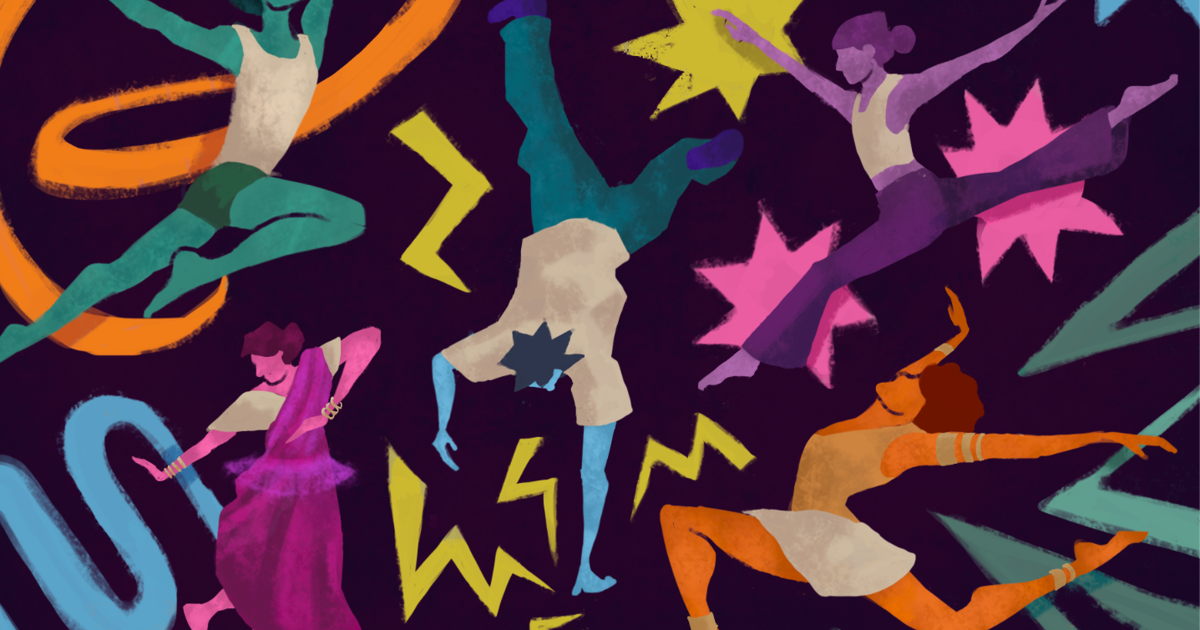
On Oct. 3 and 4, PUSH Dance Company held its ninth annual PUSHfest, proving that San Francisco’s dance scene has a heart that continues to beat. Within the four walls of the black box theater in its company space known as the Sanctuary, the audience was invited into an intimate world of sweaty dancing and passionate narratives.
Showcasing an array of local and national artists, the festival consisted of four programs over two days, along with a gala afterparty taking place Sunday, Oct. 4. Programs A and C mostly presented pieces from PUSHLab — an eight-week performance workshop held by choreographers and teachers at PUSH — whereas programs B and D featured artists with longstanding connections to PUSH.
Associate Artistic Director Ashley Gayle opened program B by first highlighting PUSH’s Youth Scholarship Fund, the beneficiary of the gala’s proceeds. She then warmly invited audience members to be in the moment with the dancers, priming them for the interactive performances ahead.
First to emerge onto the dark stage was Ayo Walker, a choreographer and professor at Columbia College Chicago, who performed her piece “Sula.” Adorned with a black veil and fur scarf, Walker embodied the rebellious and sensual character from Toni Morrison’s novel of the same name. The piece drew from historically Black social dances and used what Walker calls “Caricatureography,” a technique which translates literary characters’ narratives into dance. Against an audio background switching between narrations from the novel and a smooth blues track, Walker danced the experience of living in Morrison’s fictional neighborhood in Ohio. She turned into Sula on stage, rocking loosely with her eyes closed and arms to the sky. Her movements were magnetic and her cheeky winks left cheers from the audience hanging in the air.
Tainah Damasceno and Jaguar Santana from BrasArte, a Brazilian dance company based in Berkeley, kept the energy alive later in the show with a fusion of samba and contemporary. From thrilling lifts to mimed air-guitar on Damasceno’s leg, the partner work was electrifying. The space was so intimate that as Santana performed his flurry of footwork, his panting was audible, his sweat visible and, of course, the joy was palpable.
Some performances tried to get intimate on an emotional level. Bhumi B Patel began her piece with a meditation, urging audience members to close their eyes and imagine their ancestors. After continually reminding her audience to take breaths, she transitioned into her piece “The Tides From Orbit,” which was performed to a narration about her experience as a queer Southeast Asian woman and her research on femme lesbians during the AIDS crisis. She concluded her performance by singing along to “Move to the Moon” by Matt Nathanson, belting, “We’ll move to the moon if they won’t make room here for us.” Although its wildly different sections brought some confusion, the 12-minute performance stayed true to PUSH’s mission of providing people of color a safe space for expression and illuminating diverse narratives through dance.
Gayle showcased her work to close Program B. Originally created to honor her grandmother’s unrealized dream of being a professional dancer, her piece “Stardust” became more about relying on community and dance to find joy after loss. Under a soft blue glow that represented Gayle’s grandmother, dancers of PUSH helped bring her piece, rooted in grief, to life. The all-Black ensemble started with their hands above their hearts before moving through foundational modern steps. They added passion to their passés while the male dancers lifted each other into the air, casting beautiful shadows on the walls. For Gayle, though, finding refuge in the dance community extends beyond the stage.
In May 2025, at least 28 San Francisco arts organizations lost their National Endowment for the Arts grants as the federal government rolled back funding and halted support for companies with “diversity, equity, and inclusion” programs. Fortunately, PUSH is endowed locally by San Francisco Arts Commission and Grants for the Arts, and continues to thrive.
“Raissa, the director, is really wanting to be pivotal in being the West Coast sanctuary for people of color to express themselves and create their work,” Gayle said in conversation with The Daily Californian on the importance of dance in upholding the Bay Area’s marginalized voices. “The dance scene has been slightly gentrified — hate to say it. And with funding cuts from the government, there’s a lot of uncertainty for artists right now, especially artists of color.”
This year’s PUSHfest successfully brought together a lineup of dances expressing diverse narratives and unbridled joy in marginalized communities. With organizers such as Gayle and her company still maintaining elements of the Bay’s rich and varied culture, it’s comforting to have spaces such as the Sanctuary platforming the pulse of San Francisco’s dance scene.