
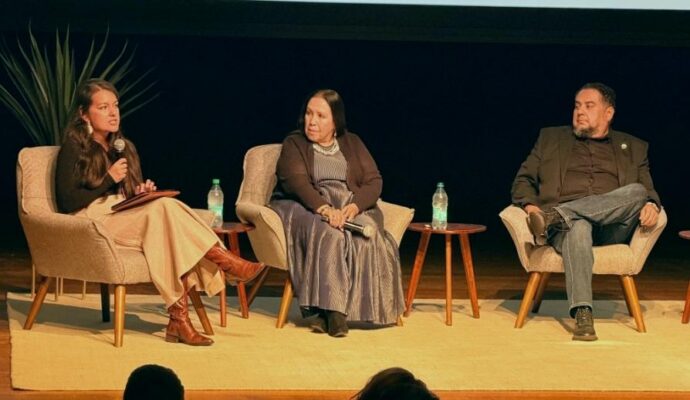
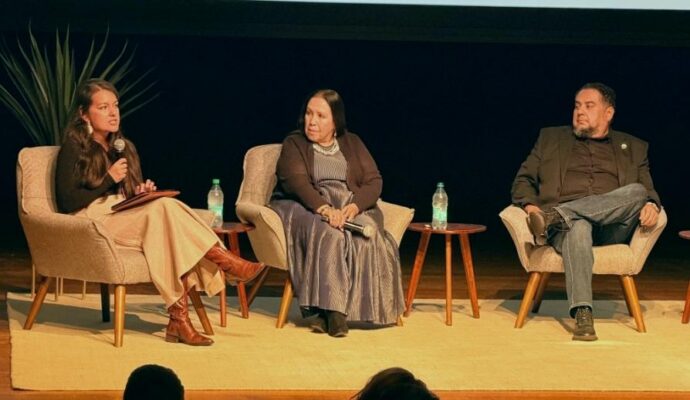
 Panelist Lauren Van Schilfgaarde (left) discusses 50 years of the Los Angeles City and County Native American Indian Commission with panelists Dawn Jackson and Rudy Ortega, Jr. [Photo by Eddie Rivera/Pasadena Now]The evening began with a song, a clapper stick and a welcome song that reached back much further than the 50 years everyone had gathered to celebrate.
“We are still here,” Samuel Lopez, a descendant of the Gabrielino Tongva people, reminded the audience at the Huntington Library.
The Gabrielino-Tongva homelands ranged across the entire Los Angeles Basin, parts of Orange, Riverside, and San Bernardino counties, from Topanga Canyon in the west to Laguna Beach in the south, and from the San Gabriel Mountains down to the sea.
And that, in many ways, was the message of the evening.
Native American leaders, scholars, commissioners and friends gathered to celebrate the 50th anniversary of the Los Angeles City and County Native American Indian Commission, established in 1976 to give the region’s growing Native American community a stronger voice in government.
There were stories about the early days, memories of political battles, a little laughter and plenty of discussion about what still needs to be done.
The Huntington’s Nenette Luarca-Shoaf welcomed the gathering, while commission chairman Mark Villaseñor recognized the more than 125 people who have served as commissioners over five decades.
The panel, moderated by Amanda Wixon, featured UCLA law professor Lauren Van Schilfgaarde, longtime commissioner Dawn Jackson and former commissioner Rudy Ortega Jr., whose father served on the original commission.
Van Schilfgaarde recalled how federal relocation programs brought thousands of Native Americans to Los Angeles during the 1950s, often promising jobs and opportunities that proved difficult to find.
The commission grew out of those struggles, giving Native families a voice in decisions affecting their lives.
Reading from its original founding documents, Van Schilfgaarde noted how government officials once described Native Americans largely in terms of poverty and social problems.
“It’s not how we describe ourselves,” she said.
“Being Indian is actually the major asset that we bring to the table.”
Jackson, who joined the commission more than 30 years ago, remembered discovering the organization almost by accident at an event at the Autry Museum.
“I’d never heard of it,” she said. “I didn’t know the vastness of our community yet.”
But she knew the importance of service, a lesson passed down by her grandparents.
“I knew that wherever I lived, I needed to do that for my community.”
She later helped bring Native leaders from across the country to Washington during the Clinton administration, advocating for the needs of urban Native Americans.
“It was just this time where we felt empowered,” she recalled.
Still, many of the same concerns remain: affordable housing, employment, childcare and keeping Native families connected to their heritage.
“We want to make sure that there’s a cultural connection for them, that they don’t feel lost out here,” Jackson said.
For Ortega, the commission’s history is also family history.
His father was among its original commissioners, and Ortega remembered tagging along to meetings as a child.
“I was forced to be involved,” he joked.
Afterward, commissioners would gather at Johnny’s Shrimp Boat on Broadway in Downtown LA, where the conversations continued long after the commission meetings.
“It was like one long continued committee meeting or something,” he said.
But his father’s message stayed with him.
“You don’t want to be the subject on the table,” Ortega recalled. “You want to be at the table to discuss the subjects.”
The Huntington’s Diego Godoy also introduced historical records from the papers of former county supervisors Kenneth Hahn, Edmund Edelman and Gloria Molina, including correspondence, meeting minutes and newspaper clippings documenting the commission’s beginnings.
The celebration concluded with an honor song and dancers wearing brilliant feathers and colorful traditional regalia, who led the commissioners out of the vast hall and into the courtyard for a reception.
As the commission looks toward its next 50 years, Lopez’s opening words offered a reminder that celebrating history also carries responsibility.
“A land acknowledgment must mean more than words,” he said.
“It is an invitation to remember whose homeland we are on.”
 Get our daily Pasadena newspaper in your email box. Free.
Get all the latest Pasadena news, more than 10 fresh stories daily, 7 days a week at 7 a.m.