
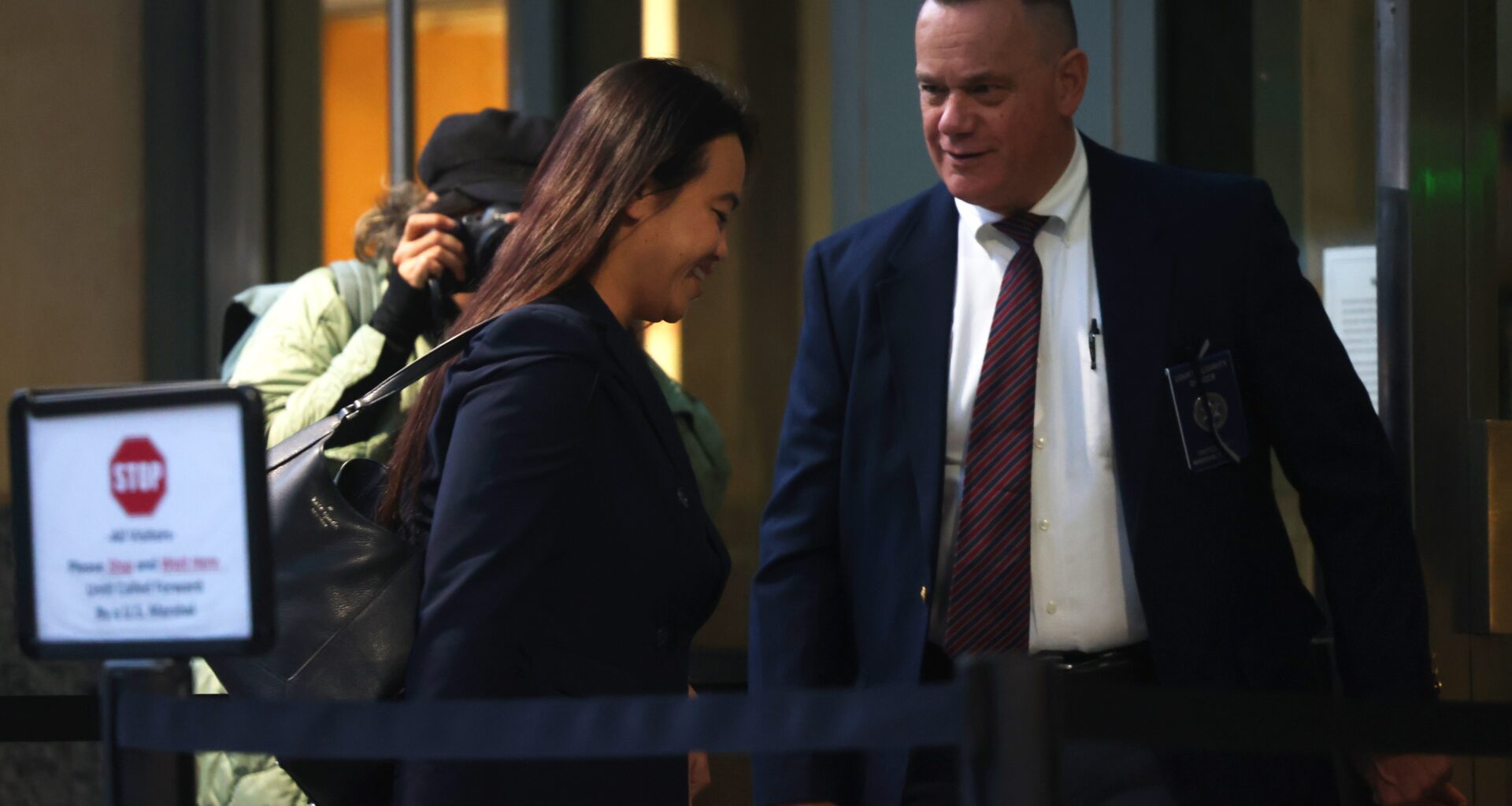
A retail worker, a San Francisco-based security guard and a retired software engineer ranked among the dozen jurors seated Tuesday for the highly-anticipated trial of Oakland’s former mayor and three others accused of trading thousands of dollars in bribes for illicit access to City Hall.
The five men and seven women selected Tuesday must now determine whether Sheng Thao along with her romantic partner, Andre Jones, and the father-son business team of David and Andy Duong orchestrated a bribery scheme that crumbled barely more than a year into Thao’s first term leading the city. That process begins Wednesday, when prosecutors and the defendants’ attorney present their opening statements in what is expected to be a trial lasting more than a month.
Among those seated Tuesday were a mother who spent time as an executive assistant for a private equity firm’s legal team, a vehicle engineer with the San Francisco Municipal Railway’s cable car division and a woman with a lengthy case load for Easterseals, a nonprofit that helps coordinate care for people with autism and other intellectual and developmental disabilities.
Also selected were six alternates tasked with sitting in on the trial in case one of the original 12 are dismissed ahead of a verdict. That group included the founder of a company focused on forest management modeling; a software engineer for the Zoox robotaxi company; a mechanical design manager in the semiconductor sector and a self-employed woman who works at a weekly farmer’s market.
Each were selected from a pool of 75 people hailing from across the Northern District of California, which covers the western half of the state from Monterey to the Oregon border.
Dozens of people did not make the cut, among them a civil prosecutor for California Attorney General Rob Bonta’s office; a director for a supportive living agency who complained about making ends meet as the chief breadwinner for her family; and a woman who had a non-elective procedure scheduled barely a week into the trial.
Early in Tuesday’s hearing, Chief District Judge Yvonne Gonzalez Rogers signaled an unwillingness to let people easily escape jury duty, pointing out “democracy is inconvenient” and that “hardships really have to be hardships.”
“The question is: What makes you so special?” she asked the jury, ahead of one-on-one questioning.
Together, the jury must decide whether Thao and her four co-defendants are guilty in one of the East Bay’s largest political scandals in decades.
Authorities claim Thao and Jones accepted bribes from the Duongs — including political favors and $95,000 toward a $300,000 no-show job for Jones — in exchange for ensuring the city’s purchase of 300 units from a fledgling housing company co-founded by David Duong and Juarez, called Evolutionary Homes. The agreement also included the promise, court filings say, of a renewed city contract for the Duongs’ recycling firm, California Waste Solutions, as well as the appointment of people favored by the Duongs to important positions in the city.
All four defendants have pleaded not guilty to a host of charges, including conspiracy to commit bribery, as well as wire and mail fraud. Each faces up to 20 years in prison for the most serious charge, if convicted.
Throughout Tuesday’s all-day hearing, new potential priorities at the looming trial emerged for both prosecutors and defense attorneys.
Assistant U.S. Attorney Lloyd Farnham repeatedly questioned potential jurors on whether they would hold anything against witnesses who testified after accepting plea deals that could result in a more lenient sentences, given their cooperation with authorities. His colleagues plan to call at least two high-profile witnesses – longtime Oakland political operative Mario Juarez and former San Leandro city councilman Bryan Azevedo – who have already pleaded guilty in connection with the alleged scheme.
One of Thao’s attorneys asked all 75 prospective jurors in one fell swoop whether Thao’s status as a former mayor – and in particular, as a public official later recalled from office by voters – would taint their view of the case. None raised their hands.
David Duong’s lead attorney likewise asked everyone whether they would automatically convict one Duong family member, simply because they were related to the other. Again, no hands shot up.
The topics largely aligned with dozens of questions posed to jurors ahead of trial in lengthy questionnaires that touched on a broad range of topics, including how closely each potential juror followed the case in the media over the last couple of years and their thoughts on homelessness in Oakland. One question proposed for the survey even asked whether the potential jurors had negative views of prostitution.
Several focused on how community members might try to influence politicians.
The attorneys sought insight into the prospective jurors’ feelings on people gaining access to politicians via “political donations and campaign contributions,” or even if “there is something wrong with companies and individuals cultivating relationships with local politicians.” And they planned to ask how concerned jurors were about corruption influencing elected officials.
Defense attorneys also sought to gauge jurors’ opinions on “whether a politician’s romantic partner should be able to have business or employment related to lobbying.” And they asked about the East Bay’s political landscape – specifically whether politicians in Oakland and Alameda County were ethical – as well as their thoughts on how Thao crashed out of that scene with her recall in November 2024.
The attorneys also sought a window into whether jurors had “lived in a household where expenses – such as rent, mortgage payments, utility bills or other household costs – are split or divided between romantic partners or spouses.” The question may have tipped prosecutors’ plans, signaled in pretrial court filings, of delving into financial state and whether he had trouble keeping up with his expenses.
Another question focused specifically on the Duongs’s livelihood, asking specifically “how ethical in your opinion are people and companies involved in the garbage and recycling business, including California Waste Solutions.”
The prosecution’s case is expected to carry on through early to mid-November, after which defense attorneys are expected to take a week or two calling their own witnesses.
Barely an hour had passed Tuesday evening before complaints arose among the newly-empaneled jury.
One man unexpectedly appeared back before the judge, announcing he had forgotten to tell her about travel plans he had already made in late October.
Another juror voiced concerns to Gonzalez Rogers about having only 10 days of paid leave to serve on the jury. The juror also reiterated concerns for how her clients at a nonprofit assisting people with developmental disabilities would be cared for in her absence.
In each case, the judge said it was too late. Both were already sworn in, and they needed to return in the morning for opening statements.
Jakob Rodgers is a senior breaking news reporter. Call, text or send him an encrypted message via Signal at 510-390-2351, or email him at jrodgers@bayareanewsgroup.com.