
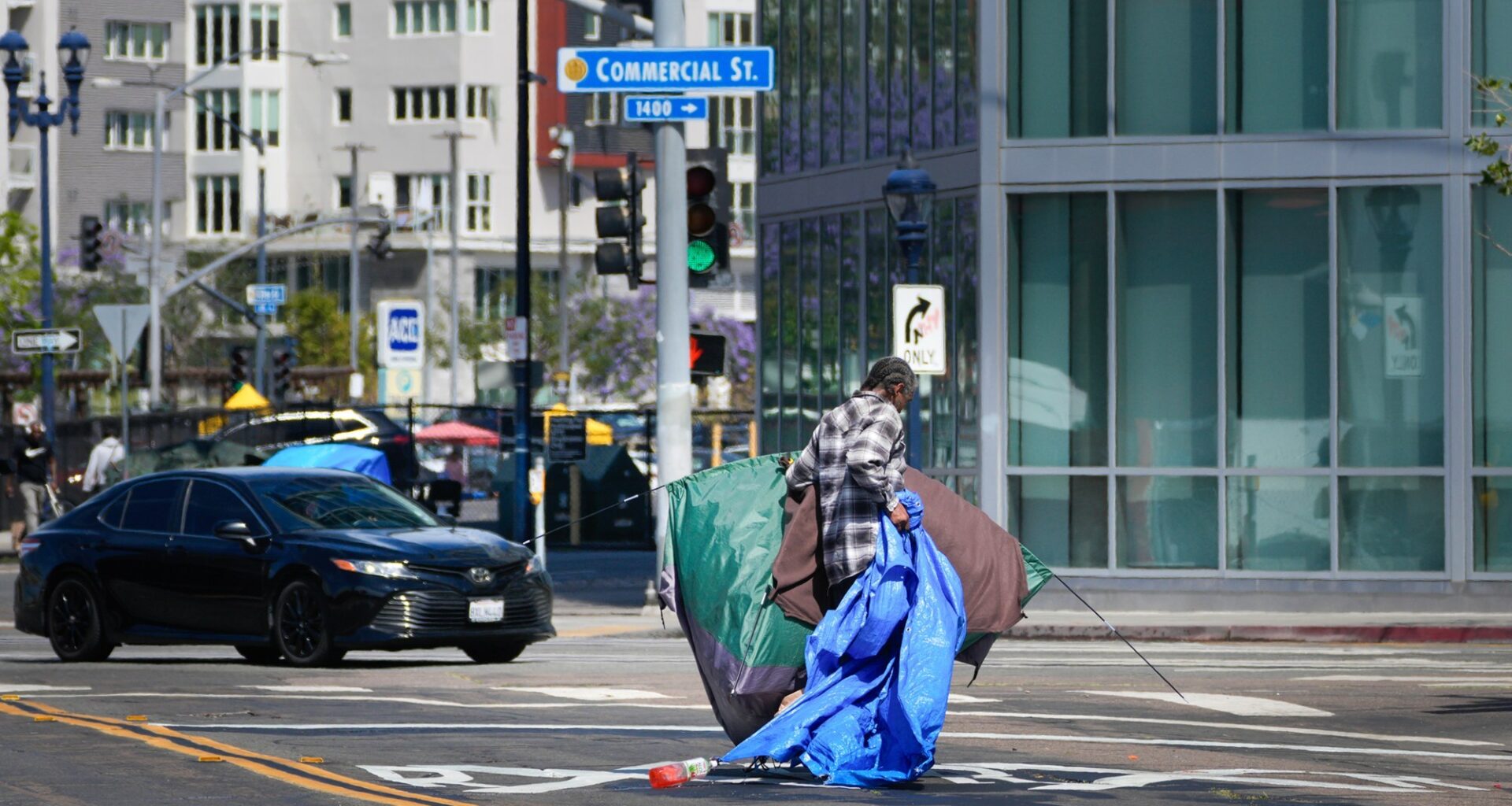
San Diego City Council members pointed out both successes and failures in the city’s approach to homelessness during a presentation at Monday’s meeting, which Council President Joe LaCava said was “probably the most robust conversation we’ve had” in regards to the issue.
The annual presentation on the city’s Community Action Plan on Homelessness was given by the city’s Homelessness Strategies and Solutions Department Director Sarah Jarman, Regional Task Force on Homelessness CEO Tamera Kohler and San Diego Housing Commission CEO Lisa Jones.
It included numerous data points compiled by the agencies they represented. It aimed to provide the council with an update on where the city was seven years into its 10-year action plan.
While some council members praised the overall efforts, others felt the presentation lacked the answers they were looking for. They noted that homelessness in San Diego was far from solved.
“Many of these people would come off the streets if we simply had a shelter bed or a safe sleeping site or somewhere else for them to go,” said Councilmember Stephen Whitburn (District 3). “How do we know that? We know they would come off the streets because many of them are asking us to come off the streets, and we are literally telling them no… That is inhumane and that is unacceptable.”
The presenters were also questioned about the disproportionate percentages of homeless Black San Diegans across several metrics, missing or incomplete data and deaths at safe camping sites, an issue not included in the presentation but brought up by Councilmember Sean Elo-Rivera (District 9).
City Councilmember Henry Foster III (District 4) pressed the agencies on what he felt were confusing aspects of how they collected and presented data, how money was spent and “who’s in charge of what” in regards to the entangled purviews of each agency.
“I’m not seeing or feeling that things are improving,” Foster said. “I basically spend my time driving into the office, driving the streets downtown and I must say I’m not necessarily seeing progress.”
Foster also pressed the agencies to admit that the region’s annual point-in-time count was not an accurate measurement of how many people sleep outside in San Diego. The count influences policy decisions, Foster said.
Kohler pushed back on this, saying it provided an accurate minimum, but “I would never say we captured everybody” the night of the count.
Jones added that a different figure in their presentation, how many people had been served in 2026, was a “better reflection of need than a single point-in-time count is.” According to the presentation, 14,769 people were served in 2026 — a 37% increase since 2019.
Foster requested the agencies provide reports and memos detailing the locations where outreach teams were canvassing in his district. He also requested detailed information, by district, of the locations San Diego Police Department’s Homeless Outreach Team were deployed to.
At the end of the presentation, LaCava proposed that the agencies ask what they would be doing the same or differently as a result of the discussion. He also tasked his body to ask itself the same questions.
“And then for the council, what are we going to do differently or the same as we start approaching budget season in terms of how we do allocations? It’s one pie and how do we carve it up?”
Monday’s presentation included data related to housing, shelters, homelessness prevention, resource outcomes, policy, funding and spending. The city’s Community Action Plan on homelessness was created in 2019 as an interagency effort to create and meet goals related to the issue over a 10-year period.