

Raising the signature threshold for ballot measures — as Mayor Daniel Lurie’s Proposition D would do — would increase the cost of qualifying initiatives from $320,000 to $1.5 million, according to estimates in a new report from the Board of Supervisors Budget and Legislative Analyst.
The nearly 370% cost increase “would likely make qualification through predominantly volunteer signature gathering substantially more difficult and increase campaigns’ reliance on paid petition circulators” the report states.
That, in turn, “could disproportionately constrain citizen-led campaigns and reduce the range of organizations able to qualify measures for the ballot,” according to the report, which said community organizations and nonprofit coalitions generally have less capacity to raise funds for signature-gathering than “well-financed interests.”
The point goes to the heart of the main controversy arising from Lurie’s three Clean Up City Hall charter-reform measures on the Nov. 3 ballot — propositions D, E and F.
Critics of the measures contend that making initiatives more difficult to pursue would undermine democracy to the benefit of the rich. Their supporters argue that San Francisco’s comparatively lax access rules have led to bloated ballots, poorly conceived proposals and political gamesmanship.
Prop. D, in particular, would raise the signature threshold for qualifying ordinance initiatives for a regular election from 2% of registered voters to 8%, which today would mean an increase from an estimated 10,615 valid signatures to 42,460.

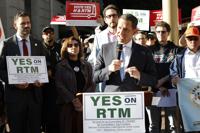
Mayor Daniel Lurie (seen in September) says his trio of ballot measures will increase government efficiency and accountability while cutting down on waste and corruption.
Craig Lee/The Examiner
Supporters say The City is an outlier for having such a low signature threshold. They say the statewide standard for signatures is 10%, as it is in Oakland.
In addition to requiring more signatures, Prop. D would eliminate the ability of a minority of supervisors to put measures on the ballot — something proponents say no other city in the state allows — mandating instead that a majority of the 11-member Board of Supervisors vote to put something on the ballot.
It would also eliminate the mayor’s ability to put measures on the ballot unilaterally — another thing proponents say no other city in the state allows— which Lurie said would “cement a fair balance of power.”
In sum, advocates say Prop. D will result in higher quality ballot proposals and shorter ballots, and it will push city officials to work together to achieve policy solutions.
“We’re the only city that allows a minority of supervisors to throw anything on the ballot without public vote or community input,” Lurie said in a recent video on Instagram. “We also require 80 percent fewer signatures than the state standard.”
“Special interests weaponize the system to push intentionally confusing measures instead of focusing on solving problems,” he said. “Prop. D ensures that measures that reach the ballot are shaped through transparency, compromise and community input.”
Prop. E, meanwhile, would centralize city contracting authority with the City Administrator. Prop. F would increase mayoral authority to hire and fire department heads, reorganize departments, and remove members of boards and commissions.
The Board of Supervisors and city boards and commissions would lose authority in those areas, the Budget and Legislative Analyst report said.
Prop. F would also let the mayor hire deputy mayors with authority over executive-branch departments, which would enhance mayoral authority, it said.
The 57-page, largely technical report was produced at the request of District 10 Supervisor Shamann Walton, who signed a ballot argument against Prop. D along with Mike Casey, president of the San Francisco Labor Council and former president of Unite Here Local 2.
Supervisors Jackie Fielder and Myrna Melgar, among others, also appear as opponents.
Asked about the report, Walton said via text that “the entire focus of the mayor’s changes is to ensure that people with means have all of the say in San Francisco.”
“The wealth gap continues to grow, housing/rent costs are astronomical and the fact that it would cost so much to qualify ballot initiatives further demonstrates that the mayor’s oligarchy does not want anyone who is not well off to thrive in San Francisco,” Walton said.
On the other side, Max Szabo, a spokesman for the Clean Up City Hall campaign, said that the measures “will fix the most corrupt parts of the system.”
“San Franciscans are paying the cost of a City Hall system that only works for special interests and the insiders opposing reform,” he said. “They trick voters at the ballot, misuse taxpayer dollars and then escape accountability.”
“Insiders and narrow interests exploit the rules and hijack our democratic process at the expense of everyday people,” Szabo said.
Szabo called Prop. D “a common-sense reform that strengthens the citizen-initiative process, keeps San Francisco’s signature requirement one of the lowest in the entire state, and is widely backed by a coalition including labor unions, small businesses, and community advocates.”
The Clean Up City Hall campaign had raised a whopping $12.8 million via 47 contributions — more than all seven other November ballot measures combined.
Several billionaires topped the donor list, including venture capitalist Michael Moritz, who gave $2.6 million; blockchain pioneer Chris Larsen, the co-founder and executive chairman of Ripple Labs who along with his wife, Lyna Lam, gave a combined $2.5 million; and investor John Pritzker, who gave $1 million.
While there are critics of Prop. E and Prop. F, there are no funded campaigns against them. Only Prop. D inspired an opposition campaign committee that has raised money — though the Fair Access, No on D campaign was grossly outmatched in terms of cash.
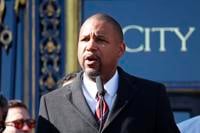
District 10 Supervisor Shamann Walton (seen in January 2025): “The entire focus of the mayor’s changes is to ensure that people with means have all of the say in San Francisco.”
Craig Lee/The Examiner
Numerous organizations have taken positions against Prop. D, but the measure’s opponents had raised just $205,700. The largest contributions came from a nonprofit housing provider and several labor organizations.
The top donor was the affordable-housing nonprofit Tenants and Owners Development Corporation, which chipped in $80,000.
Peter Stevens, the director of advocacy and arts at TODCO, said his organization had issues with all three of the mayor’s charter reform measures, but chose to focus on Prop. D because it was the “most egregious.”
“From our position, this was something that would create basically second-class citizens who are not allowed to access a right that we’ve all had for a very long time,” Stevens said.
Citizens have long used initiatives in San Francisco to address important issues such as fighting corruption and “corporate overreach,” he said.
“We see this as an attack on democracy, just straight up,” he said. “Why is this small group of people spending so much money to remove this right from everyday citizens?”
Szabo said it was “ironic” that the top funder for the effort against Prop. D was TODCO, given that the organization got a judge to let it withdraw a proposed tax measure from the November 2022 ballot because a drafting error could have let Amazon avoid the desired levy.

She says if she’s elected lieutenant governor, she wants to bring back the SAT, take on ‘woke’ universities and open up state lands to oil drilling

Local leaaders called special meeting following a report that found the local police department closed such cases at half the national rate in 2025

The Chino Valley school-board president says she wants to take politics out of schools — but her policies have been plenty divisive
Keeping ill-considered measures off the ballot is one of the goals of Prop. D, Szabo said.
The Clean Up City Hall campaign has many endorsements from unions and other entities, as well as from numerous political figures, including U.S. Rep. Nancy Pelosi and six of The City’s 11 supervisors.
One is Mandelman, who said the low bar to qualify initiatives has encouraged people inside and outside of City Hall to pursue measures addressing complex issues that would be best addressed through the normal legislative process, with the result often being confusion and frustration for voters.
“It’s been very, very easy to get measures in front of the voters,” Mandelman said. “I don’t know that that leads to the best policymaking.”
The Budget and Legislative Analyst report said community organizers interviewed said Prop. D “would substantially change the resources needed for a grassroots campaign,” and that community groups interviewed said that predominantly volunteer signature-gathering efforts would become “impractical.”
Research on campaign finance in the context of direct democracy — including petition circulation — is limited, but it generally supports the perspective of local organizers that “higher signature thresholds can reduce access to the ballot and widen disparities between grassroots campaigns and campaigns backed by large donors,” the report said.
Daniel Anderson, a spokesman for the no on D campaign, said the report confirmed what the opposition had been saying about the increased cost of qualifying ballot measures, although he said the report estimated the added costs would be even higher.
Anderson contended that Prop. D will not necessarily reduce the number of ballot measures, but it will change who can get access to voters.
“Do you have $1 million or $1.5 million to spend on signature gathering?” he said. “If so, it’s open season on the ballot. And if you don’t have that kind of money to spend, then you’re pretty well locked out.”
But District 2 Supervisor Stephen Sherrill, who has been campaigning for the Clean Up City Hall measures, said higher signature requirements have not caused problems in other cities across the state.
“Ballot measures should be about existential things under the charter or larger tax measures that are really critical, and allowing people to weaponize the ballot box has led to gridlock, has led to a lack of affordability,” Sherrill said.
“Representative democracy is all about electing leaders who you then hold accountable, and allowing special interests to weaponize the ballot box doesn’t make a lot of sense, and has led to a lot of the problems that we see today,” he said.
Sherrill said a major takeaway from the Budget and Legislative Analyst report should be that the charter-reform measures won’t cost the city money. The city Controller’s Office also separately said the measures would have a minimal effect on the cost of city operations.
Sherrill predicted that the contracting-reform provisions of Prop. E “will almost undoubtedly save The City a significant amount of money over time as contracting processes get better.”
Prop. E would concentrate more contracting authority with the mayor and the city administrator, who would have greater authority to set contract standards by introducing ordinances or adopting rules, regulations or policies, the report states.
Prop. E would also increase thresholds for contract reviews by city supervisors, notably by from $10 million to $25 million for new expenditure contracts, which supporters say would account for inflation.
Increased efficiencies could potentially save millions of dollars depending on implementation, the Budget and Legislative Analyst report said.
Between 2023 and 2025, the supervisors reviewed expenditure contracts totaling about $12.5 billion. Had the proposed thresholds been in effect, the number of reviews would have fallen from 304 to 115, with about $2.5 billion in contracts — about $830 million per year — not subject to review by the board, the report said.
The current $10 million threshold for reviewing contracts is already significantly higher than for other selected peer jurisdictions, which generally require approval from the presiding city council or board of supervisors for contracts ranging from $25,000 to $5 million, it said.
The report said the legislative-review process generally adds about two to three weeks to the board’s approval process. That’s in addition to the broader contracting process, which can take six to 12 months, according to the City Administrator’s Office, the report said.
Prop. E would also grant the City Administrator authority to adopt and amend rules and regulations governing procurement, to establish policies and standards, and to direct and supervise The City’s information-technology systems. It would increase the city administrator’s term from five years to 10.
Control of introducing most procurement legislation would shift from the Board of Supervisors and mayor to the city administrator. The board’s authority to amend such legislation would be eliminated, the report said.
Prop. F, meanwhile, would bolster mayoral authority in various ways, including by increasing the powers of the mayor to hire and fire department heads and to reorganize and merge departments.
It would increase from five to 11 the number of department heads the mayor could solely hire, granting the mayor full appointment authority for the heads of several departments, including Building Inspection, the Entertainment Commission, Planning, Public Works, Homelessness and Supportive Housing, and the Office of Small Business.
The report said the mayor currently has no appointment authority over 25 department heads — who are selected entirely by boards or commissions, or elected by voters — out of The City’s 62 departments, and he has limited authority for 32 more.
For 21 departments, commissions now submit at least three qualified applicants from whom the mayor may choose. Seven other department heads are appointed by the city administrator, with mayoral concurrence, and four others combine the mayor’s appointments with approvals by other appointing authorities, the report said.
The five agencies for which the mayor now has independent appointment authority are the Department of Early Childhood; the Department of Children, Youth and Their Families; the Office of Economic and Workforce Development; the Department of Emergency Management; and the Mayor’s Office of Housing and Community Development.
Prop. F would increase the number of departments over which the mayor has sole authority to remove department heads from five to 27. Boards and commissions remove most others.
The mayor has no authority to remove the heads of 27 city departments. For another 30 departments, the mayor either shares removal authority with other city officials or bodies, or he has another role in the removal process.
Prop. F would let appointing authorities, including the mayor, remove board and commission members without cause, whereas currently official misconduct is required.
Though some say the current setup blurs lines of accountability, Walton said the mayor already has a great deal of sway.
“There is theory, and there is practice,” Walton said. “The mayor has a great amount of power under today’s governmental structure. Even though commissions may conduct a hiring process for certain department heads, in practice the mayor is still in control.”
Mandelman also sponsored a fourth measure — Proposition A, which a supermajority of nine supervisors sent to the ballot in July — to make 110 “fixes” to the city charter.
It is referred to in some official election materials as part of the Clean Up City Hall package, though it is not on that campaign’s website, and it has its own committee.
Prop. A would modify boards, commissions and advisory bodies; change departmental operations and reporting requirements; change how supervisors approve settlements or dismissals of legal proceedings recommended by the city attorney; remove provisions allowing disciplinary action against striking employees outside of the police and fire departments; and make edits and changes to the charter and past voter-approved ordinances, according to the city Controller’s Office.
It would save $365,000 to $450,000 annually by eliminating the Sanitation and Streets Commission; the Public Works Commission; and the Street Artists and Craftsmen Examiners Advisory Committee, with other costs and savings possible, the controller said.
The Prop. A campaign had raised about $410,000. The top contribution of $150,000 came from Moritz, followed by $100,000 from Larsen.