
In the first days of the war, an Iranian drone strike killed six American soldiers. The conflict has since left 21 U.S. service members dead and 865 wounded, according to the Pentagon.
The U.S. and its allies are now pouring money into counter-drone technology. In late September, the Army awarded up to $4.15 billion in contracts to 10 companies, and this week NATO’s innovation fund named counter-drone systems among its top priorities.
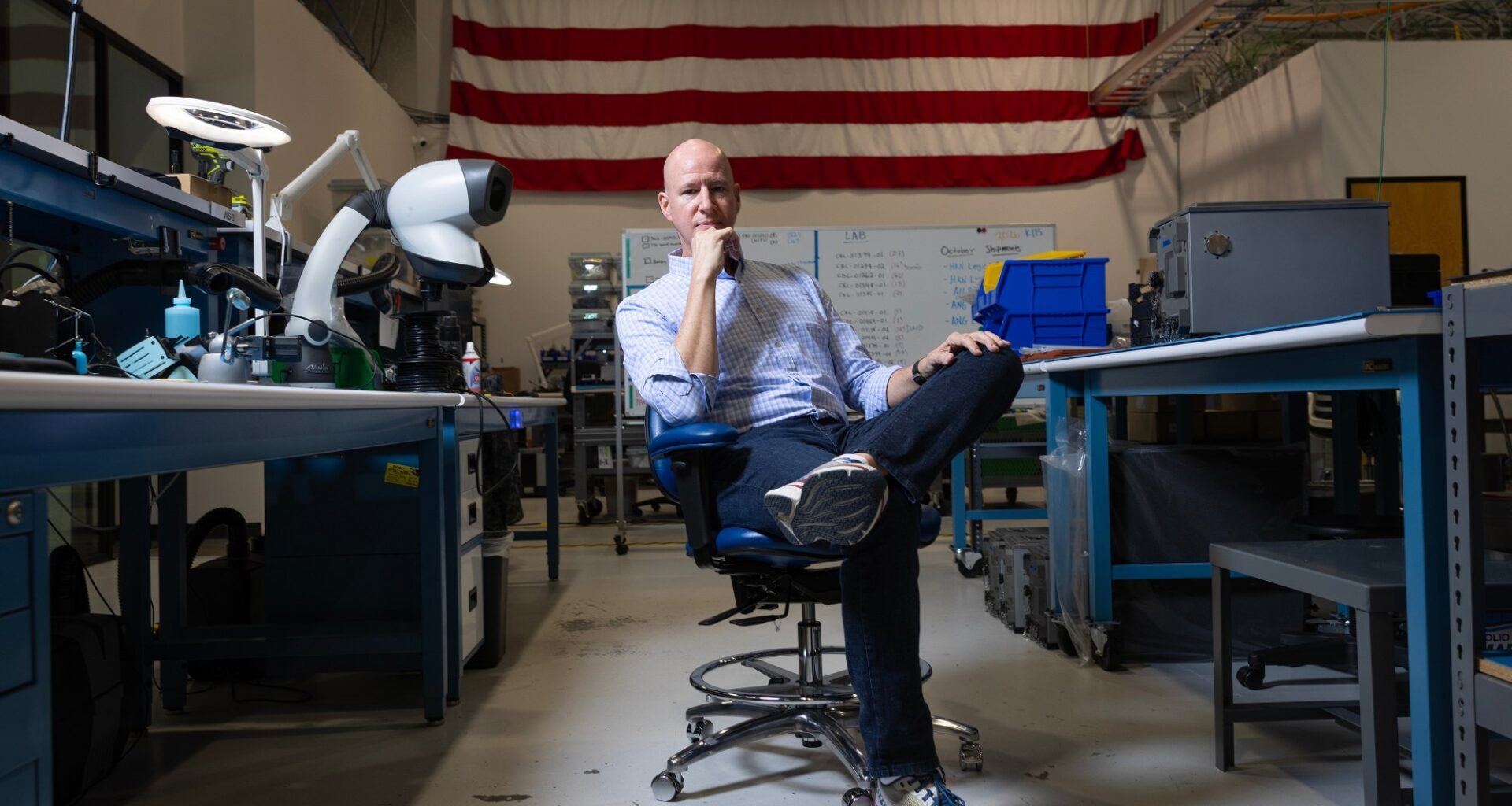
One of those contractors, San Diego’s Digital Force Technologies, says it has begun manufacturing hundreds of counter-drone systems for U.S. bases in the Middle East and Eastern Europe, said Justin MacLaurin, founder and CEO of Digital Force Technologies, or DFT.
DFT’s three-year contract is worth up to $500 million.
“The government has stated that if there is demand for more than that, they’re willing to increase the contract,” said MacLaurin.
The systems are designed to detect and track incoming drones and help operators decide quickly how to stop them.
“We were forged in the crucible of U.S. Special Operations Forces,” said MacLaurin. “They don’t care about fancy PowerPoints or marketing. They want to see if it works.”
DFT’s goal, according to the company, is to “accelerate and automate the kill chain at the tactical edge.” In practice, that means its AI software, SeraphimOS, pulls a base’s sensors and weapons into a single system that can spot a drone and recommend how to take it down within seconds.
Here’s how it works.
A radar picks up an aerial threat as far as 10 kilometers away. A camera then zooms in, and an onboard AI processor helps identify the object.
From there, SeraphimOS, which MacLaurin calls “the brain,” analyzes the drone’s flight pattern and trajectory and calculates how many seconds remain before it reaches its target.
That processing happens on the system itself rather than in the cloud, MacLaurin said. That cuts delays and keeps the data out of reach of foreign adversaries.
The software then assesses what defenses are available at the base and recommends how operators should respond.
“You’ve got remote control guns on turrets, right? You’ve got radio frequency and lasers and high-powered microwaves,” MacLaurin said, ticking through the layers of the kill chain.
Those layers matter, he said, because Iran’s cheap drones are bleeding American resources.
Today, Iran’s one-way attack drone, the Shahed-136, costs an estimated $35,000 to build and carries a warhead of about 50 kilograms.
This relatively small and cheap drone can cause mass destruction. To defend U.S. bases, Americans are shooting a Shahed down with a Patriot interceptor, which costs about $4 million.
Americans are spending more than 100 times what Iran spent on the attack.
This “cost asymmetry” has been a real challenge in this war, MacLaurin explained, one that his system aims to fix.
Though he didn’t share how much DFT’s system costs, he did say that this program makes defending against drones marginally cheaper.
“Say you defend with a laser system. The laser system itself is very expensive — say, $10 million to $20 million — but it’s just a pulse of energy. The cost to kill one drone is very, very small: pennies, right? Pennies to $1, maybe,” he said.
What’s ironic is Americans have developed some of the best defense technology in the world, he said. “What has lagged so far is a comprehensive approach to deployment.”
Iran has been incredibly creative in this war, MacLaurin acknowledged. Between the Shahed drones and Strait of Hormuz, “they’re just trying to find what will cause the biggest impact… and we’re all kind of preparing for what’s next,” he said.