
On the unknown history of gay advice columnist Jeanne C. Barney. Did you know LARB is a reader-supported nonprofit?
LARB publishes daily without a paywall as part of our mission to make rigorous, incisive, and engaging writing on every aspect of literature, culture, and the arts freely accessible to the public. Help us continue this work with your tax-deductible donation today!
IN THE EARLY 1990s, my best friend and I would spend our afternoons in the Salvation Army Thrift Store, at the far end of an enormous parking lot named Paperbark Plaza. After perusing the racks for secondhand dolphin shorts and crocheted sweaters, we’d make our way to the back of the store, walk up two carpeted steps, and settle into a little book nook. We’d skim the romance novels until we’d get to the fuck scenes, and then we’d read aloud to each other; I was just discovering V. C. Andrews, and I hadn’t yet figured out masturbation. Sometimes, at night, we would hang out in the Jacuzzi at my friend’s apartment complex, joined by her cousin Bubs, and compare nipples. Bubs’s were big and Bisquick. Mine were small and brown. “Man nipples!” they teased, laughing.
Were my nipples not normal? Could I make them bigger? Pinker? Where would I have looked for advice? Nobody I knew had the internet or even a computer at home, so romance novels and pseudoscientific sex manuals from the local thrift store provided the means to learn about my body and the pleasures it could afford until I started trying things out for myself. It was sloppy and awkward, but at least it wasn’t algorithmic or profit-driven.
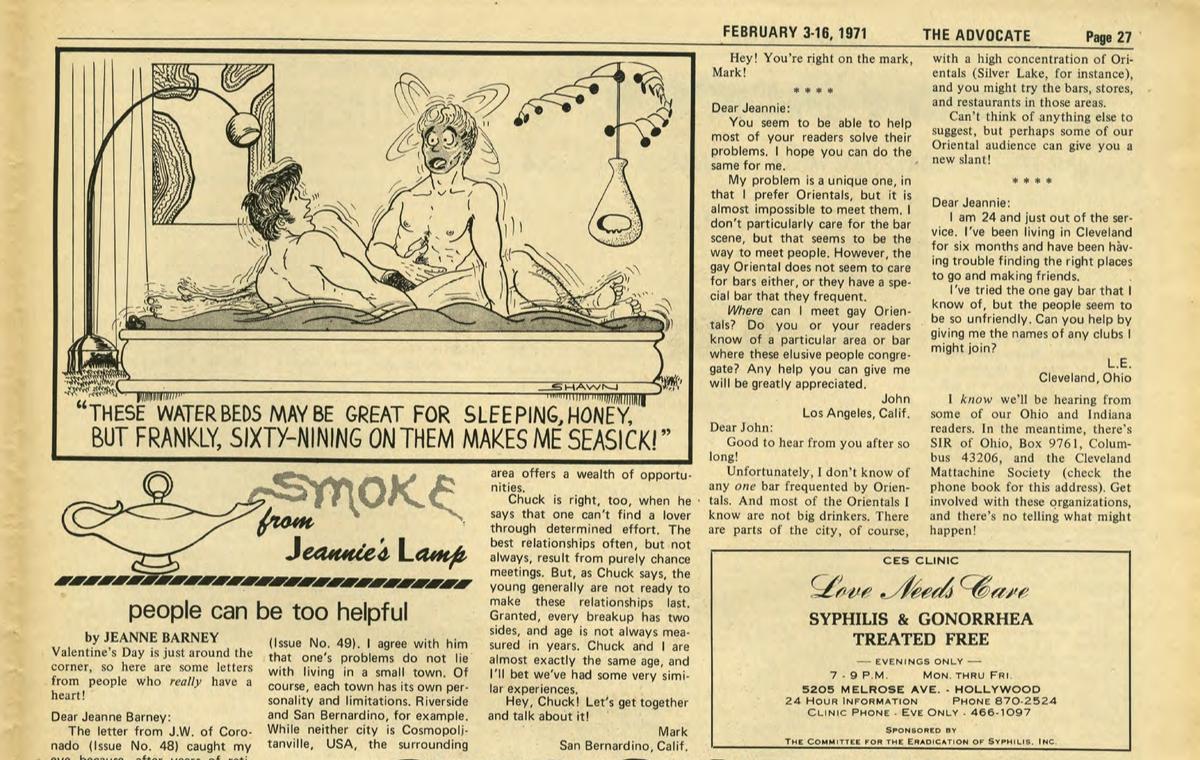
In our current moment of chatbot therapists, deranged influencers, and “democratized” access to every answer through AI, I’ve been reflecting on how my friends and I learned about sex with a mix of cringe and sentimentality. These memories were all frosty nostalgia until the other night, when I started reading Smoke from Jeannie’s Lamp, an advice column published by The Advocate in the 1970s. I learned about the column through an archive recently acquired by the Beinecke Library at Yale, where I work. I was curious to see what kinds of advice people requested back then, so I asked a student intern to hunt down every copy of the column she could find.
After spending hours at the microfilm machine, the intern delivered a folder of printouts of old newspaper pages with sexy display ads and campy jokes. The Los Angeles Advocate started out as a 12-page paper clandestinely printed on an office copy machine in 1967. By 1975, it had grown into the most important nationally circulating gay newspaper in the United States. Appropriately, its advice column, which ran from 1970 to 1975, didn’t feature the portrait of a respectable, middle-aged, middle-class, straight-looking woman. Instead, it depicted an alluring and mysterious cloud of smoke floating out of a genie’s oil lamp, beckoning letters from anyone who had a problem and needed advice.
The column was authored by now-forgotten gay activist and sex-positive journalist-editor Jeanne Chesley Barney. A straight cis woman and mom, Barney was an unlikely oracle for Gay L.A., but she championed sexual freedom and gay rights. In addition to Smoke from Jeannie’s Lamp, she published Prison Rap, a column dedicated to giving voice and support to incarcerated gays. She was the cofounder and editor of the gay male leather magazine Drummer. She was arrested at the notorious charity “Slave Auction,” held at the Mark IV Baths to benefit gay organizations, when the Los Angeles Police Department deployed over 100 officers to shut it down.
But we don’t know much else about Barney. She is said to have worn a size zero dress and enjoyed both cigarettes and Roscoe’s House of Chicken ’N Waffles. Apparently, Barney also drove a yellow convertible Pontiac Solstice. Mostly, she is a mystery.
¤
The history of the advice column goes back to the 17th century, but as a modern genre in the United States, it emerged at the turn of the 20th century in the writing of “Beatrice Fairfax” in the New York Evening Journal and “Dorothy Dix” in the New Orleans Daily Picayune. It wasn’t until after World War II that the most famous advice columnists appeared under the bylines of “Ann Landers” of Chicago and “Dear Abby” of San Francisco. In real life, Ann (real name Eppie Lederer) and Abby (Pauline Phillips) were fiercely competitive twin sisters who dueled it out through their nationally syndicated columns. Each taking a slightly different tone, these two columns enabled thousands of Americans to learn about the taboo desires, foibles, and frustrations of their fellow citizens.
Beginning in the 1950s, these columns gave voice to the problems women confronted as the broader culture embraced—or enforced—a return to traditional gender roles during the immediate postwar period. Some of the advice given is appallingly archaic and patriarchal. Still, in the ensuing years, their columns became forums for family riffs, sex education, and evolving attitudes toward marriage, as youth culture, gay liberation, and feminism reshaped American culture. In this way, Ann and Abby weren’t that different from “Jeannie,” all of whom wrote from the perspective of their self-styled personas rather than as private individuals or credentialed experts. The questions they each published revealed changing attitudes toward sex and society, shifts that their respective readerships didn’t necessarily agree upon.
Smoke from Jeannie’s Lamp appeared almost 15 years after Lederer and Phillips began writing Ask Ann Landers and Dear Abby, and it offered a more expansive and welcoming space for a broader range of sexual orientations. Readers knew the difference. In August 1970, a 21-year-old man named Charlie wrote to Barney, “This must be the most unusual letter that you have ever received.” Charlie goes on to share his concern that his lovers always discard the product of his climax into the sink. So one night, when he was alone, he decided to find out why: “I found that my semen is very bitter […] Since I’m too bashful to go to a doctor, and Ann Landers is not ready for me yet, I thought that you and your readers are the only ones I can turn to. Please help.”
¤
Barney’s advice column is hilarious and heart-wrenching. People asked her the eternal questions of humanity: Will I ever find love? How can I make myself more attractive? What should I do with the rest of my life? Who am I, really? At the same time, Barney fielded the kinds of questions you’d expect to find in an advice column written for a gay readership navigating homophobia amid the rise of the sexual revolution: Where can I find other gays? Should I come out to my parents? Is it possible to live a double life? Where can I get medical help from a sympathetic doctor? Exactly what does God think of the homosexual lifestyle? How do I decode the symbols of gay life and the abbreviations in the personal ads?
In Smoke from Jeannie’s Lamp, the reader encounters a never-ending stream of questions about how to make one’s penis larger, and endless debates about the virtues of age versus youth, circumcised versus uncircumcised, femme versus butch. But there are also questions that made me feel again like that curious, captivated teenager I once was. The following inquiries are compiled from disparate letters:
I enjoy nothing better in this world than pleasing a man sexually […] is there any way that I can stretch my anus? How does a dull, uninteresting person find companionship? I would like to get castrated. But no one will help me. My problem is that I like to go bathing on the beaches in the summer, but I’m really self-conscious because I have excessive amounts of hair on my back and shoulders. Dear Jeannie and your Smoky Lamp; I, too, have lamps but they are kerosene. I’m a cowboy and get sorta lonely. Do you think that if I asked young guys in the bars to spit on me, they would be tolerant? The foreskin on my penis will not slip over the head. What can I do? For many years, while growing up, I was always extremely aroused (and still am) by the sight of a man who had lost one or both legs. I’d appreciate some information about crabs. I’m a gay girl and find it difficult to meet single women. The hairline on my forehead is receding, and my friend, who has a very luxurious growth of pubic hair, has suggested that it would be a good idea to transplant some of his pubic hair (six or seven inches long) to my forehead. Is this possible? Do you know anything about a sexual inclination to mud? Are golden showers healthy? Do you know where I can meet conservative gay guys who wear wingtip and executive-type shoes like black-laced Florsheim oxfords? Is there a gay Weight Watchers? Do you think any of your readers would be interested in helping a [five foot five], green-eyed, brunet, Aries transexual find gainful employment so that she may earn enough for a much-wanted sex operation? Can you be in love with two people at the same time?
Dear Jeanne Barney answered these questions with care and humor, sometimes taking a letter writer to task for their biases, sometimes encouraging a letter writer not to lose hope. She took pains to try to help without judgment; she didn’t always succeed. Sometimes her replies were snarky or defensive.
In reading across the five years that Smoke from Jeannie’s Lamp was published in The Advocate, I began to see that it wasn’t just Barney’s advice that made her column tick: the column eventually became a sexy, strange, inspiring public square. Readers would write to say that they identified with someone else’s problem, or to disagree with her advice, or to reach out to get in touch with someone who was having a hard time. Barney published these letters too, turning her column from a Q and A into a conversation. The smoke billowing out of Jeannie’s Lamp was that of a whole scene taking shape in real time.
Barney’s readers were drag queens and chicken queens, longhairs and active servicemen, urbanites and lonely souls stuck in small Midwestern towns, gays living abroad and those living behind prison walls. And the topics discussed weren’t just “personal.” There were also calls to boycott stores, reminders to vote, and warnings about vice squads and mail fraud. She provided contact information for doctors, lawyers, churches, carpenters, and electricians.
Disagreement flourished. Norms and taboos were actively hashed out. Even incest wasn’t a topic of consensus. For example, one of the more unusual letters published in her column was from D. W. and D. W., of Los Angeles: “We are two guys in love, and we love each other very much. We also just happen to be brothers. And twins. Identical Twins. We HAVE thought it over and are practically bursting to tell Mom and Dad and have pretty definitely decided to do so.” And so, they go on, “being in love, we want to be married in a church.”
Since they are blood relatives, Barney replies, they can’t be married in a church, but “personally, I see nothing wrong with your relationship, although I do wonder if—being identical twins in love with each other—it does not mean that each of you is really in love with himself.” A few weeks later, Jim and Ron from Burbank write a response: “Dear Jeannie: after reading the letter from D. W. and D. W. and then your answer to them, I think something is wrong with you.” Contrary to what you might be thinking, Jim and Ron did not disagree with Barney’s tolerance of the brothers’ relationship. They disagreed with her assertion that they couldn’t be married. “No, Jim and Ron,” Barney replied. “There is nothing wrong with me, but there is something wrong with you […] you’re uninformed.” Before answering D. W. and D. W., Barney had called the local church to ask if the brothers could be married, and the answer was no. “What[,] do you think I make up my facts as I go along?” she asks Jim and Ron.
Reading Barney’s retort amid the current barrage of fake facts and hallucinating machines, we might ask what expert advice is anymore and whom we can trust with our most intimate questions. Where do we turn for help when we’re not sure whom to ask? Barney’s column offers a glimpse into a time before we could just type our questions into a search bar and get an answer from Google, WebMD, or ChatGPT. Back then, to get a customized reply to a specific question, people had to talk to other people. But asking someone for advice could be risky. How would they react? Who might they tell?
The newspaper advice column offered both the discretion of a confidant and the camaraderie of the public sphere; when we ask AI something, we are denied both. With each query, our personal data is stored and monetized while also made invisible to us. The algorithm scrapes countless sources—some expert, some dubious—and delivers us a synthesized answer. Despite the vastness of the resources the answer is drawn from, this artificial reply feels like just that: artificial, hollow, lacking expertise even if it partially derives from experts and real data.
Might expertise require something more than the synthesis of information? Might it include being open and receptive to someone else’s situation? Perhaps real expertise even requires empathy and an authentic desire to understand. It is conjured not just from facts but from human feelings as well.
Not only does Charlie, with his bitter semen, trust that Barney will be sympathetic to his problem. He also indicates that he’s not relying on Barney’s advice alone; it’s her readership that might be able to help. “Readers write to advice columnists to participate in a sort of public discourse,” explains David Gudelunas in his book on the history of advice columns, “and readers who never actually mail a letter to the columnist use the column as a way to gauge their own behavior and to eavesdrop on the problems of their friends and neighbors.” The primary function of the advice column, Gudelunas argues, was not actually to give advice but to serve as a barometer of social norms surrounding sexuality. Maybe readers would write back to say Charlie’s bitter semen wasn’t that unusual or unlikable, or perhaps his letter inspired countless others to taste-test their own.
The advice given in Barney’s column was idiosyncratic to her experience and personality—drawn from the time and place she lived, her education, her social connections, her own biases and blind spots. The letters to Barney speak of discrimination, fear, homophobic threats, and unfair legal and medical systems, all of which are growing problems in our current moment. As much as her column reveals the progress of the last 50 years, it also exposes the rapid and frightening erasure of gay rights—like so many human rights—today.
¤
Jeanne Chesley Barney died in 2018 without much notice. No obituaries ran in the gay or straight press, in Los Angeles or elsewhere. Some of her friends and fans didn’t even know she had died until the contents of her house went up for sale in January 2019. Hundreds of photographs, handwritten letters, posters, artwork, and ephemera documenting gay history were sold at an estate sale first come, first served. Andy Campbell, an art historian and friend of Barney’s, was by turns enraged, disappointed, and mournful when he learned that her belongings were being liquidated and scattered via eBay.
Did Barney’s family not see the value of her archive? Campbell and a small group of friends tried to buy as much as much as possible to keep Barney’s archive intact. He even visited the homes of some of the pickers who were reselling Barney’s effects on eBay to try to convince them not to disperse her archive. But it was already too late.
About six months after the estate sale, Barney’s belongings began to surface in the rare book trade. In June 2019, Swann Galleries held its first ever Pride Sale. The Manhattan-based auction house pitched the public sale of hundreds of artifacts, photographs, letters, and ephemera as “An Exploration & Celebration of the Art, Influence & History of the LGBTQ+ Community.” Untold numbers of people consigned their things to Swann and untold others bid on them—dispersing gay history like confetti at a Pride parade.
Two lots from Barney’s archive were included in the sale. New Haven’s William Reese Company, a rare book business working on behalf of Yale’s Beinecke Rare Book and Manuscript Library, picked them both up and pulled them together, thus establishing the beginning of the Jeanne C. Barney papers at Yale.
A few months later, more of Barney’s materials appeared on the market. A bookseller based in Houston named Adam Schachter had come into possession of hundreds of Barney’s letters, drafts of her columns and event calendars, handwritten notes, photographs, and newspaper clippings. Yale acquired these too. Then, in January 2021, the library acquired another tranche of Barney materials from Rachel Furnari, a bookdealer in Burlington, Vermont, who specializes in radical art and social movements. In May 2021, more materials surfaced, this time in East Williamsburg, Brooklyn, at a gallery specializing in photo archives.
Yale wasn’t the only institution to preserve Barney’s archive. Stanford University’s Special Collections library also acquired materials that seem to have entered the rare book trade through Barney’s estate sale. The Leather Archives & Museum in Chicago also holds material about Barney, some of which was purchased from eBay by a fan and donated to the museum in 2020. Today, Jeanne Barney can be found in the archives of gay figures and organizations, collected by libraries and museums across the country.
Barney died before she could tell her own story, without having placed her archive to be preserved intact. But even in its dispersed and fragmented state, it offers us something valuable. Her archive, like her column, is filled with the heartfelt letters of even lesser-known individuals. Tiny pieces of other people’s stories are still being saved and shared through her.
We may never know who Jeanne Barney really was, but we can appreciate, now more than ever, the value of the work she did. In August 1975, Barney closed her column with an apology: “To the many, many readers who are waiting for personal replies, mea culpa! I’ve been up to my clavicle, but will try to dig myself out soon. Thanks for your patience.”
¤
Note: Thanks to my intern Kassidy Schiavi, and to Meghan Freeman, who showed her how to use microfilm.
¤
Featured image: Scan of Jeanne Barney’s column in The Advocate, February 1971. Courtesy of the author. Image has been cropped.
LARB Contributor
Lucy Mulroney is a writer and a scholar of archives and visual culture. She is the author of Andy Warhol, Publisher (University of Chicago Press, 2018) and co-author of The After Archive (Post45, 2021), with Lisa Cohen, Maura Finkelstein, Renee Gladman, and Kathryn James.
Share
Copy link to articleLARB Staff Recommendations
Professor and programmer Maggie Hennefeld explores the world of forgotten silent film actresses and archivists’ struggles to rediscover lost film art.
Kyle Stevens considers the 1951 film “Olivia,” an obscure queer classic from an under-appreciated.