
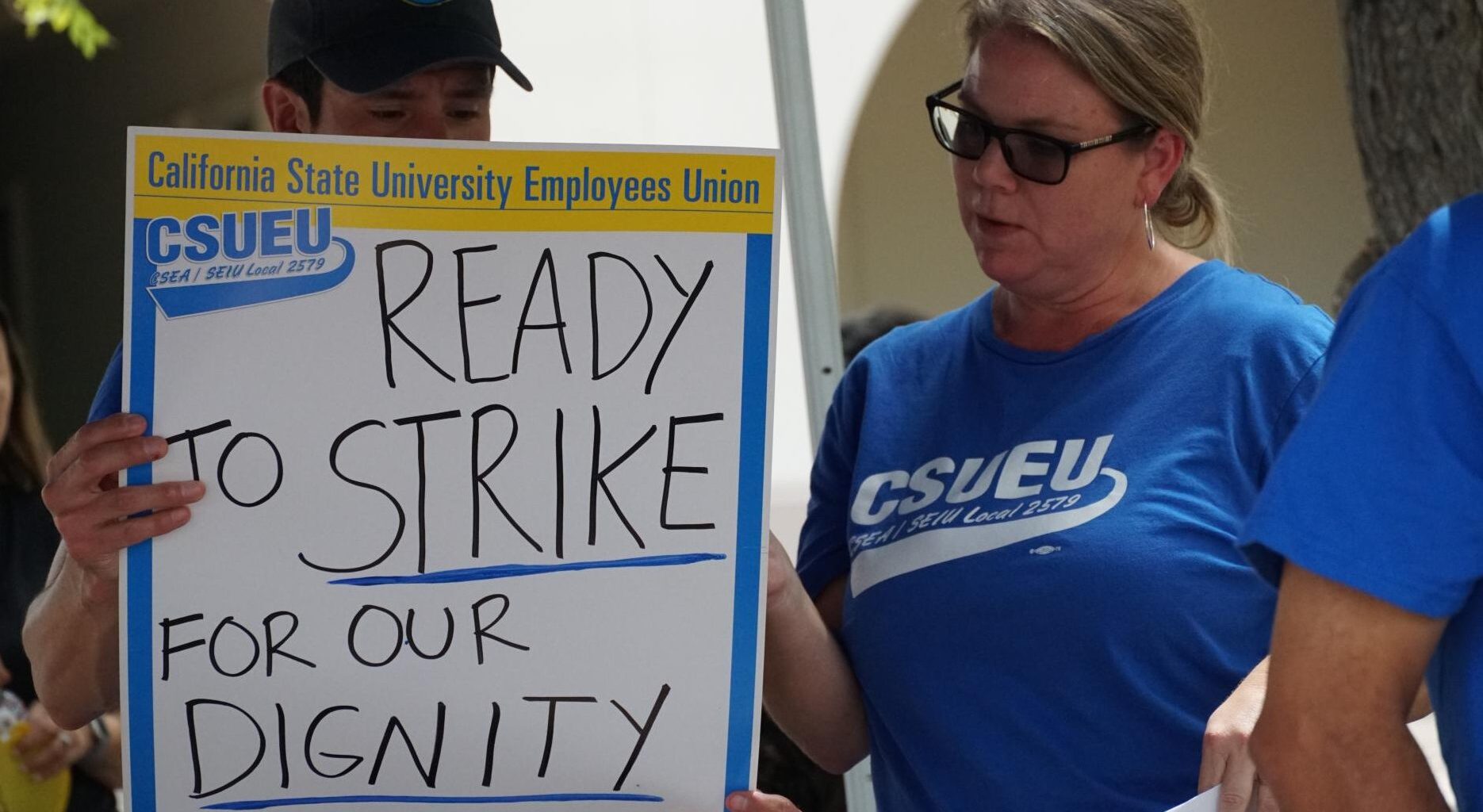
In February 2024, student assistants in the California State University system voted overwhelmingly to join the CSU Employee’s Union, becoming the largest union of student workers in the country under CSUEU Unit 15.
Two years later, they are still in negotiations with CSU for their first contract. The process has been long, but with bargaining kicking off again in September, student workers believe they may finally have the leverage to get a deal.
Last year, the CSU employed over 20,000 student assistants, according to the 2025 Employee Profile. Classified as non-academic student workers, they hold a variety of roles on the campus, from manning the desks in dorms and libraries to assisting in athletics and communications.
The Daily Aztec’s editorial board are officially employed as student assistants.
Despite playing an outsized role in keeping campuses running, union organizers say many student workers are struggling to make ends meet in one of the most expensive states in the nation.
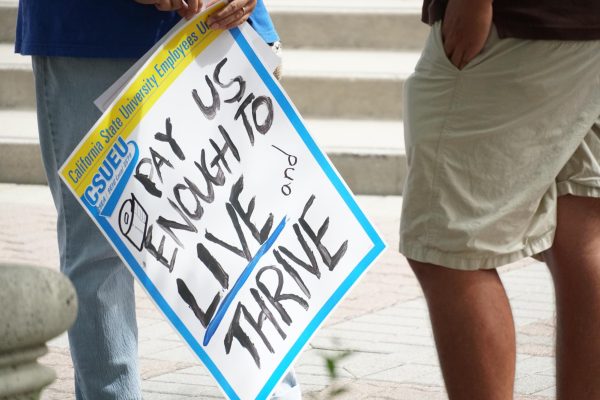 A CSUEU member holds a sign and speaks to students before during CSUEU’s weekly Wednesday rally on SDSU’s Centennial Walkway, Wednesday Sept. 9, 2026, San Diego, Calif. (Roman Fong)
“We’re the largest educational system and the fourth largest economy in the world, and yet student assistants and students in general are still falling below the poverty line,” said Devon Cenario, a student worker and union member at CSU Stanislaus.
The union’s demands have largely remained the same since 2024: higher pay, sick time and cheaper parking, according to CSUEU members.
Because students are technically employed by the state universities are only required to pay student assistants the state, rather than local, minimum wage, according to union Kaily Brooks, a student assistant and CSUEU member. This means some students working for SDSU only make $16.90 per hour, rather than the $17.75 per hour they could make at almost any other job in San Diego or the $20 per hour they could get in fast food.
Brooks, one of the students who voted to unionize in 2024, learned this fact from organizers at an early information session and it was part of what motivated her to get involved.
“San Diego minimum wage was more than what I was making because I was making state minimum wage,” Brooks said. “And I was like, ‘that doesn’t make any sense, I’m living in San Diego.’”
The local minimum wage is still less than San Diego’s “living wage,” which is around $33 per hour for a single person with no children working full-time.
Additionally, unlike most other California state employees, student assistants are not eligible for sick leave. And unlike staff and faculty, who are guaranteed a discount, they pay the full, student price for parking.
Claudia Gonzalez, a student working in the SDSU library who became active in CSUEU last spring, thinks the pressure on students to organize will increase as tuition continues to rise.
“
CSU keeps telling us it’s a privilege to work on campus, and it isn’t a privilege.”
— Claudia Gonzalez, student assistant
Overall, organizing student workers can be an uphill battle. In a public-sector workplace with high turnover, the union must constantly reacquaint itself with new employees, according to Erin Foote, CSUEU’s vice president for organizing.
Brooks, who sits on the Unit 15 Bargaining Committee, emphasized that she is grateful for the opportunities the university provides but feels the CSU does not fully understand or take seriously the pressures on students.
“When you actually live it, you realize, ‘Okay, there’s a lot of work that can and needs to be done,’” Brooks said. “I think it’s emotionally taxing to sit across the table from people who do not want to fix a very easily fixable problem.”
In response to emailed questions about bargaining and Unit 15’s demands, a CSU spokesperson said, “Student employees play an important role in supporting campus programs and services while gaining valuable work experience as part of their educational journey. The CSU remains committed to bargaining in good faith with CSUEU and is working toward an agreement. Because negotiations are ongoing, we are not providing additional details regarding bargaining proposals or discussions at this time.”
In an interview with Daily Aztec editors last month, SDSU President Adela de la Torre deferred to the chancellor on specific negotiations, but emphasized the difficulties facing university employees.
“This is a hard process, but it has to happen. And I think we have to really think about the fact that the affordability crisis is a real crisis,” de la Torre said. “It is something that is affecting the daily living of individuals, particularly in San Diego.”
So far, Unit 15 has held two bargaining sessions this semester, the first on Sept. 15 and the second on Sept. 29. For the first time since the union was formed, students are negotiating at the same time as CSUEU Bargaining Units, 2, 5, 7 and 9, which represent university staff, as well as other prominent CSU unions.
With the other unions out of contract, a joint strike is on the table, giving both students and staff increased leverage, according to Foote.
“
I feel very confident that our goal is to settle both contracts. Full-time staff are not going to walk away from the table without student assistants also having a contract.”
— Erin Foote, CSUEU vice president of organizing
Although they still hope to reach an agreement, organizers are now preparing for a possible strike. Local chapters are surveying membership and holding practice pickets.
“We’ve just understood that we have to be strike ready,” Cenario said. “It’s been how many months, how many years, and CSU management doesn’t seem like they’re ready to budge at any point … we’re not willing to settle with this multimillionaire school system.”