
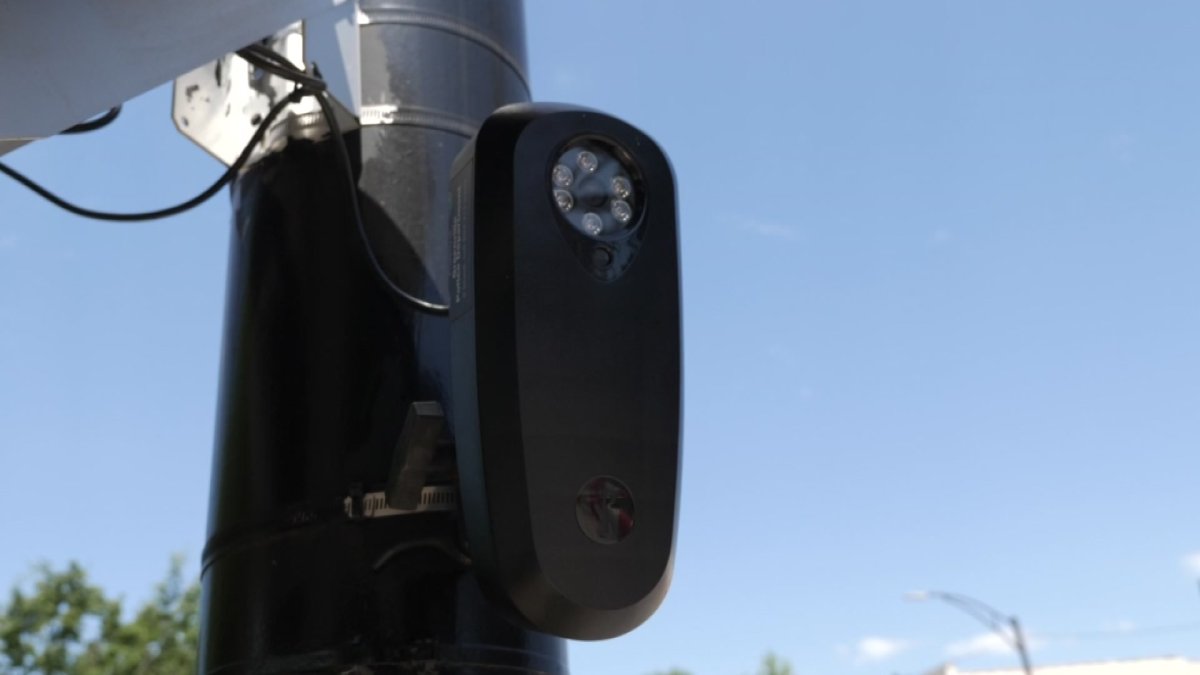
A San Diego city councilmember called for the city to remove its Flock cameras Tuesday, saying they are causing too much fear in local communities.
Councilman Stephen Whitburn has repeatedly voted to keep Flock’s automated license plate reader cameras, which are densest in Council District 3 of downtown, Balboa Park and its surrounding parts, but said national events have changed his mind.
With last week’s report about ICE expanding its operation in San Diego and targeting schools and construction sites, the urgency to turn off the cameras has heightened, said Whitburn.
Community patrollers say federal agents have been using different tactics to blend in so they can make arrests during immigration enforcement operations. NBC 7 and Telemundo 20’s Guillermo Mendez spoke to construction site workers about their experience.
“The Trump administration and ICE and their un-American, anti-immigrant brutality have created a police state in many of our communities. Many people worry Flock cameras are being used in that crackdown,” Whitburn said.
Whitburn said until now, he voted in favor of the cameras as a matter of public safety, for helping to solve crimes and the belief that the police department used them responsibly.
“Families are afraid of being separated. Workers are afraid of being targeted on their way to work. Parents are afraid of what could happen when they take their children to school,” Whitburn said. “American citizens have been detained. These are our neighbors, and they deserve to feel safe in their own city.”
ACLU sues city of San Diego and SDPD
Last month, the American Civil Liberties Union Foundation of San Diego & Imperial Counties filed a lawsuit against the city of San Diego and the San Diego Police Department seeking to halt the city’s use of ALPRs.
The suit alleges that through its network of at least 500 ALPR cameras across the city, San Diego is violating the California Constitution by infringing on citizens’ privacy rights.
“The city of San Diego and the San Diego Police Department’s ALPR system is an invasive, around-the-clock mass surveillance technology that can reveal intimate details of a person’s life,” said Samantha Itazawa, advancing justice staff attorney at the ACLUF-SDIC.
It seeks to have a court order the cessation of the city’s use of ALPR technology, to uninstall all street-light cameras and associated hardware, and to delete all data collected by ALPRs and street-light cameras.
“This information can demonstrate travel patterns of individuals as they go to work, drop their children off at school, or attend a house of worship, doctor’s office or protest,” said Itazawa. “This widespread collection of ALPR information poses serious threats to communities’ privacy and freedom of movement.”
The lawsuit also challenges the efficacy of the technology, which recently came under fire in San Diego after two men were wrongfully arrested based on an ALPR hit despite being five miles away from the scene of an alleged crime.
SDPD chief responds to misuse claims
San Diego Police Chief Scott Wahl pushed back on claims of misuse Tuesday.
“For nearly three years, SDPD has shown that ALPR technology can help solve serious crimes while protecting people’s privacy,” Wahl said. “We’ve followed strict rules, conducted regular audits and helped set a national standard for responsible use.
“The results speak for themselves. This technology has helped solve more than 900 cases. In this councilmember’s own district, it’s assisted in hate crime sprees against our LGBTQ community and helped find a suspect in the attempted kidnapping of a child. He knows firsthand the difference this technology has made,” Wahl continued.
“Let’s also be clear: SDPD has never shared ALPR data for immigration purposes. Not once. We welcome oversight. We’ve spent years building safeguards and holding ourselves accountable. But we shouldn’t lose sight of what this technology has accomplished for victims and their families. Our communities deserve public safety decisions based on facts, not politics.”
The 30 days the SDPD is allowed by local law to keep the data matches La Mesa and National City as the least amount of time in the county. The San Diego County Sheriff’s Office and Coronado, Oceanside, Carlsbad and Chula Vista allow the data to be kept for a year. In Escondido, that increases to two years.
San Diegans push back on ALPR technology
Mayor Todd Gloria shared the chief’s sentiment.
Gloria said automated license plate readers have assisted in nearly 900 criminal investigations and allowed San Diegans to recover over $8.7 million in stolen property.
“San Diego has also set the gold standard for transparency and oversight of surveillance technology. Our landmark TRUST Ordinance established a public review process, independent privacy oversight and clear requirements governing how surveillance technology is evaluated and used,” said Gloria. “We’ve strengthened those protections through auditing, public reporting and tighter controls on access to information.”
In December 2025, the council voted 5-3 to continue using ALPR technology during an annual technology review. Whitburn voted for the technology.
Hundreds of San Diegans spoke at the meeting, with the majority in opposition to ALPR technology, but the council took the advice of the SDPD to continue its use, physically tied to the Smart Streetlights contract approved with Ubicquia in 2024.
“I’m not going to deny the effectiveness if you are watching everyone, all the time,” Councilman Sean Elo-Rivera said last year. “Flock is a proven bad actor who is unwilling or unable to stop their technology from being abused.
“For years, San Diegans asked the city to invest in community instead of spending millions on creepy surveillance. The mayor and a majority of the council ignored us,” Elo-Rivera said. “Across the country and here at home, those concerns have been proven right with improper data sharing, misuse of the technology, and false arrests.”
In June, as the council and the mayor’s office worked to create a balanced budget, Flock cameras again came under scrutiny. Several council members felt there was an unfair juxtaposition between defunding libraries and recreation centers and the $2 million ALPR contract with Flock.
“License plate readers being directly opposed to children and families is a false comparison and is being done deliberately,” Councilman Raul Campillo said. “Criminals who have beat families to death in my district have been caught by this. Who here wants to go tell those families `no, your family doesn’t get justice?”‘
Ultimately five of the nine-member council voted to leave the contract untouched. Whitburn’s turn on the issue could be Flock’s death knell in the city, depending on November’s election.
“When someone calls for assistance, they don’t need a Flock camera; they need help to be on the way quickly,” Whitburn said. “Let’s turn off the cameras and cancel the Flock contract. Let’s use the savings to speed up response times when people call for help.”