
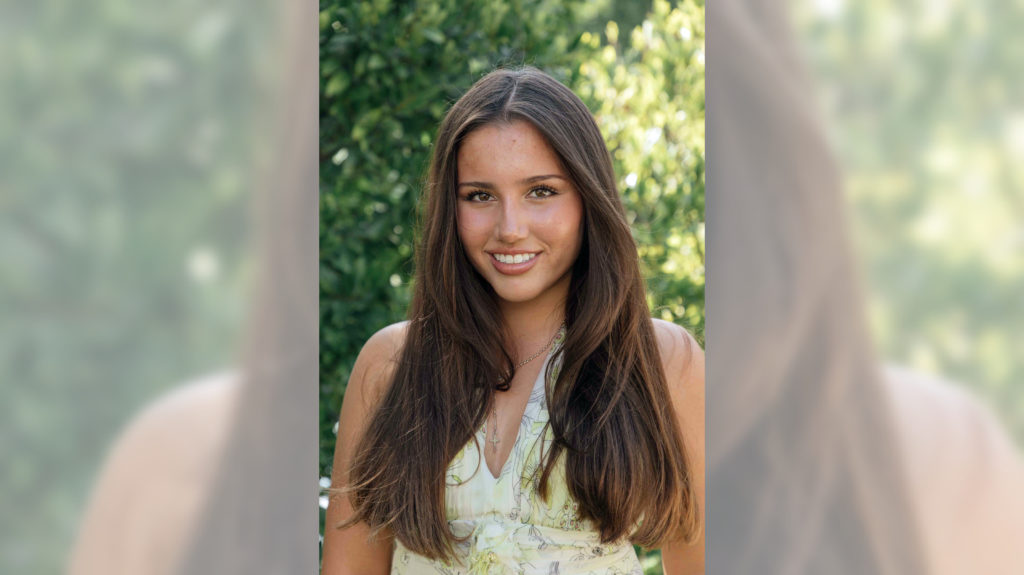
Sophia Moreno has been active in debate since sixth grade, but she never expected her debating experience to spark her interest in policy and economics.
She’s now a co-captain of the debate team at Marlborough School, the girls’ college-preparatory school in the Hancock Park neighborhood of Los Angeles. And that interest has evolved into something much, much bigger for the 17-year-old high school senior.
Moreno, whose family belongs to St. Martin of Tours Church in Brentwood, recently created and launched a complete suite of financial literacy tools, the First Investor Project, including a website, an app, and illustrative calculators, to help low-income families become more financially literate.
Among her biggest supporters is Father Paul Fitzpatrick, the pastor at St. Martin of Tours.
“I think it’s remarkable what she’s doing, especially targeting low-income Spanish speakers,” Fitzpatrick said of Moreno’s website, a free, bilingual resource that helps families navigate and enroll in Section 530A Accounts (also called Trump Accounts), a federal child-investment program still not well known to a wide swath of the population.
“It’s neat when you see teenagers doing things beyond their limited worlds and who realize that having been blessed with much comes with a great responsibility to give back to others.”
Fitzpatrick has connected Moreno with community organizations and other resources to help get the word out.
An awareness gap
Trump Accounts are new tax-advantaged investment accounts created under section 530A of the Internal Revenue Code. The law was signed July 4, 2025, and the accounts became available to families in July 2026.
Every child under 18 with a Social Security number is eligible for an account. Children born from 2025 through 2028 could also receive a onetime $1,000 contribution from the federal government.
Separately, the Michael and Susan Dell Foundation is contributing $250 to accounts for children 10 and under who live in zip codes where the median family income is $150,000 or less.
Families and others can contribute up to $5,000 per year to an account, which minors can withdraw once they turn 18, but families must first enroll in the account.
And therein lies the problem, Moreno said. Not that many parents are aware of the accounts — especially those low-income Spanish speakers.
“The awareness gap is bigger than I expected — it’s so pronounced,” said Moreno, who spent several months outside of her schoolwork building the First Investor Project. “There’s been very little outreach from government to target these families, many of whom are in economically precarious situations.”
Moreno hopes the First Investor Project website, which walks people through the steps necessary to set up a savings account, will help educate more families.
“When I heard about these accounts,” she said, “I realized the impact they could have, and it made me realize that good could be achieved at a high institutional level.”
Lessons from her parents
Moreno credits her parents for instilling in her a responsible mindset about finances, as well as a drive to help others less fortunate.
Erik Moreno, an immigrant from Ecuador, is executive vice president of growth and new initiatives at Sony Pictures Entertainment. His wife, Cara, is a former consumer tech start-up chief operating officer who now works as a media consultant in strategy, finance, and business opportunities.
Both have instilled in their four children a desire to give back to the community.
“We committed ourselves to passing three things on to our children: our Catholic faith, the gift of speaking Spanish fluently, and service,” Erik said. “We are immensely proud of the work Sophia is doing with First Investor Project because her work not only embodies the values we are transmitting to all our children, but also because she is actively making a difference in financial literacy in Los Angeles.”
Cara said she and her husband have always encouraged their children to work, earn their own money, and learn early about saving and investing.
“And also to recognize what a privilege it is to have that knowledge and the responsibility to share it,” Cara said.
Nonprofit work
Financial literacy has long been important for Moreno, who at age 13 started working at an art studio part-time during summers.
When she was a sophomore, Moreno became involved with the nonprofit Credit Abuse Resistance Education (CARE), founded in 2002 by U.S. Bankruptcy Court Judge John C. Ninfo II in New York.
The organization, which now operates several chapters nationwide, educates young people about the consequences of credit abuse and the importance of sound money management.
In her volunteer work with CARE, Moreno visited schools, homeless shelters, and community centers to teach financial literacy to low-income families throughout Los Angeles.
So far, Moreno has partnered with 10 organizations to raise awareness about the Trump Accounts and First Investor Project. Estrella TV, the U.S.-based Spanish-language broadcast network serving Hispanic and Latino audiences, has featured Moreno on various shows.
Besides raising awareness for the First Investor Project and schoolwork, Moreno is also filling out college applications.
She hopes to earn dual degrees in economics and international relations.
Meanwhile, she’s watching her wallet and investing her money wisely — and helping others do the same.
“Some families don’t think the [Trump Accounts] program is real,” Moreno said. “But politicians come and go, and this has been signed into law. All people need to do is fill out one form. That critical first step is very easy.”

Greg Hardesty was a journalist for the Orange County Register for 17 years, and is a longtime contributing writer to the Orange County Catholic newspaper.