
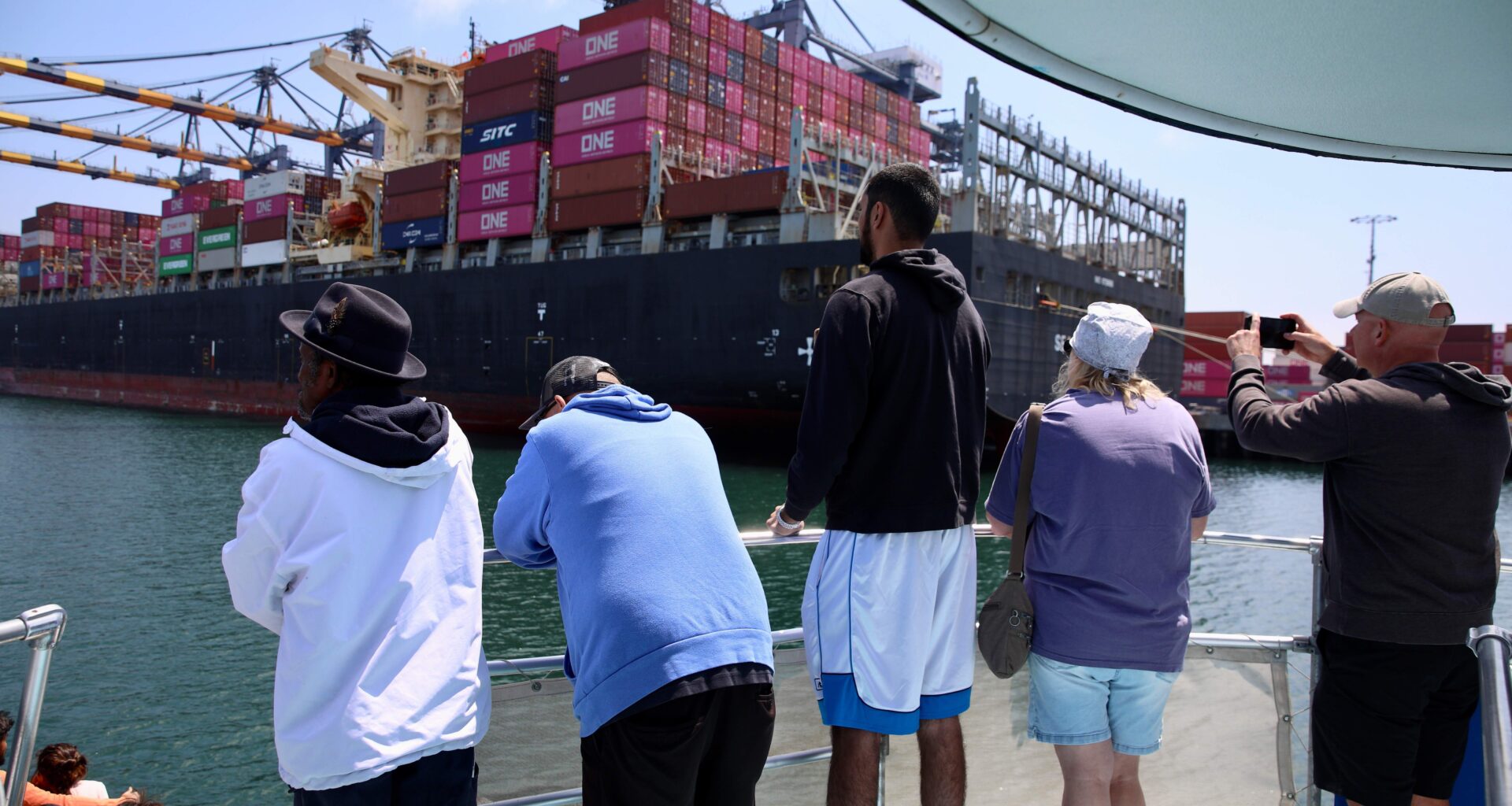
At his monthly online news briefing on Thursday, Oct. 15, Port of Long Beach CEO Noel Hacegaba highlighted the port’s recent all-time cargo records and the port’s readiness for more growth by way of its expanding infrastructure.
This month, for example, the port saw the MSC Arina — a massive container ship capable of transporting 24,000 twenty-foot-equivalent units — arrive, because of POLB’s ability to offer some of the deepest channels available, Hacegaba said.
Through electrifying and modernizing to maximize the space it has, he added, the port is pushing forward with “bigger plans for the future.”
The port’s all-time record-breaking cargo numbers for September were reported earlier this week and reiterated at Thursday’s news briefing.
The port, founded in 1911, moved 997,177 TEUs in September — making it the busiest month in its history. The port’s previous busiest month was October 2024, when 987,191 TEUs moved through the complex, port officials reported this week.
The pattern was also seen in the neighboring Port of Los Angeles, which logged its busiest month in its history during September. That port was founded in 1907. It handled 1,042,652 containers last month.
But among ongoing challenges, Hacegaba said, are high diesel prices that are costing truckers $700 to $800 to fill up.
“Smaller trucking companies are having difficult times,” Hacegaba said.
Addressing the upcoming full closure of Vincent Thomas Bridge, which sees traffic connected to both ports, Hacegaba said plans are in place so Long Beach will not be impacted.
“This closure will not affect operations here at the Port of Long Beach,” he said. “The port will be open and operating as normal.”
Extended gate hours will be put in place before and after the bridge closure, he said. The bridge is expected to be closed from Nov. 7 to February for a deck replacement project.
The Port of Long Beach has set up a website for more information and to receive alerts: polb.com/vtb.
Peter Friedmann, executive director of the Agriculture Transportation Coalition, joined Hacegaba on Thursday to also discuss the status of exports.
“There’s nothing we produce in agriculture of forest products in our country the cannot be sourced somewhere else in the world,” Friedmann said. “If we do not deliver affordably, dependably, to our foreign customers, those foreign customers can and will find alternatives to sourcing in the U.S.”
Those exports form “in many cases the backbone of the country,” he said. “We have been reminded of the lesson the hard way when we impose tariffs on other countries.”
The result, Friedmann said, can be retaliation and customers going elsewhere.
Both Hacegaba and Friedmann also discussed the key importance of ports being designed to keep cargo moving.
The port’s expansion of on-dock rail projects, especially the $1.8 billion Pier B program designed to triple on-dock rail cargo capacity and cut down truck traffic, Hacegaba said, will be “a game-changer.”