
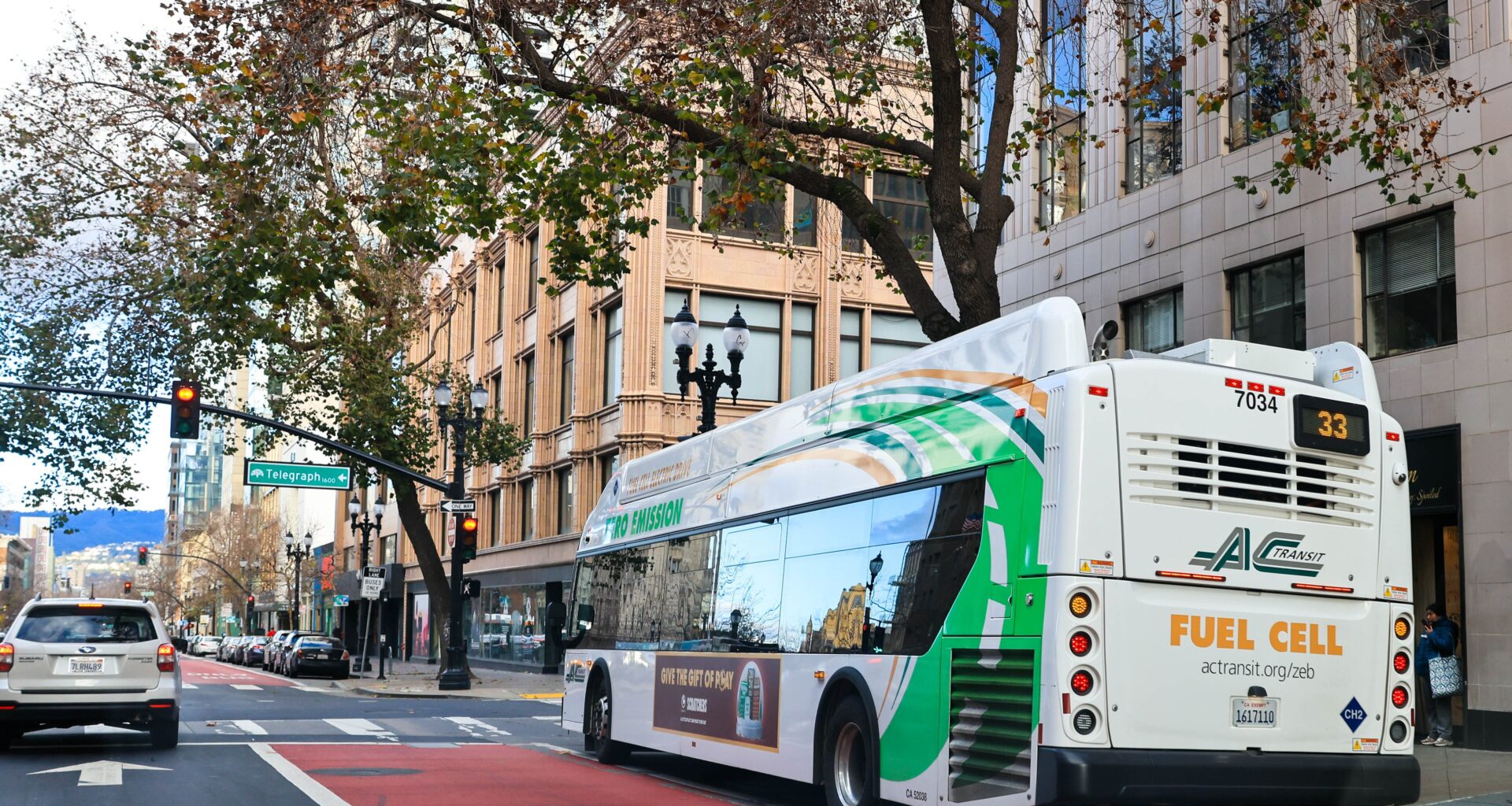
Should voters reject the Regional Transit Measure on the November ballot, AC Transit could cut as much as 16% of its services next year, including the elimination of Transbay routes and curtailed riding schedules, according to a contingency plan presented to the public on Wednesday.
During two separate meetings, the bus agency examined the proposed elimination of numerous local lines, and all-nighter and weekend routes in order to address a potential budget shortfall – services that largely impact those that are most vulnerable.
“What’s really shocking is when you tell them who AC Transit is and who the riders are,” said AC Transit Ward 1 Director Harpreet S. Sandhu. “Three-fourths are people of color, two-thirds are low-income, and 65% who don’t have another way of getting around without AC Transit.”
Projected to receive just under $50 million per year from the Regional Transit Measure, AC Transit faces a structural budget shortfall in excess of $40 million through the rest of the decade, according to the agency. Like other Bay Area transit agencies, the shortfall is due to the sunsetting of pandemic-era relief funds, operating costs rising faster than revenue and a ridership volume that has failed to return to historic averages.
Funding for AC Transit largely consists of local, state and federal dollars. Just 6% of funding comes from bus fares, down from 12.6% in 2019, according to the agency.
Proposed line cuts
Facing a fiscal cliff, AC Transit has created a contingency plan if the Regional Transit Measure is unable to provide a boost to its funding.
All weekend service on Transbay lines – Line F, NL, and O – would be canceled, affecting connections to Salesforce Tower in San Francisco from San Pablo, Berkeley, Alameda and the Eastmont Center in Oakland.
“I disagree with the idea of eliminating all your Transbay services on the weekend,” said Mark Aguilar, a former AC Transit bus driver. “If we remember the ’89 earthquake, BART was the only means of getting across to work when the bridge went out. If something happened with BART, people are going to get stranded.”
In addition, Line 19, servicing downtown Oakland to Alameda Point and the Fruitvale BART station, and Line 46L, connecting neighborhoods between the Oakland Coliseum and the Oakland Zoo, would both be axed from the network. Both have consistently low ridership, according to AC Transit.
All-nighter service Lines 800, 801 and 851 would remain unchanged. But Lines 802, 805 and 840 would be dropped. The agency would offset the losses with 4 a.m. starts on Lines 40, 72, and 73.
The local weekend Line 251 would also be eliminated.
Reduced hours
Under the contingency plan, most standard local routes that currently operate from around 5 a.m. to 12:30 a.m. would see operating hours reduced to 6 a.m. to 10 p.m.
More severe cuts would affect central and south Alameda County and western Contra Costa County, where late-night service would be lost on Lines 211, 216 and 231. Lines 200 and 210, connecting south Alameda County between Union City and Fremont, would see operating hours reduced to 7 a.m. to 10 p.m. across the entire week.
Many low-ridership routes connecting neighborhoods in the hills and suburbs to major lines would face shortened schedules and less frequent stops. Routes that currently transfer passengers between 6 a.m. and 11 p.m. would see hours pulled back to between 7 a.m. and 7 p.m.
Local core routes in central Alameda County – Lines 6, 40, 57, 72M – which currently begin around 5 a.m. with the last pickup around 1 a.m., would see a service cut of 40%.
“My other concerns are people who go to college at night, such as the 54 to Merritt, the 60 to Cal State Hayward and Chabot, and the 97,” said Clarence Fischer, an East Bay resident who spoke during public comment Wednesday. “If something could be ensured that students who take night classes could get home from Merritt, Chabot and Cal State East Bay.”
Some of the primary bus routes would remain largely unchanged, including Lines 1T, 51A, 57, 72L and 72M. Many weekday routes along the highest ridership corridors would preserve weekday frequency of 15 minutes or better.
If voters reject the Regional Transit Measure, AC Transit’s contingency plan would go into effect by June 13, 2027.