
The New York Knicks begin defense of their NBA championship against the Philadelphia 76ers on Tuesday in a matchup for the ages. And I’m not saying that because the game’s oldest player, LeBron James, will be on the court. I’m saying that because Madison Square Garden is the game’s oldest building.
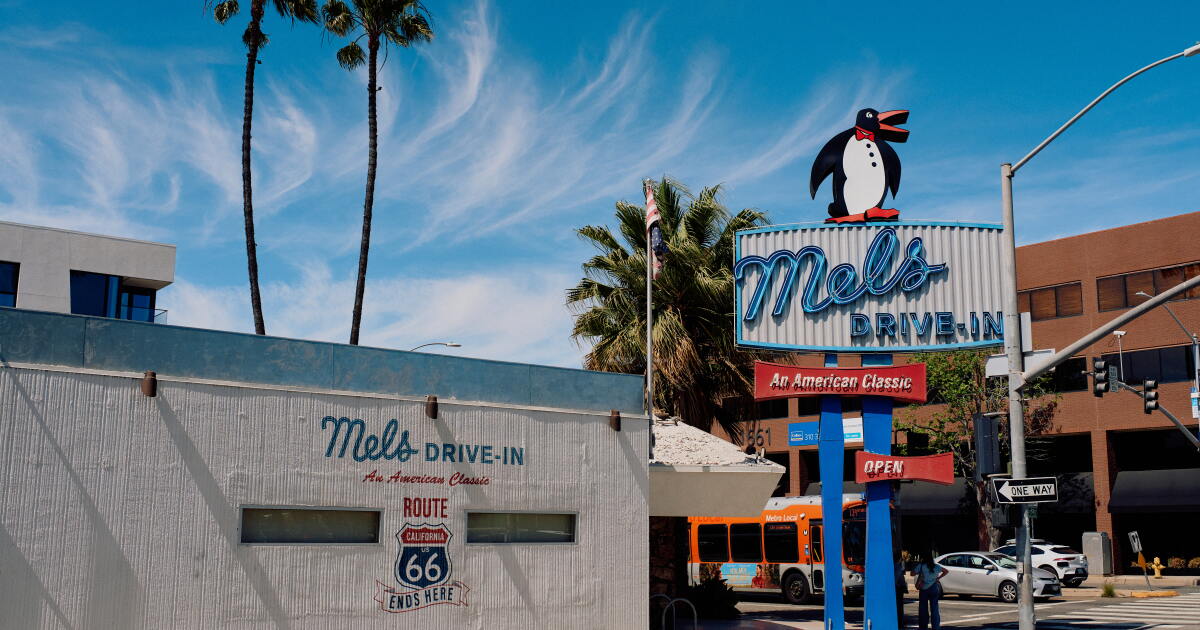
Opened in 1968, the arena is in superposition. That is to say it is decaying physically and undecaying in the city’s heart. In NBA folklore this is “The Mecca” — but how many more people would attend and spend how much more money if the Knicks played in a modern venue? By today’s Intuit Dome standards, keeping the team in a 60-year-old building is leaving a lot of money on the table. Money, after all, is why the Chicago Bears are considering leaving the century-old Soldier Field, for a new spot in Hammond, Ind. And money is why ValueRock wants to knock down Mel’s Drive-In to build an eight-story apartment building.
Since 1959 — before the Knicks moved to the Garden and before the Bears made Soldier Field home — the midcentury design of that diner has meant the end of the westward drive on Route 66. For a lot of people, that’s a “Who cares?” For many others, like the preservationists pushing to save Mel’s, the mere thought of demolishing the iconic restaurant is offensive. Eating there was certainly on our bingo card when my son and I first drove across the Southwest decades ago, and it continues to be a favorite breakfast spot of ours. My family is not the only one that adores this slice of Americana, as proven by the steady stream of locals and travelers who still dine there.
I’m sure the area could use the 138 apartments ValueRock is promising (provided they’re affordable), but what does the legend of Route 66 get out of the deal? Because when you are the steward of an iconic landmark, bricks and mortar represent only a fraction of the upkeep. There is also a relationship with the community that must be not only maintained but also respected.
When the company bought the property six years ago, it seemed like a happy marriage, with leaders saying they understood Mel’s to be “a historical landmark within the community.” Now, they’re ready to leave Mel’s for something younger with first-floor retail space. And like most divorces, this one is headed to “court.” Or in this case, a December hearing with the Santa Monica Landmarks Commission, as area conservancy groups push for a historic designation for Mel’s.
There is an argument to be made that keeping a restaurant open for “old times’ sake” is stupid. The house I grew up in, as well as the elementary school and high school I attended, are all gone, yet I’m still 100% Detroit. Do you really need a building to feel connection? No. But my hope is that the decision regarding Mel’s is driven not by what is most profitable but by what is most enriching.
If the owners of the Knicks were driven solely by money, the franchise would have moved to an arena where high-price suites would turn the team into even more of a cash cow. But then again, they would no longer be playing in “The World’s Most Famous Arena.” It’s a trade-off that can’t be entirely quantified or even identified by our five senses. For those who are not attuned to the spirit of a community, it’s easy to miss the invisible aspects that hold it all together.
Moving the Chicago Bears to Indiana may increase the bottom line for owners, but it can’t replicate the laughter you hear walking along Lake Shore Drive to get there on Sundays. That is its own kind of value. Just like watching the Knicks at the Garden or eating a stack of pancakes at Mel’s. The difference between nostalgia and foundational can’t be found on a spreadsheet. Just as a house in and of itself does not make a home, it takes more than housing to make a community.
And it takes more than money to make a person rich. When you own a team like the Knicks or the Bears, when you are in charge of beloved spaces like Mel’s, that understanding isn’t part of the deal.
That is the deal.
YouTube: @LZGrandersonShow
Insights
L.A. Times Insights delivers AI-generated analysis on Voices content to offer all points of view. Insights does not appear on any news articles.
Viewpoint This article generally aligns with a Center Left point of view. Learn more about this AI-generated analysis Perspectives
The following AI-generated content is powered by Perplexity. The Los Angeles Times editorial staff does not create or edit the content.
Ideas expressed in the pieceThe column argues that Mel’s Drive-In matters beyond its commercial value: as a Route 66 landmark and a gathering place, it helps sustain a community’s shared identity and history.By comparing Mel’s with Madison Square Garden and Soldier Field, the piece contends that places can hold a value that profit calculations do not capture. The author acknowledges that housing is needed, but argues that redevelopment should not be driven solely by what is most profitable.The column supports weighing preservation alongside new housing, rather than treating the choice as simply keeping a diner or building apartments. The conservancies likewise say landmark status could protect the diner’s defining features without ruling out housing on the site.[2][3]Different views on the topicThe redevelopment case is that the property could serve a different community need: ValueRock’s preliminary proposal would replace the diner with an eight-story mixed-use building containing 138 apartments and ground-floor retail.[1][2]From this perspective, preserving the existing building should not automatically take priority over adding homes. The project remains at an early stage, however, and the city says no demolition permit has been filed.[2]The choice may not be all-or-nothing: ValueRock has said it is open to a compromise, and the conservancies say landmark designation would allow housing while requiring review of how development treats the site’s historic features.[2]