
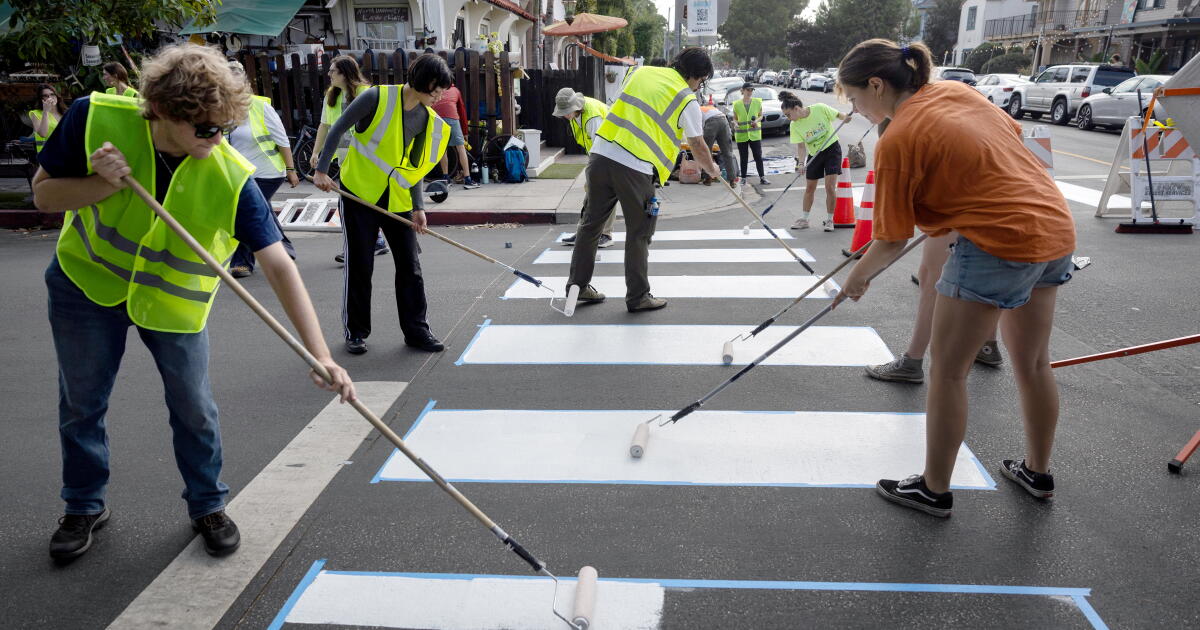
At an intersection in Hyde Park that, days earlier, had been the scene of chaos — a young girl on the ground, a car with a teenage boy on the windshield, a mother screaming — Jonathan Hale led his band of rebels. They were armed with paint rollers.
What they were doing on a recent Sunday was illegal — an act for which Hale has previously been arrested. In a neighborhood touched by tragedy, where residents say speeding is rampant, they painted crosswalks without permission.
The previous week, they’d done similar work at West 30th and Orchard streets in South Los Angeles. Clad in bright yellow construction vests, the group of about 40 illegally painted thick white continental crosswalks at the spot where neighbors had created a canopy of hanging sneakers. In less than two hours, the group’s work was done; there were fresh crosswalks where previously there was a single faded stop line.
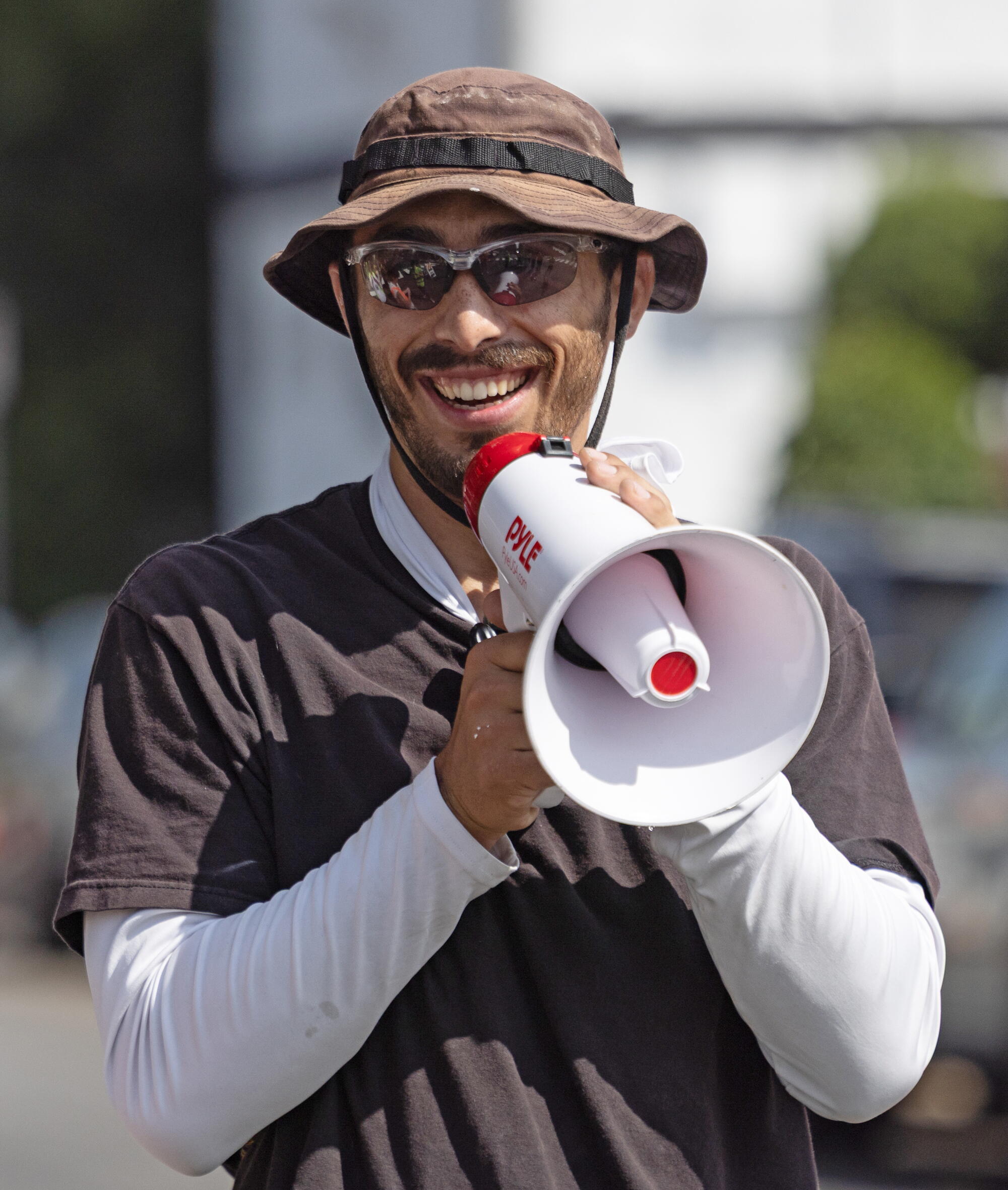
Jonathan Hale uses a megaphone to thank the volunteers who helped paint crosswalks at an intersection near USC in September.
For Hale and his group, known as People’s Vision Zero, the work was an improvement and long overdue in a part of Los Angeles where cars hitting pedestrians is an all too common occurrence.
With his unwavering commitment to refurbishing without permission, Hale has been portrayed by local and national media as a “vigilante,” a “guerrilla” activist and a “street safety activist” since fall 2025.
According to Hale, he hasn’t donned any kind of mantle. The 26-year-old Bay Area transplant says he sees the work as necessary.
“The city of Los Angeles hasn’t made public safety and safer streets a priority, and we can’t wait any longer,” Hale said. “So it’s up to us, to regular people, to finish that work with or without the city’s help.”
Meanwhile, the city’s Department of Transportation says it has tried to work with Hale and, having met with him, “delivered on all commitments” to street repainting. Whether authorities will try to stop him as he pursues his mission — painting that officials have said isn’t in line with rules — is unclear.
Activist from a young age
Hale grew up in Los Altos, an affluent Bay Area suburb between Palo Alto and San José, but said he and his family eschewed many upper-class values of their neighbors, including embracing “exclusionary zoning policies” and avoiding public transportation.
In Hale’s teens, an adult leader of his Boy Scout troop spoke out against the creation of a bus lane.
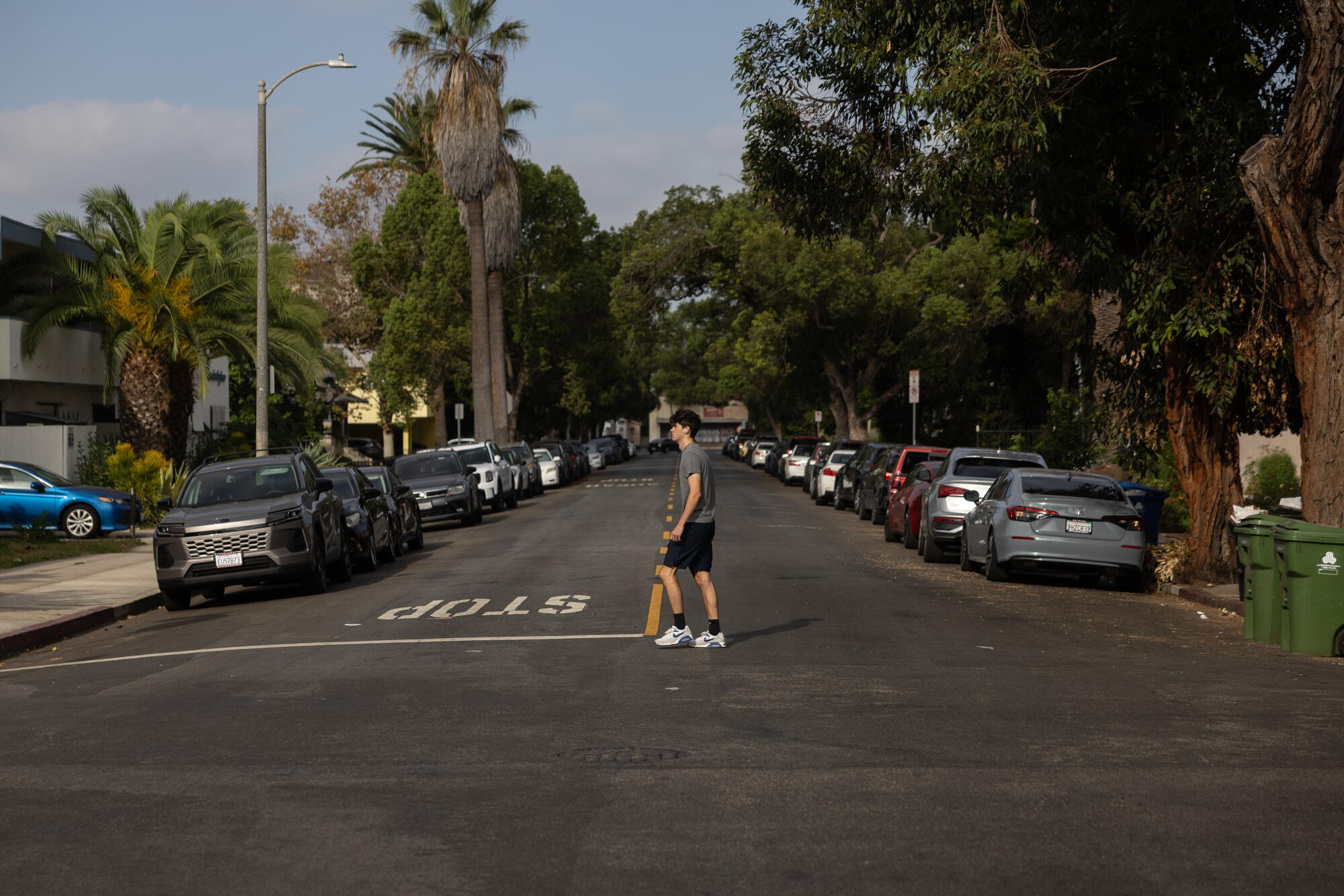
A pedestrian crosses an intersection near USC later targeted by the crosswalk-painting crew People’s Vision Zero.
Hale loved the Valley Transit Authority Bus No. 522, which he rode when commuting from Los Altos to his San José high school, Bellarmine College Preparatory. He wore 52 on his football jersey in honor of the bus line while playing for Bellarmine.
“I had really admired this guy because he was a civic guy,” Hale said. “Then when I asked him about the bus, he said, ‘No one takes the bus’ and he would prefer more parking. I just thought about how unfair that was.”
Hale later showed his budding activist bent, and made news locally, when he and a few teammates took a knee during the national anthem in the fall of 2017, about a year after San Francisco 49ers quarterback Colin Kaepernick put the gesture in the national spotlight.
Shaped by his time in Oakland 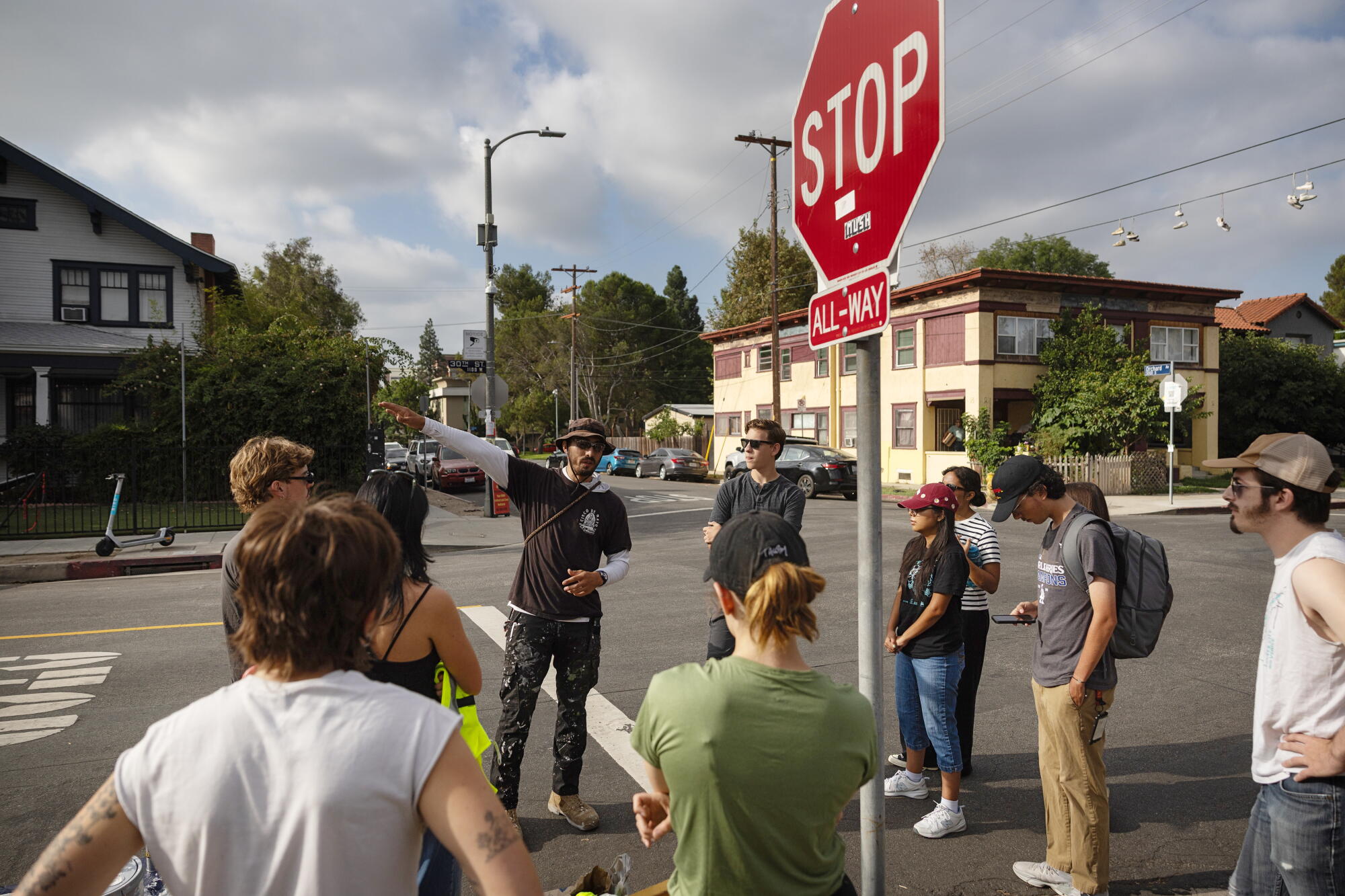
Jonathan Hale gives directions to his group of volunteers near USC in mid-September.
Hale graduated from UC Berkeley in 2022 with degrees in philosophy and psychology as well as an interest in journalism, having served as a photo editor with the student newspaper, the Daily Californian.
Perhaps he would have continued in journalism if not for two fateful years living in Oakland. He moved to the city from nearby Berkeley his final semester in college.
Hale said he shared a large Victorian home in a gritty part of town with “a bunch of dudes.” There, he met liked-minded friends who commuted everywhere and loved martial arts (another passion).
He also dipped his toe in freelance photography and content creation, while watching and learning from guerrilla activists and tactical urbanists who pressured Oakland city officials for quicker permitting and processing of crosswalk and street-sign repainting.
“I didn’t get involved at the time, but I studied what worked and their impacts,” he said.
Another incident that Hale said affected his worldview occurred in October 2022. He was involved in a hit-and-run collision when, he said, a driver made a “sudden and unprotected left turn” at a green light and slammed into him as he was riding his favorite motorcycle, a Suzuki DR-Z400SM Supermoto.
Hale said he “went flying over the hood of the car.” Although his bike was totaled, he suffered only minor injuries.
“I lucked out because I wasn’t really hurt,” he said, “but I saw again how safety isn’t optimized for people outside cars.”
The call of activism 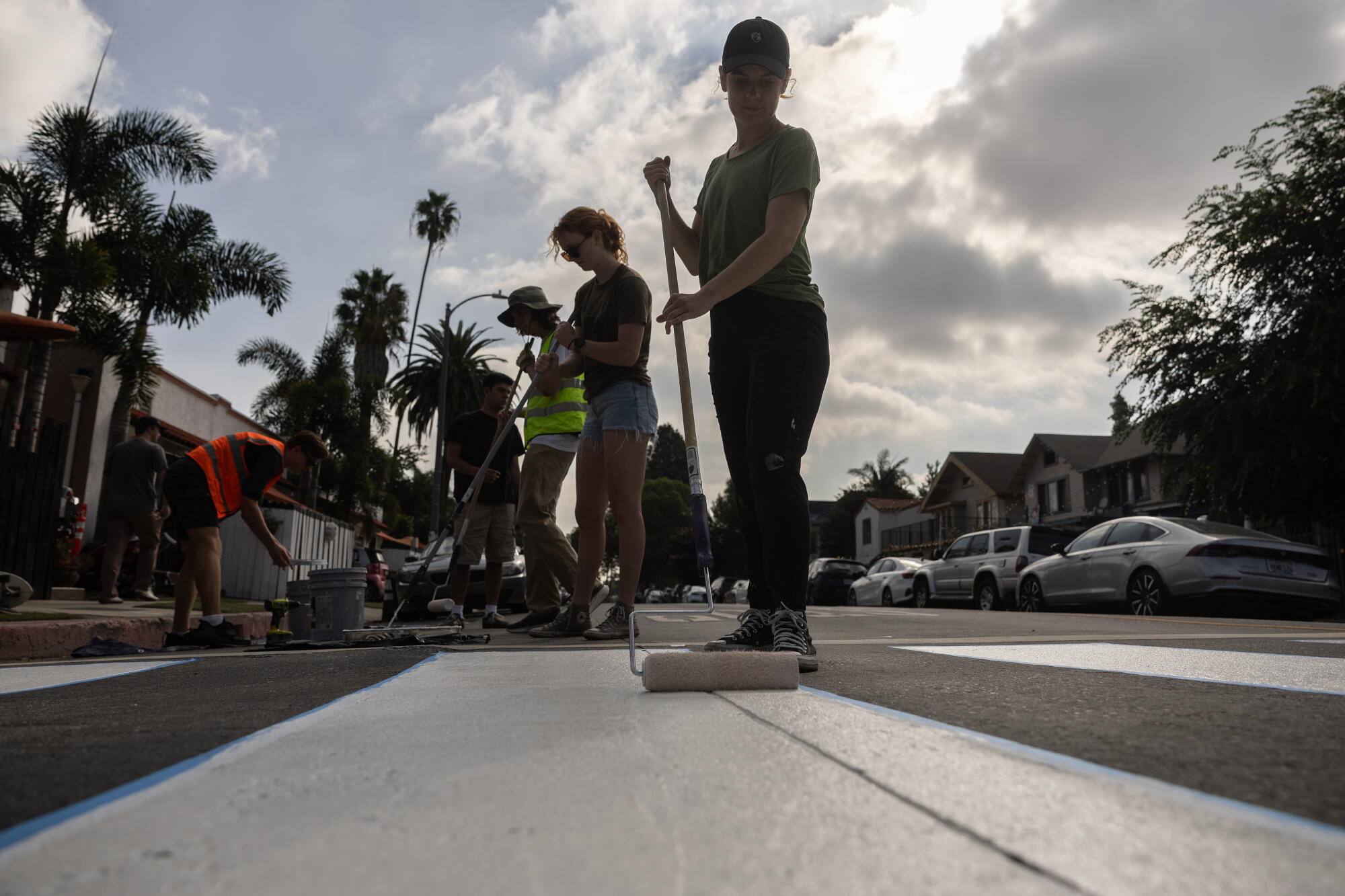
Jonathan Hale says residents have asked if his crew were city workers. He said he’s told them no, but the group was “here to help.”
Hale is now a law student, having enrolled in 2024 in UCLA’s School of Law J.D. program. He’s also a legal intern at the Inner City Law Center, advocating for more housing, better transit and better infrastructure, he said.
In late May 2025, he joined with known anonymous street-painting group Crosswalk Collective to paint faded crosswalks at Stoner Park in the Sawtelle neighborhood of Los Angeles, near where he lived, because “there were a lot of kids that would be walking to the park for its recreational facilities,” he said.
The volunteers painted yellow-striped crosswalks on “every corner adjacent to the park,” said Hale, who paid about $200 to cover the cost of the paint. He noted neighbors said that several calls to the city’s 311 service to request such a retouching had gone unfulfilled.
Although Hale was proud of the action, he was nervous about how the city would react, particularly after the story was broken by Westside Current.
His apprehension turned into anger when the city’s Department of Transportation erased the DIY crosswalks two months later.
“That’s when I was radicalized, going back to the original site and seeing it — seeing our efforts to protect the community — erased,” Hale said.
The Department of Transportation told The Times in August 2025 that the crosswalks did not comply with accessibility requirements.
The Transportation Department said then that no requests for crosswalks had previously been made at the location near Stoner Park, though the mayor’s office said that the Bureau of Engineering had received “multiple sidewalk accessibility requests surrounding Stoner Park between 2017-2018.”
Eventually, the city repainted crosswalks at Stoner Park.
The birth of People’s Vision Zero 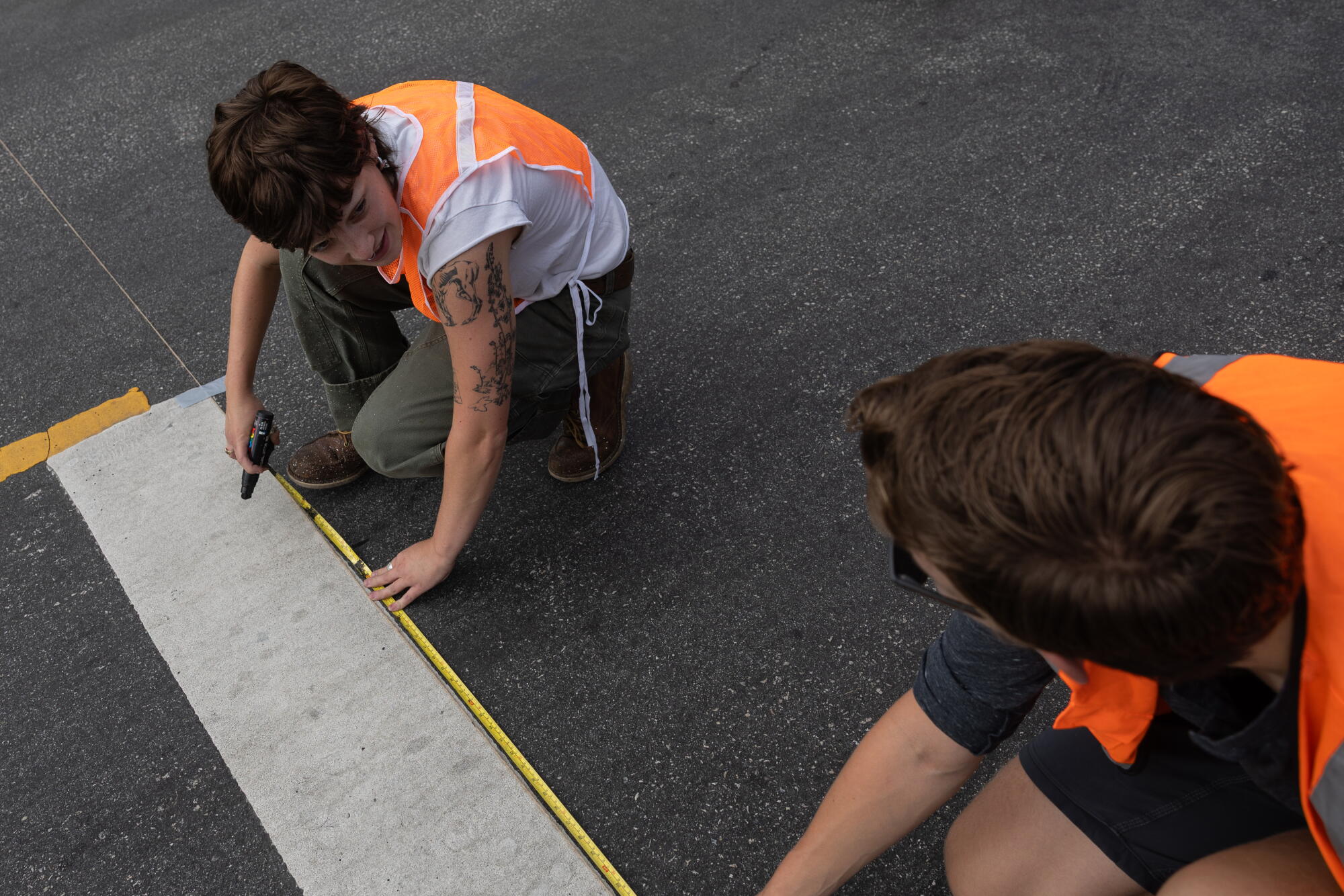
Venus, a volunteer, measures the spacing of the lines of a crosswalk in Los Angeles.
Hale founded People’s Vision Zero shortly after and rallied fellow believers on Reddit and Instagram.
The group takes its name from the city’s 2015 plan, named “Vision Zero,” to eliminate all traffic-related deaths by 2025.
Since summer of that year, Hale has led his roughly 150-person cohort of passionate and, they insist, civic-minded volunteers on a crusade to repaint and add scores of crosswalks to corners and intersections they see as dangerous throughout Los Angeles.
Some of the roughly 18 locations were chosen, Hale contends, because the city failed to respond to numerous 311 calls for improvement. Others have been at the sites of fatal collisions. Hale told NBC4 that he takes into account collision data from UC Berkeley researchers when choosing sites.
The group painted crosswalks in Koreatown in October 2025 and in Palms and Westwood in November.
In December, Hale was arrested on suspicion of misdemeanor vandalism while painting in Westwood. A social media post of the incident galvanized supporters, and the case was dismissed in January.
It was at that first November painting that 27-year-old Minnesota native and Palms resident Ceci Stratton joined the effort.
“I just had to get involved and I loved doing this,” Stratton said, “but I also immediately noticed the impact on visibility on that street. That’s why we were there.”
Street safety is deeply personal for Stratton. Her 20-year-old brother, Nate, was a junior at the University of Indiana in Bloomington when he was struck and killed by a drunk driver in September 2022 while riding his scooter back to his apartment.
“I think about my brother, his legacy and that of my family, and I want to do something to help people where I live,” Stratton said. “He motivates me now.”
Hale was one of many safety advocates who stood in front of City Hall on Sept. 15 asking L.A. Mayor Karen Bass to declare a state of emergency due to increasing traffic deaths.
At a City Council meeting that day, Damian Kevitt, Hale and several others spoke during public comment and provided an open letter that included more than 1,000 signatures to the mayor and council.
Kevitt, founder of the nonprofit Streets Are for Everyone, lost a foot in 2013 when a car hit him while he was biking and dragged him for a quarter of a mile. He noted that petitioners documented that traffic deaths rose 56%, from 186 fatalities in 2015 — the year Vision Zero was proposed — to 290 in 2025.
In 2023, traffic fatalities (336 in total, including 179 pedestrians) surpassed homicides for the first time in a decade. That trend continued for the next two years.
City officials released the results of a long-awaited audit in December 2023 about the city’s missteps in which auditors said officials had executed, by the end of that year, only about half of 56 key “actions and strategies” targeted for completion by either 2017 or 2020.
“Insufficient support from the Mayor’s Office and City Council Districts has at times limited the effectiveness of Vision Zero Program delivery,” the audit states. “The level of oversight of the Vision Zero initiative diminished over time and so has the level of enthusiasm at City Hall.”
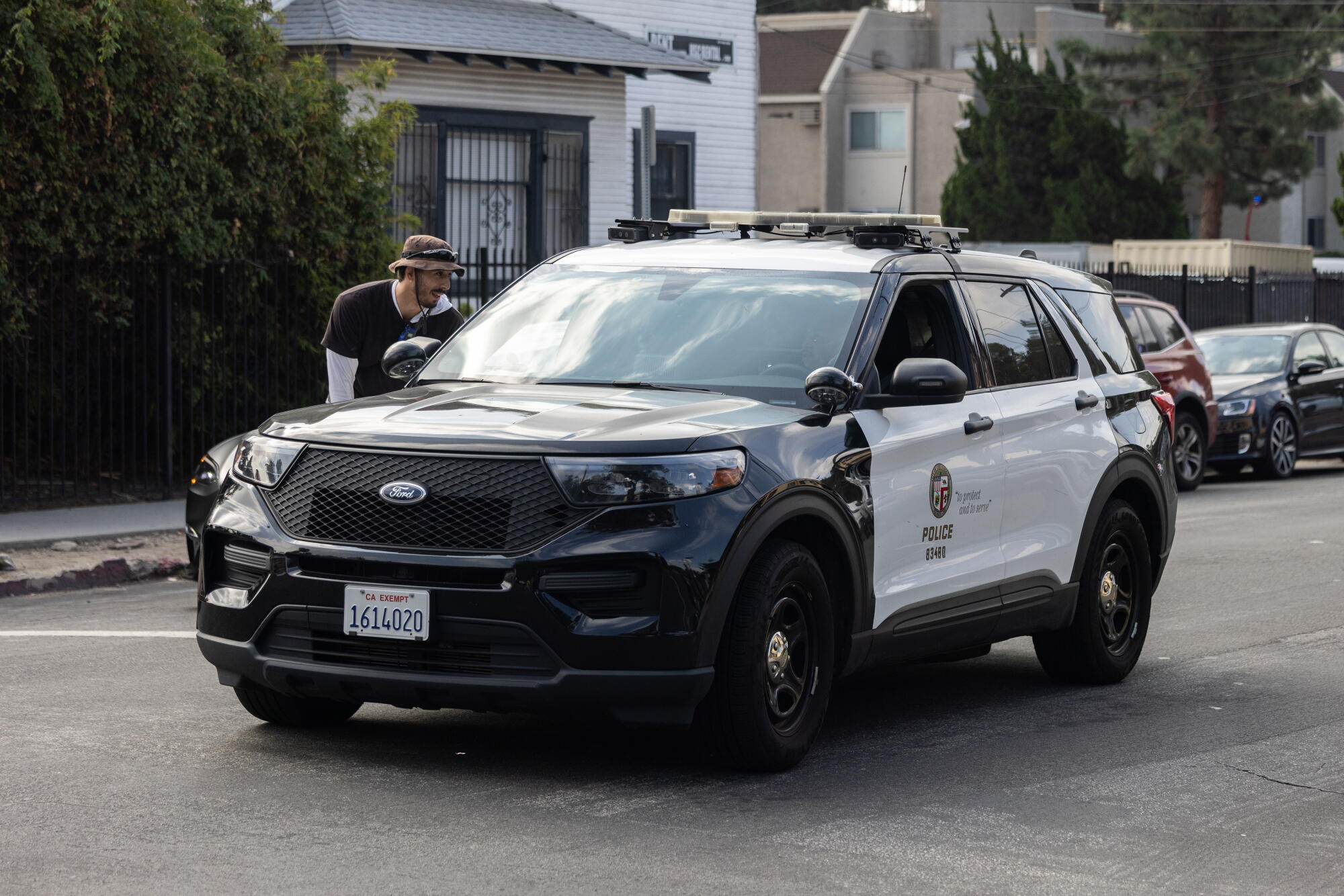
Jonathan Hale interacts with police officers during the painting project near USC. His activities have led to run-ins with police and city officials.
What Hale wants from the city
Hale provided emails to The Times in which he outlined discussions and meetings he’d had with Department of Transportation and other city officials.
In early December, he informed the mayor’s office he would paint at the intersection of Kelton and Wilkins avenues in Westwood. He was later arrested by police. Neither the mayor’s office nor the Department of Transportation responded to a question on whether they played a role in the apprehension.
The mayor’s office told Hale at the time that “all changes must go through the City’s formal review and approval process.”
Hale said he had met with officials three times, the last time being in February. He said he had two demands that mattered most to him: that the city legalize his group’s efforts and that it recommit to Vision Zero.
Colin Sweeney, a Department of Transportation spokesperson, said the agency “has met directly with Jonathan Hale on several occasions” and included him in a traffic safety advocate roundtable this summer.
Sweeney said, when it comes to painting crosswalks, “the department has delivered on all commitments it made during those discussions.”
“LADOT is committed to addressing traffic safety, including exploring new opportunities to streamline processes to better improve safety and mobility for all Angelenos,” Sweeney said in an email.
He said the Transportation Department had combated the growth in traffic fatalities by adding or maintaining more than 1,000 crosswalks every year (1,346 in the 2025-26 fiscal year).
The department, he said, also redesigned more than 20 miles of high-injury network streets — those with a concentration of traffic injuries and fatalities — on major corridors such as Reseda, Adams, Hollywood, Avalon and Venice boulevards and Figueroa Street, with projects designed to prevent severe and fatal crashes underway on major corridors including Pico, Sunset, Westwood and MLK boulevards, Broadway, Spring-Alameda and Ohio Avenue.
‘I don’t know why that’s so controversial’ 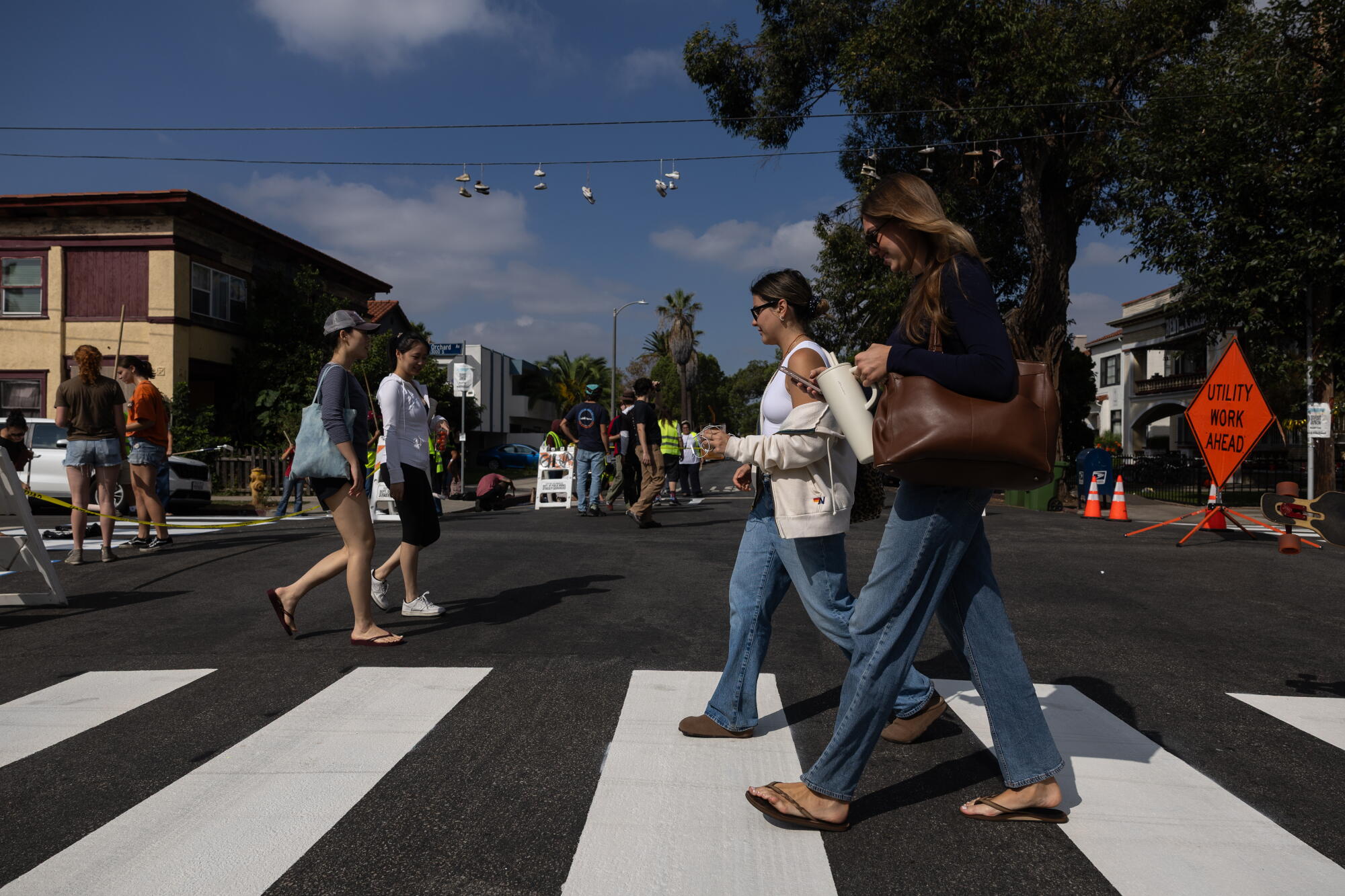
Pedestrians walk on one of the four fresh crosswalks near USC.
For People’s Vision Zero member Anthony Salazar, what the city misses with its warnings and statistics are community members who feel ignored.
“Watching people asking if we were with the city because they’ve been waiting for a long time for action was something I wasn’t expecting,” said Salazar, a 31-year-old Hollywood resident. “We had to tell them, ‘No,’ but we were here to help.”
Hale said he would continue to paint as long as there was a need.
“People can call me whatever, but I just want to promote safety and help people,” he said. “I don’t know why that’s so controversial.”