
Even with people’s modern attention span suited mostly for 15-second Instagram reels, a five hour opera can still engage and dazzle you with its enriching performance. I can attest to that.
The evening of Nov. 7 marked the fourth performance of Richard Wagner’s “Parsifal”this year, which has made its first epic re-emergence on to the San Francisco Opera stage after 25 years, under the direction of Matthew Ozawa and conduction of Eun Sun Kim.
Before the opera, the sounds of the orchestra practicing in the pit below the stage began to fill the room. I could feel almost a sense of nervousness that I was about to experience a form of art with a deep legacy. Maybe because we are accustomed to digital entertainment, we forget that live experiences bring us closer not just to the art, but the people who make it and who have contributed to it over time.
This feeling proves itself to be true in many ways — the opera, from beginning to end, holds many surprising layers.
Parsifal” is an odd story. It is gripping more because of its roots in Arthurian legend and baffling depiction of religion rather than an actually beloved story or likeable characters. It takes elements from Christianity, Buddhism, and Eastern thought to depict a cult-like society dependent on two items: the Holy Spear and the Holy Grail.
The conflict arises when the spear is stolen after the king commits a sin through giving into lust, for which he receives a perpetual wound on his side. Society falls into a state of despair, and it is emphasized that only an “innocent fool” can return the spear. Who’s the fool? You guessed it — our hero, Parsifal.
Though the narrative raises odd questions about the depiction of women, sexuality and what it means to preserve a “pure society” in opera — not to mention any seed it may hold of Wagner’s antisemitic views — the performance and production themselves left no questions about what true artistry looks like.
Brandon Jovanovich’s performance as Parsifal is thunderous. From scene one, his presence and tenor voice dominated the stage, and his acting was genuine and impassioned. Alongside co-stars Tanja Ariane Baumgartner as Kundry, Brian Mulligan as Amfortas and Kwangchul Youn as Gurnemanz, the voices that tell the story never faltered — they were filled with richness and personality, bringing unique life to their respective characters.
The orchestra transported audiences to a mythical realm highlighting Wagner’s famous leitmotifs, or musical themes for each item and character, which includes the famous “Dresden Amen” as the Grail’s theme. Wagner used leitmotifs repeatedly through his operas to train audiences to identify musical sequences and derive meaning out of them.
Robert Innes Hopkins’ set design is both artistically and mechanically impressive. The set in the first and third acts is a circular panel with different levels, each section rotating in a different direction. The hefty beams built on top are the base for the tangled tree branches that depict the German forest, and later, are the base for arches that make up the Temple of the Grail.
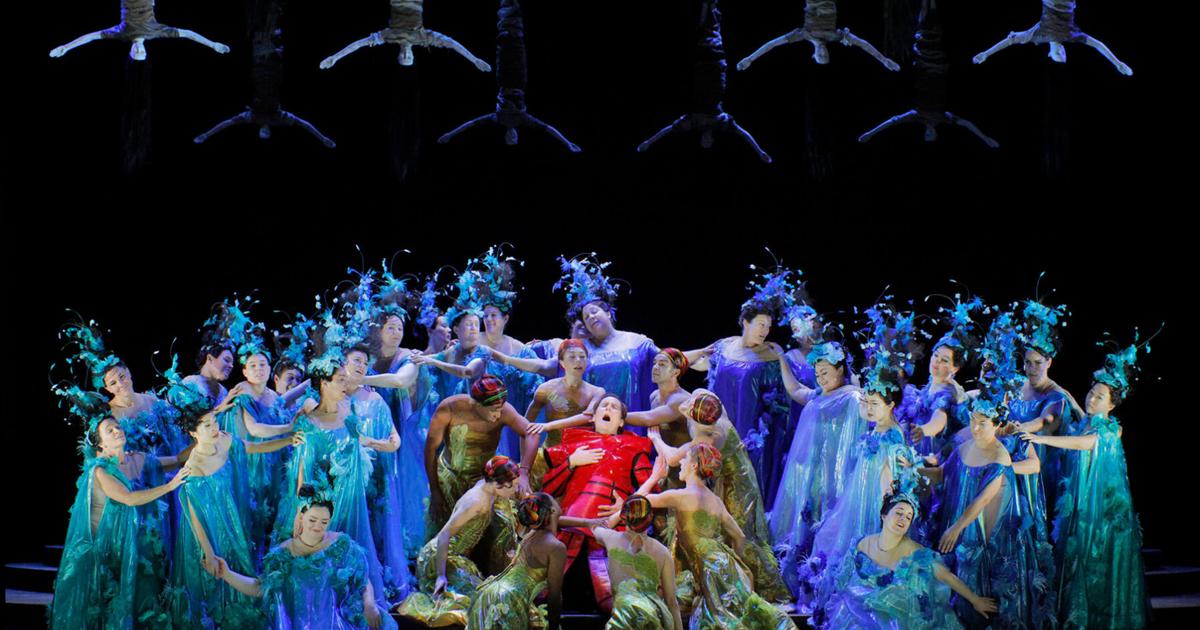
The most visually captivating designs are found in the second act. Scene two opens in Klingsor’s magic garden, overrun by flower maidens that try to seduce Parsifal. Their costumes are intricate, frilly and colorful. One specific formation is awe inducing: Parsifal in shiny fire-truck-red armor in the center, surrounded by dancers in butter-yellow dresses, who are encircled by dancers in turquoise dresses — the hues are blooming. It is almost a completely beautiful scene, if it wasn’t for the chilling touch of the artificial upside-down bodies hanging from the ceiling.
Regardless of our own taste, productions like SF Opera’s “Parsifal” are reminders that whether or not we can afford the luxury of time, we cannot afford to lose the sustenance art provides us with. Especially today, when these forms of art are most at risk, trust that after five hours in a room of world-class orchestra and opera singers, you will find something — that can probably never be found in Instagram reels — to carry with you.