
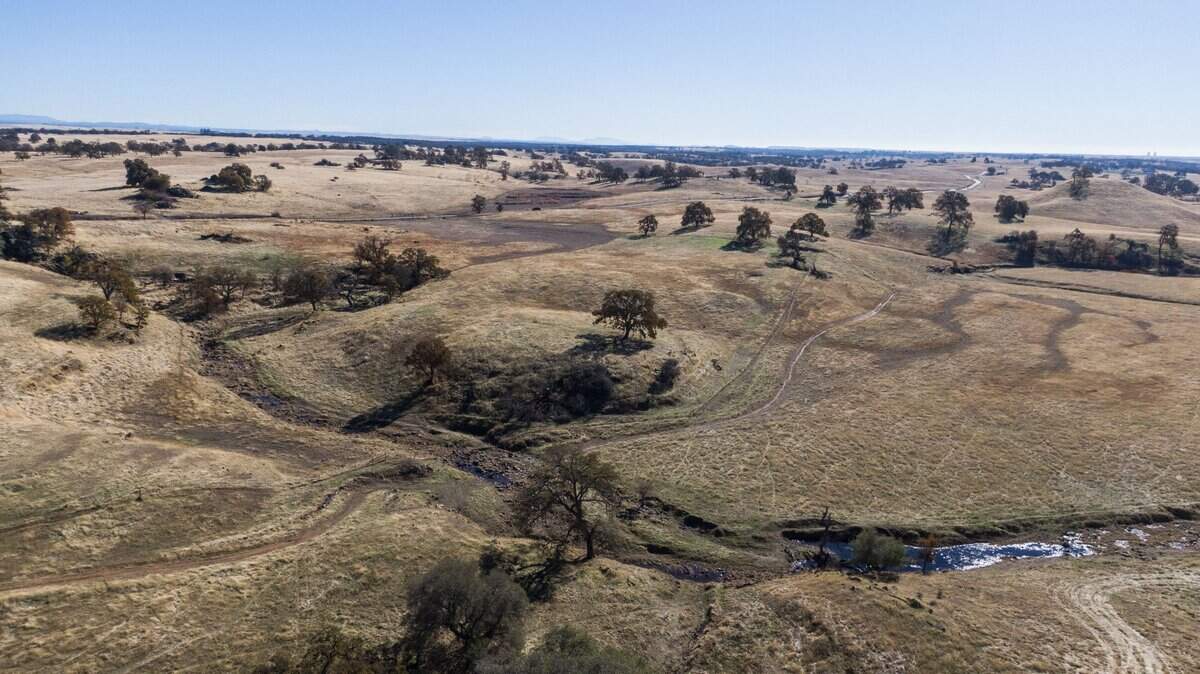
Coyote Creek flows through the rolling hills of eastern Sacramento County near Scott Road in 2024.
HECTOR AMEZCUA
Sacramento Bee file
A settlement has been reached in an environmental lawsuit over the Coyote Creek solar energy project which will allow the project to go forward but at a reduced scale, according to a representative of the environmental groups suing the developer.
The groups had sued Sacramento Valley Energy Center under the California Environmental Quality Act after the Sacramento County Board of Supervisors voted in November 2025 to approve a 1,412-acre project on the 2,704-acre Barton Ranch property.
Former Sacramento Mayor Heather Fargo, who is president of Environmental Council of Sacramento, said in a phone interview Friday that the project’s footprint would be about 20% smaller with the settlement. The settlement will also preserve around 3,300 mature blue oak trees and establish a conservation easement with Barton Ranch, which is in eastern Sacramento County near Folsom.
Click to resize
Her group joined the Sierra Club and the California Native Plant Society to oppose the project, which is being developed by Sacramento Valley Energy Center, a subsidiary of D.E. Shaw Renewable Investments.
“We would like to see the solar energy produced, so we weren’t trying to reduce the number of panels,” Fargo said. “We were trying to reduce the amount of impact.”
Requests for comment from representatives for the Sacramento Valley Energy Center weren’t immediately returned Friday.
Attorneys for law firm Nossaman LLP, which represents the Sacramento Valley Energy Center, denied many of the lawsuit’s allegations in an April filing.
What settlement means to environmentalists
About 3,500 mature blue oak trees were going to be removed with the project. Under the settlement, that number is around 200. Carol Witham, an ecologist and volunteers for the California Native Plant Society, characterized that as a win.
“Given what we were facing, I mean the sheer reduction in oak tree destruction is a major victory,” Witham said. “The increased area of conservation easement on the ranch itself is also a major victory. The improvements to the wildlife corridors and making sure that they aren’t using stuff like rodenticides and a bunch of other things on the project all contributes toward making this less of a blight on the landscape.”
Sean Wirth, conservation chair for the Mother Lode chapter of the Sierra Club, also praised the settlement.
“To have a settlement where the project is substantially better, I feel is a big win,” Wirth said. “I still wish the project was someplace else, but that’s not something that we were able to control.”
Will SMUD buy power from project?
The Sacramento Municipal Utility District announced in January that it was cancelling a 2021 deal it had reached with the developer to buy power from the Coyote Creek Agrivoltaic Ranch.
SMUD board member Gregg Fishman said the district had made the deal to buy power from the project before its environmental impacts were known. Fishman said that with the settlement in place, he didn’t know whether the developers would approach SMUD again.
“It’s something that I would be in favor of at least considering and looking at, depending on what the price was and again assuming that they have all of the potential legal challenges settled,” Fishman said.
Fargo said it wouldn’t necessarily be an issue for her if SMUD were to buy power now from the project, provided the process was public and the settlement was honored.
“I feel very settled in my mind that we did the right thing to sue and we’re doing the right thing to settle in this way,” Fargo said. “It wasn’t easy but it was important and yeah, I feel good about it.”
This story was originally published October 16, 2026 2:17 PM.

The Sacramento Bee
Graham Womack is a general assignment reporter for The Sacramento Bee. Prior to joining The Bee full-time in September 2025, he freelanced for the publication for several years. His work has won several California Journalism Awards and spurred state legislation.