
If you’d like to live near the water along the spectacular California coast at some point in your life, you have a number of options.
You can settle in, say, Culver City, which is several miles inland, and wait for rising tides to arrive.
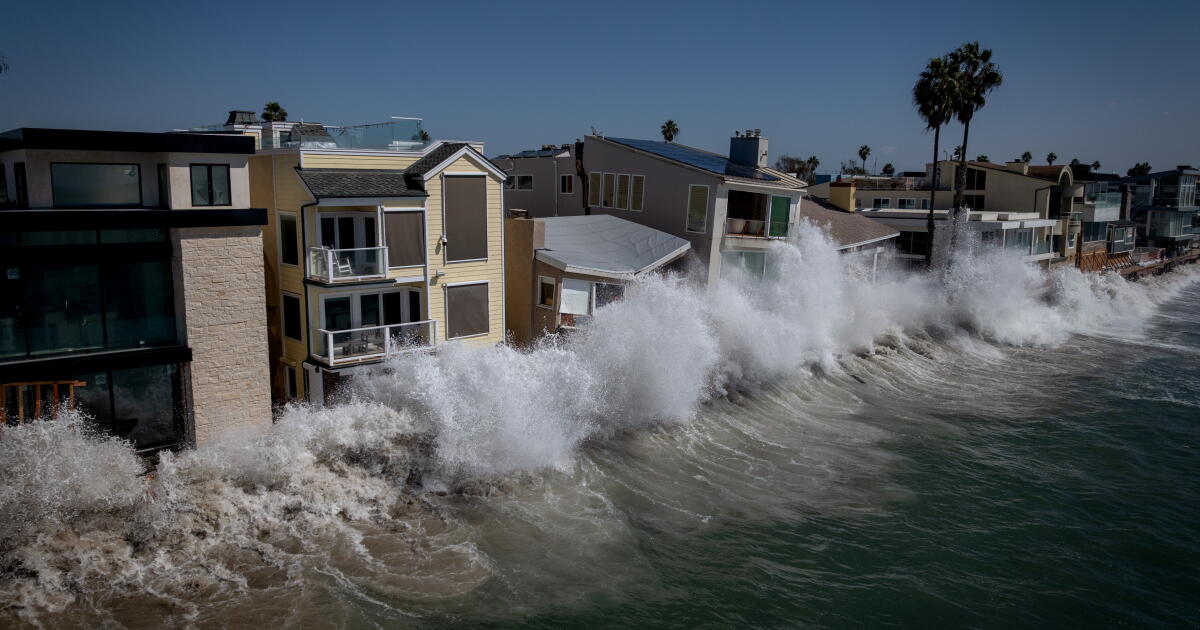
Or, if you just can’t wait that long, I saw a listing you might be interested in. It’s in Capitola, near Santa Cruz, right next to the wharf. The three bedroom, two bath, 1,850-square-foot condo, one of a string of Venetian, pastel beachfront homes, is listed for $3,995,000.
“The beach is your backyard, the cool ocean is your pool,” says the promo.
Given what’s happening right now along the California coast, you might not have to leave that condo to go for a swim. But UC Santa Cruz oceanographer and geologist Gary Griggs, who has seen the thrashing of that row of homes in previous years, is not going to make an offer.
“I’ve got a number of photos,” he said, “that show waves breaking over the top.”
Someone will buy the place, eventually, despite the chance of it becoming a fish tank. California is flush with dumb money and bad judgment, and an insatiable romance with an epic 1,200-mile shoreline.
But it’s time to rethink the relationship.
Last weekend in Long Beach I said a few words at the 50th anniversary of the California Coastal Act, which has kept our shoreline from looking like Atlantic City or Miami Beach by balancing sensible development with conservation and public access.
“The coast is never saved, it’s always being saved,” I said at the 50th, borrowing as I often do from the late Peter Douglas, hammering home the need for constant stewardship, from one generation to the next.
But in an ironic twist, part of the parking lot was underwater, a tractor had raised a berm to hold back the ocean, and just to the south, homes were being thrashed by waves. The coast wasn’t being saved, it was being reclaimed by the sea.
From there I headed south for a friend’s planned birthday party on the sand in Newport Beach, but city streets had been flooded and beaches were closed. The party was moved indoors.
We have not seen the worst of it, with a fall forecast that includes the possibility of an epic Super El Niño that could coincide with king tides, Kelvin waves and a peak lunar nodal cycle, all of which my colleague Rosanna Xia laid out a couple of days ago.
It’s not going to rain hammerheads and sea horses, I don’t think, but coastal destruction could be dramatic.
“We’re likely going to break a number of water level records,” said Timu Gallien of the UCLA Coastal Flood Lab. “It’s not implausible to see some of the piers wiped out, or breakwaters or jetties.”
“This is a glimpse of our future,” said former California Coastal Commission Director Jack Ainsworth. “This is it. It’s here.”
Some low-lying communities have been warned for years to prepare for rising sea levels, Ainsworth said, but have put off the inevitable.
In some areas, the only sane maneuver is what’s called “managed retreat,” meaning relocation of structures farther inland. But that is fraught with legal and political challenges and resistance.
Look, if you want to live on the sand and can afford to do so, good for you. But the general public should not be on the hook for your losses. Along the entire coast, public infrastructure that we all benefit from is under threat, including roadways, parks and railroad tracks, and that’s where any public investment ought to go.
Among the tools available are sand berms, cobble berms (sand on top of small stones), jetties, dredging and relocating sand, and below-surface breakwaters. Living shorelines, such as those along the Orange and San Diego county coasts, involve piling sand atop boulders or smaller stones and covering the berms with vegetation.
But these projects don’t happen overnight, Gallien said. “Right now we’re seeing reactive responses. OK, let’s throw up some sandbags and plywood.”
Kelsey Ducklow, coastal resilience director for the Coastal Commission, said the agency has awarded millions in grants for local planners to study the threat to their communities and come up with plans. Some locales are further along than others, Ducklow said, but there’s no single strategy that will work everywhere, and one typical response is, “Yeah, we know we need to do something. But where’s the money to do it?”
The three choices we have are mitigation, adaptation and suffering, Griggs said. We’re likely to do some of each, but on the mitigation end of things, sea walls, rock revetments and armored cliffs are temporary fixes.
“In the long run, there’s nothing we can do to hold back the Pacific Ocean,” said Griggs, 83, who has been teaching for 59 years. “Everything we do is a Band-Aid, and comes with different price tags and lifespans.”
Griggs was featured in Xia’s award-winning book “California Against the Sea: Visions for Our Vanishing Coastline,” which explores the impact of sea level rise and community responses that range from denial to respectful intervention.
Precious ecosystems are under threat, Xia wrote, “trapped between rising water on one side, pavement on the other.” And multiple Southern California beaches that are “so deeply tied to the state’s heart and soul” could be lost.
I asked Xia what she thought about the rising threat this year.
“So many people think about the coast as a place — a place that doesn’t move,” she said. “But the coast in reality is a living dynamic process that changes every time a wave crashes ashore. That’s the heart of the issue — we’re fundamentally trying to impose permanence onto a space that is meant to be constantly changing.”
We haven’t been the best stewards of the planet, and maybe what’s happening now is a bit of a reckoning. From the first time I saw the California coast as a young lad on vacation from the hot interior, I think I understood that the truest way to love the sea was to fear and respect it.
I now have more fear and more respect.
And maybe, too, a deeper love.
steve.lopez@latimes.com