
Operation Yellowbird, the Umbrella Movement, and the dissidents of Hong Kong. Did you know LARB is a reader-supported nonprofit?
LARB publishes daily without a paywall as part of our mission to make rigorous, incisive, and engaging writing on every aspect of literature, culture, and the arts freely accessible to the public. Help us continue this work with your tax-deductible donation today!
This essay is a preview of the newest issue of our print journal, the LARB Quarterly, no. 50: Scene, out now. Become a member for more essays, criticism, poetry, fiction, and art—plus the next four issues of the Quarterly in print.
¤
ON THURSDAY, JULY 30, 2020, I fell asleep to reruns of Law & Order. At four the next morning, my phone rattled against the metal file cabinet that doubled as my bedside table. I tried to ignore it, but it buzzed relentlessly. Nobody calls at four in the morning to say everything is fine.
I had woken up a fugitive. Hong Kong authorities had issued arrest warrants for me for “inciting secession” and “colluding with foreign powers,” phrases so elastic and theatrical that they seemed to belong to another century. Conviction on either charge carried a possible life sentence.
Messages. Screenshots. News alerts.
One friend wrote: “You are not in Hong Kong right now, are you?”
One reporter demanded, “Call me immediately.”
Another sent only a link to the front page of Ta Kung Pao, Hong Kong’s largest pro-Beijing newspaper.
Outside my apartment, the horizon was dark, though Los Angeles was already awake. While coffee dripped, I paced barefoot in my kitchen and reread the news story, as though refreshing the page enough times might somehow load a different headline. Emails and DMs flooded in, along with the Uber Eats receipt for the forgettable Thai food I’d ordered the night before and a cheerful reminder about my upcoming dentist appointment: “Text ‘C’ to confirm.” They would have to wait. Besides, prison comes with dental care.
Eventually, caffeine and muscle memory kicked in. I had dealt with this kind of news before. I opened my laptop to cross-reference news reports online, as though the story were 133 about someone else entirely. But there I was on the front page. Not the most flattering photo, but it did make me look much younger. I checked whether they had gotten my name and age right (they had).
Exactly a month earlier, on June 30, I had stayed up late waiting for the text of Hong Kong’s new national security law to appear online. The law had been drafted in Beijing in secret. No one in Hong Kong—not legislators, lawyers, or the public—had seen it. It would be unveiled only after it had already gone into effect. This was Beijing’s answer to the mass protests that had erupted the previous summer over a proposed extradition bill that would have allowed Hong Kong residents to disappear into mainland China’s courts. The law allowed ordinary acts of speech, protest, association, and publication to be prosecuted as “secession,” “subversion,” “terrorism,” or “collusion with foreign organizations.”
Once it appeared, I texted my legal counsel: “How do you think this affects us?” “Well,” they replied, “if you keep reading to Article 38, I think they wrote this for you.” This particular article stated that these laws applied to anyone “outside the Region,” as well as a “person who is not a permanent resident.” They had essentially proclaimed planetary jurisdiction. I was admittedly flattered. Not many people have a law drafted for them personally. Is this what it feels like to be wanted?
The geometry of my world had changed overnight, and yet, that morning, there were no knocks at the door. No sirens outside. I found that, despite my changed circumstances, my own body betrayed me with its commitment to routine. I brushed my teeth. I checked the baseball scores. I thought about going back under the still-warm sheets.
My parents sent me away in 1990, believing that distance would mean safety. They stayed behind in Hong Kong, and I grew up in the United States. This was a way to let me choose my own future. But now, distance seemed to mean very little. What they wanted me to escape had found me.
¤
Dissent was a family occupation. I was not the first Chu to be named a criminal. In 2017, a WhatsApp message woke me with the news that my father, Reverend Chu Yiu-ming, had been arrested. Facebook messages popped up, offering the requisite thoughts and prayers. I stared at the glowing screen in the darkness, trying to understand how something so enormous could arrive with such mundane intimacy and tiny font. The charge? “Conspiracy to commit a public nuisance.”
My father’s arrest was not a surprise. He had first fled communist China as a boy and then spent his childhood ricocheting between church families, borrowed beds, rooftop settlements, and relatives. Stability arrived in fragments: a meal here, a mattress there, a shopkeeper willing to hire him temporarily before casually explaining it was time to move again.
He had traveled to Tiananmen Square in May 1989 at the height of the student protests. He told me about how he had walked along Beijing’s Chang’an Avenue, the Street of Eternal Peace, on June 3, 1989. Loudspeakers crackled wildly between the communist anthem “The Internationale,” the Cui Jian rock ballad “Nothing to My Name,” and Beethoven’s Ninth Symphony. The freshly erected Goddess of Democracy stood facing Mao’s portrait across an endless encampment of sleeping bags, bicycles, cigarette smoke, watermelon rinds, and young faces convinced it was their duty to be there. That night, the tanks rolled in. Those who escaped the massacre scattered into train compartments, warehouses, factory dormitories, and the improvised geography of hiding. Protesters became fugitives overnight.
As far back as I can remember, freedom and fugitivity often traveled together. When I was 11, I spent countless late nights and lazy afternoons in rented homes tucked deep inside the New Territories, neighborhoods usually reserved for vacations, weekend family bike rides, barbeques, and endurance hikes. My playmates were university students six or 10 years older. We were instructed to keep conversations short and spare, and we were not permitted to wander beyond the invisible boundary marked by the house’s awning. Adults worried that neighbors might begin asking questions. None of us were on vacation.
The houses and visits were part of Operation Yellowbird, which my father co-founded. This was a sprawling underground network that moved student leaders and dissidents wanted by the Chinese government across the border and into exile. They were smuggled through fishing villages, often by accomplices who knew only their portion of the journey. The people behind Yellowbird made for an unlikely cast: my father was joined by a business mogul, a Cantopop singer, and Szeto Wah—the gruff, chain-smoking head of the teachers’ union, who was affectionately known as “Wah Suk,” or “Uncle Wah”—as well as many others who still remain nameless.
After Tiananmen, many Hong Kongers began arranging backup lives elsewhere. My father did the same. He was lucky—British officials arranged for him (but only him) to receive a British passport. Whether this was intended to protect him or merely spare the colonial government from future embarrassment remained unclear. The rest of the family was left exposed (in my family, staying alive has always required complicated division and subtraction). The passport was simply an insurance policy. My father never intended to leave Hong Kong.
And remarkably, he didn’t. My father was 73 years old when he surrendered himself to the Hong Kong police, still recovering from the intestinal surgery that had nearly killed him. It was a moment we had waited years for. In 2013, he launched Occupy Central alongside Benny Tai, a constitutional law professor, and Chan Kin-man, a sociologist: this was a campaign demanding that Beijing honor its promise of genuine universal suffrage in Hong Kong. Eighteen months later, after Beijing foreclosed the possibility of meaningful elections, hundreds of thousands of people took to the streets in what became known as the Umbrella Movement. I joined them the first night police met the peaceful masses with tear gas canisters, rubber bullets, walls of tactical shields, and batons. Strangers passed around face masks, umbrellas, and bottled water, everyday objects repurposed as protection and treatment for exposure. Pill-shaped black cartons tumbled through the air into crowds of suit-and-tie office workers and teenagers in school uniforms. Advance and retrieve. Rinse the eyes and repeat.
As the peppery haze dissipated into the harbor, what had begun as a temporary occupation settled into a standoff after the government refused to engage with the demand. No one expected days to turn into weeks, then months. By that point, traffic lanes were filled with tents, handwritten signs, and supply stations stacked chest-high with bottled water and instant noodles. Underpasses morphed into makeshift study halls where students pored over homework beneath headlamps late into the night. Every morning, volunteer crews appeared in bright yellow vests carrying their brooms from home to sweep the pavement and sort recycling into neat piles. Strangers slept shoulder to shoulder, the day’s trapped heat rising from the asphalt long after midnight.
Outside the Legislative Council building, thousands of rainbow Post-it notes, hand-drawn illustrations, emergency numbers, and love poems accumulated into the Lennon Wall, a sprawling living archive of longing and opposition. New extensions multiplied overnight, tracing the contours of concrete walls and crawling across staircases, pillars, tunnels, and uneven public surfaces not originally designed to hold anything at all.
After the first night of tear gas, we settled into the streets around the Legislative Council. Some nights, I slept on the pavement, leaning against a concrete median beside teenagers in school uniforms and office workers still dressed in crisp shirts and khakis. Standing in the middle of the growing occupation, I spent my days explaining Hong Kong to foreign reporters.
Every night, I watched the wall thicken like coral. New layers folded themselves around older ones. Empty spaces were devoured, and yet individual expressions somehow remained visible. In one section, marked with an official warning reading “POST NO BILL,” the notes carefully outlined the words rather than covering them. Self-appointed guardians of the wall sorted supplies, translated speeches, and preserved messages in sandwich bags and plastic wrap before rainstorms dissolved the ink. Spontaneous, synchronized public nuisance.
Hong Kong specializes in temporary structures that somehow manage to endure. Growing up in Hong Kong meant growing up beneath bamboo scaffolding. Entire skyscrapers disappeared behind lattices of pale bamboo poles tied together with nylon strips. Like gigantic cocoons, the casing would eventually crack open, and a new bank tower, primary school, public housing estate, or remodeled temple would unfurl. The poles clacked rhythmically as workers hauled new lengths upward. Foremen barked and cursed from the street in Cantonese while scaffolders traversed the grids carrying drills, radios, ropes, and box cutters with terrifying ease. Tourists always seemed horrified and worried about falling debris, but even under typhoon winds, the bamboo bent almost imperceptibly with the weather rather than against it.
As a child, I would spend my days looking up, watching men in rubber sandals smoking cigarettes 40 stories above the pavement, balanced on the poles. The scaffolders I grew up watching spent years as apprentices learning where the bamboo should flex, how weight traveled through overlapping intersections, how tightly nylon strips needed to be pulled by hand so entire towers could sway. From below, everything looked improvised. Up close, every intersection depended upon accumulated trust, repetition, and precision, all invisible to outsiders and novices.
Occupy Central was built with the same slow, patient scrupulousness. Long before anyone occupied the roadways in Admiralty, Causeway Bay, or Mong Kok, quieter rehearsals had spread across the city. Church fellowship halls filled night after night with folding chairs, electoral flowcharts, projector screens, half-eaten pineapple buns, and arguments stretching well past midnight. Volunteers practiced de-escalation drills. Medics rehearsed treating tear gas exposure before anyone knew whether tear gas would actually be used. Lawyers drafted civil disobedience pledges with the care of monks drawing paper talismans. Retirees debated with university students over electoral procedure and the virtue of compromise. Nearly 800,000 people voted in an unofficial referendum on how Hong Kong should choose its leaders despite cyberattacks, official warnings, and Beijing’s dismissal of the entire exercise as political theater. The state later described all this as a conspiracy. Which, to be fair, it was. There is a reason we all brought umbrellas.
¤
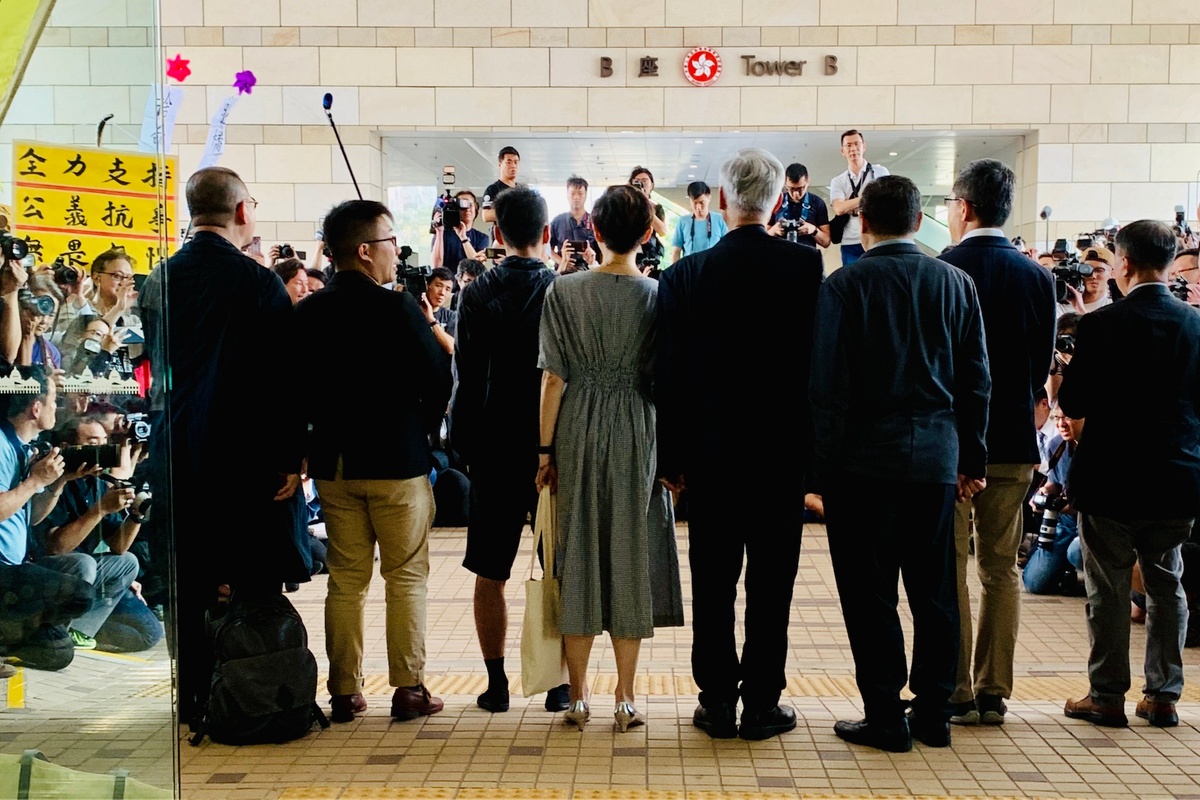
My father, Kin-man, and Benny stood trial in 2018 on charges of conspiracy to commit public nuisance, incitement to commit public nuisance, and incitement to incite public nuisance—a backhanded recognition of their capacity to turn strangers into collaborators. From the outside, the West Kowloon Magistrates’ Courts building was a featureless concrete box. Inside the courtroom, the proceedings felt suspended between empires and eras, complete with barristers wearing white horsehair wigs and using thick British accents. Clerks shuffled beneath fluorescent lights, carrying stacks of legal documents while the defendants—professors, students, legislators, a minister (my father)—lined the defendant’s dock.
The trial was the hottest ticket in town. The tabloids called them the “Occupy 9.” Hundreds lined up overnight to secure courtroom passes. The audience was tightly controlled. You could live-tweet but not read a book or fall asleep. At one point, I caught my dad whispering into the ear of one of his codefendants. They both laughed, and I wish I knew the joke.
The case unfolded with the finality of a funeral and the momentum of a wedding. The verdict had arrived long before the trial began. For the state, convictions promised closure to what had become a global embarrassment. This was an opportunity to discipline disorder, unravel conspiracy, and renumber history. And yet, the organizers understood something the state did not: courtrooms are public spaces. Every hearing created another opportunity to assemble, testify, sing, wait in line, and remind the city what had happened beneath the highways and skyscrapers only a few years earlier. My father later described that courtroom as “the most honorable pulpit” of his ministry.
Because of his age and health, my father received a suspended sentence, while Benny and Kin-man were immediately taken into custody. Outside the courthouse, scores of supporters, journalists, and diplomats gathered behind heavy police barricades as prison vans idled nearby beneath television cameras and police lights.
My elderly father broke through the crowd. There is a photograph of him running after the prison van as it drives away. His hair disheveled, tears streaking down his face, supporters reaching out to hold him back before he stumbles into the street. They had built all of this together. Now, only some of them were being taken away.
¤
I learned over the years that exile can be upgraded to immigration if you possess the means. Snakeheads (the Chinese term for human smugglers) gave way to flight attendants. Fishing vessels became jetliners.
Eventually, it was my turn. I boarded the plane with my most treasured possession: my LEGO sets, painstakingly dismantled and packed into secondhand suitcases like cultural artifacts. A family friend gifted me a top-of-the-line Sony Walkman and I cried listening to my idol, Leslie Cheung, during the 16-hour flight to LAX. Once there, we waited for hours, seated in the cavernous hall beneath a comically large American flag, before finally being waved through. I was carrying everything and yet had nothing to declare.
Patrick (not his real name), a pharmacist and a Tiananmen supporter, led the welcoming party. He had been one of the final stops in Operation Yellowbird, helping dissidents resettle after they arrived in the United States. Now he was there to receive me.
Patrick became my legal guardian until I turned 18.
¤
My arrest warrants arrived almost 30 years after my arrival at LAX.
A reporter once asked whether my father had sent me away so I could someday inherit the international front of Hong Kong’s democracy movement. I couldn’t answer that question at the time, but just days after I was named, a State Department official contacted me, needing help finding safe passage for five young Hong Kong activists who had escaped by speedboat to Taiwan after facing protest-related charges. They were being held in isolation on a military base while bureaucrats quietly negotiated where they could disappear next. They did not realize they had reached someone who grew up in the afterlife of Operation Yellowbird.

Samuel Chu with his brother and parents in Hong Kong, ca. 1986. Photo courtesy of Samuel Chu.
The coordinates had changed, but the choreography did not. Instead of relying on memorized maritime routes, the teenagers navigated by iPhone GPS. Encrypted group chats replaced code words scribbled onto scraps of paper. But once again, frightened youngsters were ferried across borders by strangers, learning to trust one another.
¤
For a long time, I had a miniature replica of the Goddess of Democracy, the statue that stood in Tiananmen Square for only five days before the People’s Liberation Army reduced it to rubble. I used to fantasize about the Central Academy of Fine Arts students who fabricated it from wire, plaster, Styrofoam, and papier-mâché. One day, you are sketching still lifes and charcoal studies in a classroom; the next, you are hauling a 10-meter monument into the center of a revolution. The students devised decoys to evade authorities, hauling pieces of the statue across Beijing on six bicycle rickshaws at dusk before assembling it beneath bamboo scaffolding in the square itself, under the eyes of Chairman Mao.
Eight years later, another monument arrived in Hong Kong. On June 3, 1997, the Pillar of Shame—eight meters of twisted human bodies stacked upward in grief and accusation—was unveiled at the annual June 4 vigil. Twenty-eight days later, Hong Kong changed hands.
The Pillar arrived because of an unlikely phone call. Jens Galschiøt, a Danish sculptor who had never been to Hong Kong and knew no one there, searched newspaper articles until he reached my father, one of the founders of the Hong Kong Alliance. Together they conspired to bring the sculpture into Hong Kong before the handover, believing it would never be allowed in afterward. After the vigil, it seemed to have found a permanent home at the University of Hong Kong, where it stood for 24 years before masked workers dismantled it in the middle of the night in December 2021.
I knew Jens only through old photographs and yellowing newspaper clippings scattered through the Alliance archives at home. Decades earlier, my father had quietly arranged for those archives to be shipped out of Hong Kong. Half came with me. The other half went to Jens in Odense, Denmark. After the Pillar was dismantled, I traveled there myself. We stood among replicas, fragments, and unfinished sculptures. The following year, another Pillar of Shame stood beside the remnants of the Berlin Wall.
Those obsessed with control often mistake disappearance for erasure. The blood gets washed away. Bullet holes patched over. Monuments dismantled. Search terms erased. But certain things survive precisely by dispersing themselves.
On the train ride out of Denmark, somewhere between Odense and the German border, I noticed that the sky lost its shape. At first, it looked like smoke drifting from a distant fire or a rainstorm at terminal velocity. Then the blackness folded inward, expanded, changed direction all at once.
Thousands of starlings cascading in waves so dense that they seemed to liquefy the evening sky itself. The birds moved with impossible precision. No collisions. No visible leader. They dissolved and reorganized themselves instantly, each bird navigating by the slightest movements of the seven nearest to it. It looked like thought changing direction. The Danes have a name for this: “Sort sol”—black sun.
For starlings, flight is survival. No one survives the hawk alone.
One bird.
Then eight.
Then thousands.
A slight turn. A tightening wing. Tiny fluctuations in one bird’s speed and direction sensed and answered instantly by the seven nearest to it. No bird sees the whole formation. Move and survive. No one holds the whole map.
¤
Featured image: Chu Yiu-ming and democracy activists after their convictions, April 9, 2019. Photo courtesy of Samuel Chu.
LARB Contributor
Samuel Chu is president of the Campaign for Hong Kong and was the first foreign citizen targeted under Hong Kong’s National Security Law. For more than two decades, he has organized campaigns for democracy, human rights, and social justice in the United States and internationally.
Share
Copy link to articleLARB Staff Recommendations
Two recent novels tackle the complex aftermath of the 2019–20 Hong Kong protests.
Snowden ran there; Wasserstrom combs through his own 25-year relationship.