
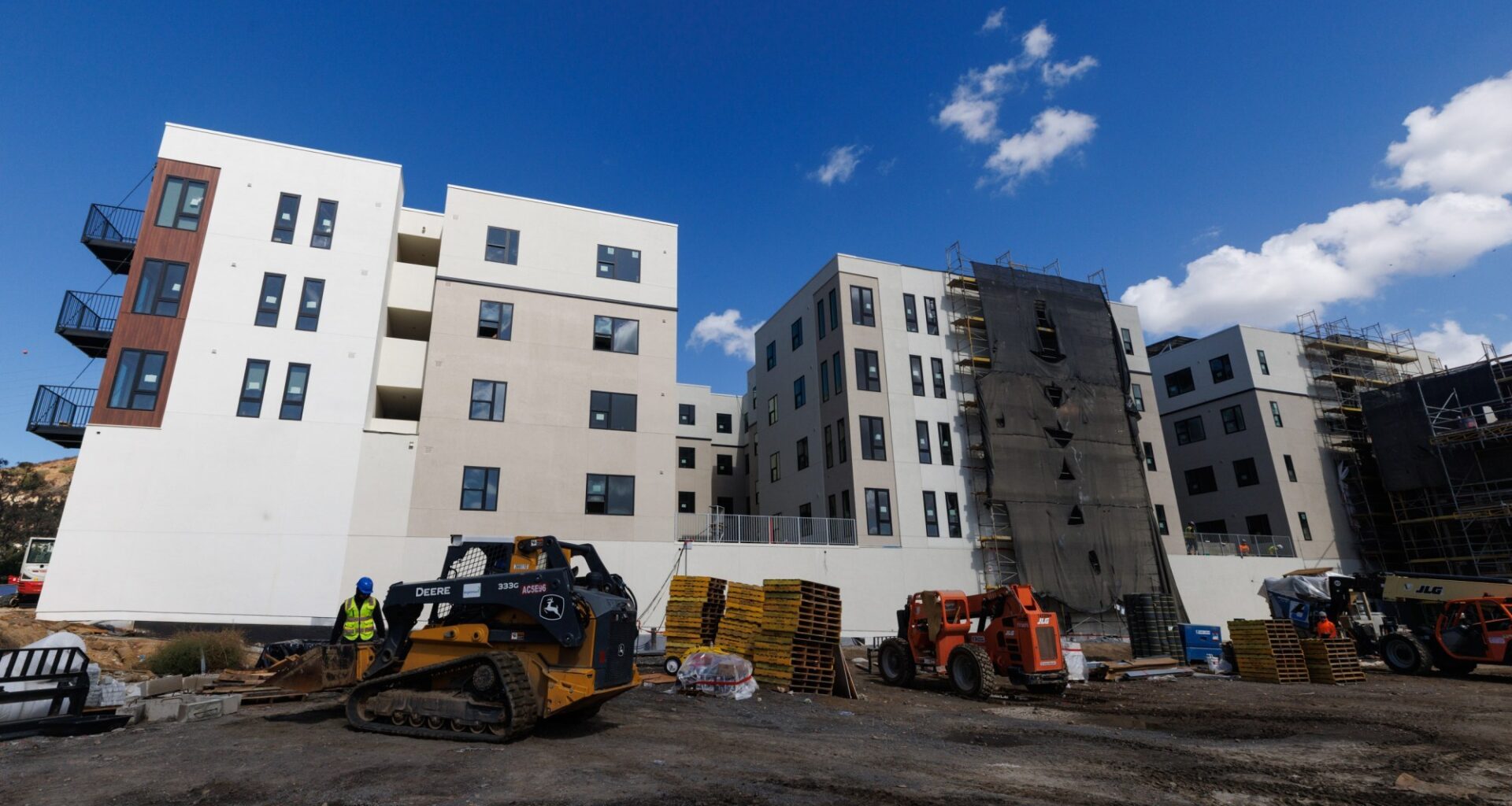
Affordable housing developer Community HousingWorks had high hopes when it first conceived plans for a 57-unit project in City Heights that would not only house homeless veterans but also low-income individuals earning as little as $36,750 a year. Four years later, the project is nowhere near close to breaking ground as the nonprofit scours the state in search of $5 million to close its funding gap.
Similar funding headaches bedevil a 96-unit project in Chula Vista that another San Diego nonprofit, Wakeland Housing, has been pursuing for nearly five years. The $65 million development, which targets both individuals transitioning out of homelessness and low-income families, is still short $35 million after years of foraging for available state and local dollars.
Tracking down financing for projects housing the county’s lowest-income households has always been a daunting, highly competitive process, but even more so now. It’s been eight years since California voters passed the last major bond issue targeting affordable housing — and three years since the billions of dollars it allocated entirely evaporated.
Help, though, is on the way, say advocates, in the form of Proposition 1, a proposed housing measure that would allow the state to borrow $11.25 billion through the sale of bonds to be used exclusively for affordable housing. It’s nearly three times the sum voters approved in 2018 and is considered one of the largest affordable housing bonds in state history. There was a statewide measure voters approved in 2024 that largely focused on mental health treatment, but included in the proposition was $2 billion available to local governments to turn hotels, motels, and other buildings into housing and to also construct new housing.
The lion’s share of Proposition 1, which requires a simple majority to pass, would go toward financing the kind of projects developers like Wakeland and Community HousingWorks have been pursuing for decades. The two nonprofits alone have projects totaling more than 3,700 units that are currently stalled for lack of sufficient funding.
The San Diego Housing Federation estimates that if voters approve Proposition 1, it could mean an estimated $900 million for San Diego County that could be leveraged against other multiple funding sources, key among them local contributions and federal tax credits, to create roughly 3,600 new homes for the region’s neediest households.
“The fear is that we are slowing down,” said Stephen Russell, who heads the federation. “Yes, we’ve been making progress getting chronically homeless individuals off the streets into housing, but in any given month, more people fall into homelessness than we take out of homelessness. San Diego’s housing crisis is driving working families out of our region and putting our most vulnerable neighbors at risk.
“Prop. 1 is a direct response. It would send significant state funding to San Diego and move shovel-ready projects that are stalled only for lack of money. These homes are ready to build. Prop. 1 gives us the means to build them.”
The need is acute considering that the county is nearly 130,000 affordable homes short of what it needs, Russell says. It’s no surprise then that wait lists soar to 5,000 for projects offering as few as several dozen subsidized units.
Housing the neediest
Wakeland Housing’s Peter Armstrong suspects that development of affordable rental complexes could double over the next several years if Proposition 1 prevails.
“As affordable nonprofit and for-profit developers in this day and age, we’re doing the work that used to be done by the public sector, but we will be able to build more projects and more units faster if this bond measure is approved,” said Armstrong, who is Wakeland’s vice president of real estate development. “From the time a project is an idea to when it starts construction, rather than taking six years, we’ll do it in three years, and we’ll double the production of affordable housing in San Diego County.”
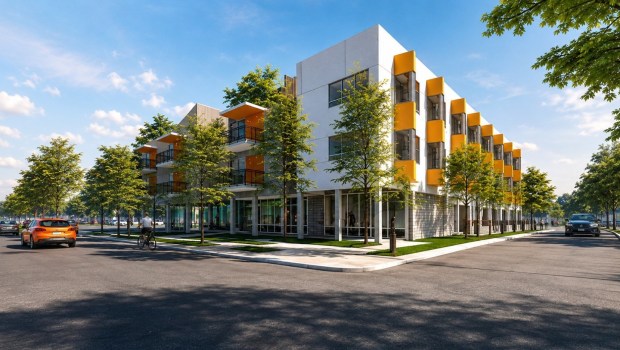 Rendering of The Haven on Palm, an affordable housing complex for older adults now under construction in Imperial Beach. (Wakeland Housing)
That should be welcome news to renters, many of whom struggle to afford high rents in the county. According to the latest U.S. Census Bureau estimates, more than half of renter households in San Diego County are considered “housing cost-burdened,” meaning they spend more than the recommended 30% of their income on housing costs. Even more concerning are the roughly 25% of renting households who rely on more than half of their income on housing.
Statewide, the bond funds would be enough to subsidize as many as 40,000 shovel-ready projects, according to the state’s Legislative Analyst’s Office.
Boosting homeownership
While new apartment complexes, typically affordable to households making up to 60% of the area median income, would be eligible for the largest share of Proposition 1 funds, they wouldn’t be the sole beneficiary. The measure also designates various pots of money — although lesser amounts — for homeownership assistance, including a special program for California veterans and subsidies for farmworker and tribal housing.
Beyond the 40,000 low-income rental units, the Legislative Analyst’s Office estimates that the bond funds could help an additional 40,000 households, including 2,100 veterans, by providing homebuyer assistance.
More specifically, the measure, which has no organized opposition, would do the following:
Provide $7.2 billion to acquire, build, or renovate rental housing, like the projects undertaken by Wakeland and CommunityHousing. Such developments would be required to keep rentals affordable to low-income households for a period of 55 years.
Set aside $1.1 billion to support homeownership for low- and moderate-income households. Some of the first-time homebuyer loans that would be funded with this money would not have to be paid back until the homes are sold or paid off. Other funds would go directly to nonprofits and other organizations for acquiring land to build homes for eligible low-income homebuyers.
Allocate $1.25 billion for home loan assistance to veterans.
Provide $1 billion for affordable housing assistance targeting farmworkers, local tribes and college students.
Provide $500 million for a variety of infrastructure projects to support affordable housing developments, like water, sewage, parks and transportation improvements.
Create a $200 million pot of money available to cities, counties and other entities for pilot projects aimed at developing housing at reduced costs.
Although Proposition 1 has no organized opposition, it did encounter some resistance when the state Legislature decided to place what’s known as the Veterans and Affordable Housing Bond Act of 2026 on the November ballot. At the time, some Republican lawmakers balked at the idea of incurring more debt to pay for housing without tackling the factors that make it so expensive to build.
According to the Legislative Analyst’s Office, the state’s annual cost to repay the bonds would be $500 million to $600 million, which would come out of the general fund. There would, however, be no cost to California taxpayers for the $1.25 billion allocated for veterans housing because buyers’ mortgage payments would be used to repay that portion of the overall bond program.
There is one other affordable housing measure on the ballot — Proposition 37 — and unlike Proposition 1, it would not require tapping into California’s general fund. It would authorize up to $25 billion in revenue bonds to loan middle-income homebuyers 17% of a newly-built home’s purchase price for a down payment. Borrowers would be required to contribute 3% toward the down payment, and the state bonds would be repaid using borrowers’ monthly payments.
The income threshold for eligibility, though, would be considerably higher than for the low-income residents targeted in Proposition 1. Eligible households for Proposition 37’s homeownership assistance could make up to 200% of the median local income, which in San Diego County is nearly $262,000 a year for a family of four.
Public sentiment for housing bonds
Recent polling suggests that voters aren’t especially troubled by Proposition 1’s impact on the state budget, said Mark Baldassare, survey director of the California Public Policy Institute. A poll conducted in September found that 55% of likely voters would support the measure, while 43% would not.
“When people read about bond measures, they’re not always aware of the fiscal consequences for the California taxpayer and state budget and how it will impact other priorities for state spending,” Baldassare said. “In this case, there are no opponents and a list of supporters that doesn’t seem to be so much self-interested groups but groups like the Federation of Teachers and Habitat for Humanity that are trying to help particular parts of the population with housing issues.”
Not surprisingly, an overwhelming proportion of renters — 72% — said they’d vote for Proposition 1 compared to 49% of homeowners, said Baldassare.
“So for a housing bond to pass in California, you need to convince enough homeowners that it’s a worthwhile pursuit to pass it,” he added.
While it has been quite some time since a large affordable housing bond appeared on the California ballot, it isn’t as though the state has been stingy when it comes to supporting low-income housing projects. In the past several years, the state Housing and Community Development Department has released funding rounds of more than $200 million a year to finance multi-family housing projects serving lower-income families.
That, along with federal tax credits, which developers use to attract private investors to financially support their projects, has been crucial to getting affordable complexes off the ground. So, too, is local funding, although it isn’t as reliable a source as it once was, says Armstrong of Wakeland Housing.
“The challenge is that there are a number of affordable housing developers working in the county of San Diego, and we’re all going after pretty limited sources of funding, from the cities, from the county, from San Diego Housing Commission,” he said. “For instance, we just started construction on a new project in Imperial Beach. The city gave us $600,000, but back in the days of redevelopment, we would have gotten $6 million from a local jurisdiction.”
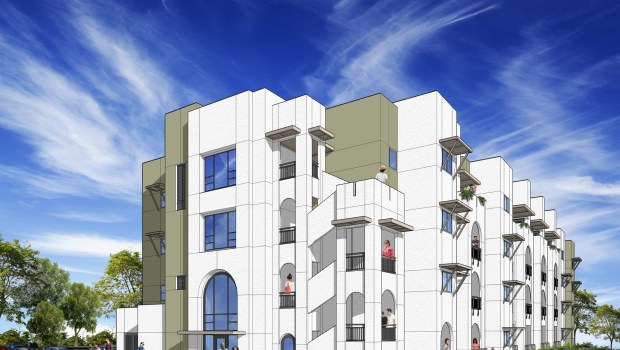 Rendering of 45-unit Navajo Family Apartments that is currently under construction in San Carlos area, with completion anticipated in mid-to-late 2027. Community HousingWorks is the developer. (Community HousingWorks)
Given the increasingly keen competition for scarce funding, Proposition 1 would at least loosen the purse strings for the next several years as developers struggle to break ground on in-demand rental housing projects, said Stephen J. Swiecicki, vice president of Community HousingWorks.
“This really is that critical middle piece of funding between local sources and tax credits in what is already a very expensive environment,” Swiecicki said. “We’re seeing interest rates continue to tick upward, costs are still ticking up. So with that bond money, you end up having a balance where we can unstick these projects and move a lot of them forward. And there’s just too many of them sitting on the sidelines.”