
One stadium was supposed to rise beside a working marine terminal in National City. Another would have replaced an Oceanside golf course. A third was proposed along Chula Vista’s waterfront.
Others were imagined above a cargo terminal, in East Village and, repeatedly, in Mission Valley.
None were built.
By the time mayor Kevin Faulconer assembled his Citizens’ Stadium Advisory Group in January 2015, the search had become an exhausting exercise in eliminating possibilities.
Adam Day, who chaired the nine-member committee, recalls reviewing more than a decade’s worth of studies and consulting architects, financial experts and veterans of previous attempts.
His group inherited what he describes as “a dozen sites and locations that had been thrown about, some studied more seriously than others.”
But Faulconer wasn’t asking for another countywide search. The assignment was to choose between downtown and Mission Valley, then devise a financing plan.
“We didn’t have the benefit of time,” Day said.
Mary Lydon, a longtime land-use consultant who served alongside Day, remembers the region’s determination to exhaust every possibility.
“Exploring all those sites certainly shows that our region was trying to find a solution,” Lydon said. “We were going to uncover every rock to see if we could figure it out.
“But at the end of the day, even their preferred location of downtown didn’t work and they left.”
Nearly a decade after the Chargers’ departure, this week’s installment revisits nine stadium possibilities: where they could have gone, how they might have been financed, why each failed and what became of those locations.
Next week, we’ll examine the negotiations themselves and whether the relationship between the Chargers and San Diego had deteriorated beyond repair before the last proposals were considered. A subsequent examination of the 2016 Measure C campaign will explore what voters were asked to approve, why they rejected it — and whether the outcome was inevitable.
Together, the three stories seek something more useful than assigning blame to the Spanos family or City Hall.
If San Diego ever gets another opportunity to attract an NFL franchise, what can it learn from its experience with the Chargers?
The land-value era
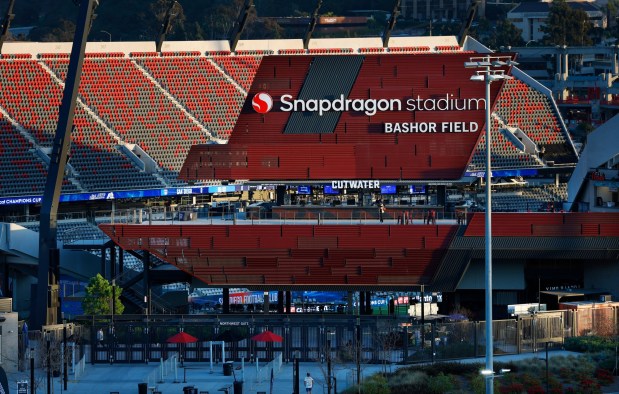 Snapdragon Stadium shown on Feb. 3, 2026. (K.C. Alfred / The San Diego Union-Tribune)
Mission Valley reconstruction
Year: 2003-06
Location: Qualcomm Stadium, Mission Valley
Acreage: 166 acres; the Chargers eventually sought development rights to about 60 acres.
Estimated stadium cost: Initially $400 million, later roughly $450 million.
Public mechanism: The original 2003 concept called for about $200 million in public financing for a $400 million stadium, with city land and development revenue central to the plan. By August 2003, the Chargers were proposing a privately financed stadium in exchange for development rights.
Development component: Up to 6,000 homes, plus hotels, offices, retail, restaurants and parkland.
Key advocates: No sustained advocate; Mayor Dick Murphy convened a task force that urged shifting construction risk to the team.
Chargers contribution: Initially about half the cost through team/NFL funding; later the team promised private stadium and infrastructure financing with a development partner.
Biggest obstacle: Development economics, compounded by traffic, floodplain, groundwater and infrastructure problems.
Why it failed: The Chargers could not secure a development partner willing to shoulder the financial risk, while the city’s fiscal crisis made public assistance unlikely.
What’s there today: Snapdragon Stadium and SDSU Mission Valley.
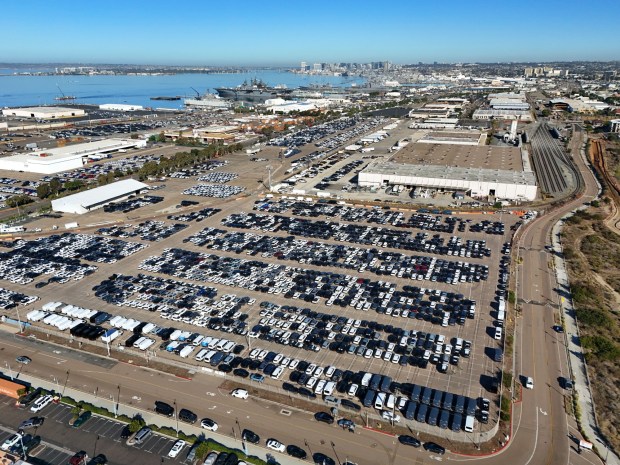 Imported cars are parked at the National City Marine Terminal on October 14, 2026 in National City, CA. (K.C. Alfred / The San Diego Union-Tribune)
National City waterfront
Year: 2006-07
Location: Waterfront near the 24th Street Marine Terminal.
Acreage: 52 acres — 32 Port-controlled and 20 owned by BNSF Railway.
Estimated stadium cost: About $600 million; parking and infrastructure could have pushed the project beyond $1 billion.
Public mechanism: Land and development opportunities, not a direct city stadium appropriation.
Development component: Mixed-use projects on separate parcels, supplemented by waterfront commercial activity.
Key advocates: Mayor Ron Morrison and National City officials.
Chargers contribution: No fixed sum; private financing with a development partner was proposed.
Biggest obstacle: Split ownership and extensive infrastructure requirements around an active port.
Why it failed: BNSF resisted providing critical acreage, while relocation, roads and parking added enormous costs.
What’s there today: An operating marine terminal handling vehicle shipments, rail and other cargo.
The countywide search
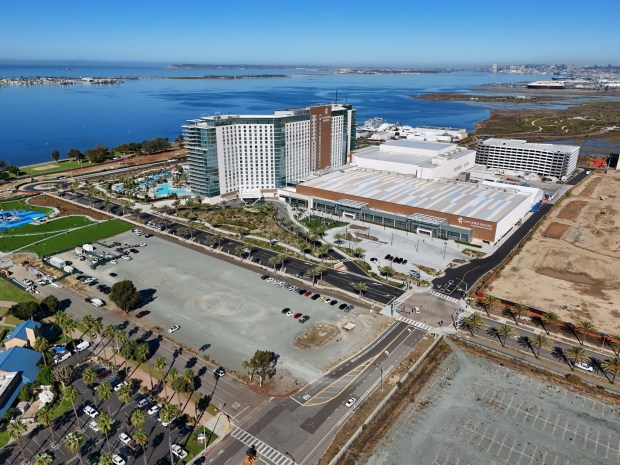 The Gaylord Pacific Resort & Convention Center was built on the Chula Vista Bayfront, seen here on October 14, 2026 in Chula Vista, CA. (K.C. Alfred / The San Diego Union-Tribune)
Chula Vista
Year: 2006-09.
Location: South Bay Power Plant waterfront and eastern Chula Vista near Route 125.
Acreage: No final parcel; a roughly 500-acre property in eastern Chula Vista was among the inland sites studied.
Estimated stadium cost: The Chargers’ regional stadium estimate exceeded $800 million by 2007; by early 2008, the team estimated a Chula Vista stadium would cost about $1 billion.
Public mechanism: Private financing backed by development rights, dependent on public infrastructure and regulatory approvals.
Development component: Residential and commercial development, potentially inland even for a waterfront stadium.
Key advocates: Councilman John McCann; Mayors Steve Padilla and Cheryl Cox supported studying options.
Chargers contribution: No set amount; roughly $220,000 was spent on studies.
Biggest obstacle: On the bayfront, power-plant removal, enormous infrastructure costs and Port, Coastal Commission and state approvals; inland, access and transit.
Why it failed: Neither site yielded workable land, infrastructure and financing terms; the power plant alone was not decisive.
What’s there today: The former power plant is gone. The broader bayfront is now home to the $1.35 billion Gaylord Pacific Resort & Convention Center, opened in 2025, and new public parks.
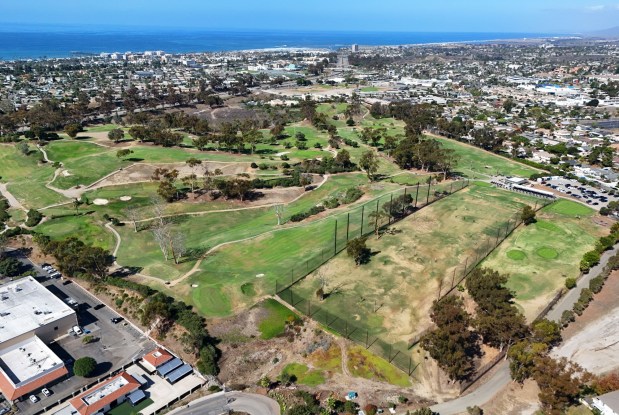 Goat Hill Park Golf Course on October 13, 2026 in Oceanside, CA. (K.C. Alfred / The San Diego Union-Tribune)
Oceanside, Goat Hill
Year: 2007.
Location: Center City Golf Course, now Goat Hill Park, east of Interstate 5.
Acreage: About 72 acres.
Estimated stadium cost: No site-specific budget was completed; the Chargers’ regional stadium estimate exceeded $800 million by 2007.
Public mechanism: Access to city-owned land and privately financed construction; protected park status required voter involvement, with substantial local opposition.
Development component: Offices or mixed-use development nearby or elsewhere in the county.
Key advocates: Mayor Jim Wood participated; council support was mixed.
Chargers contribution: No fixed figure; the team opposed a direct municipal construction subsidy.
Biggest obstacle: Insufficient space for both stadium operations and lucrative development, plus traffic concerns.
Why it failed: The team concluded the location could not support the project.
What’s there today: An active 18-hole golf course.
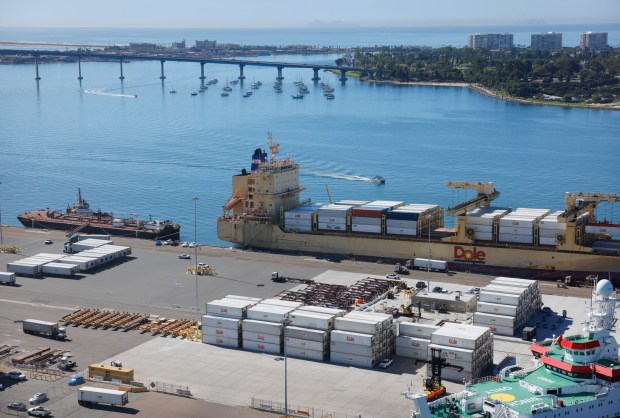 A Dole ship is unloaded at the 10th Avenue Marine Terminal on October 14, 2026 in San Diego, CA. (K.C. Alfred / The San Diego Union-Tribune)
Tenth Avenue Marine Terminal
Year: 2008; revived in 2012.
Location: Tenth Avenue Marine Terminal on San Diego Bay.
Acreage: About 96 acres.
Estimated stadium cost: No adopted budget; an elevated deck over the port could itself rival stadium construction costs.
Public mechanism: Proposition B sought a change to the Port’s planning framework, not approval of a completed Chargers deal.
Development component: A platform above working maritime operations supporting possible stadium, convention, hotel and commercial uses.
Key advocates: Private proponents Richard and Nancy Chase and Frank Gallagher, not the Chargers.
Chargers contribution: None committed.
Biggest obstacle: Engineering, cost and disruption to cargo operations.
Why it failed: Roughly 70% of voters rejected Proposition B; Port officials opposed later revival attempts.
What’s there today: A working cargo terminal.
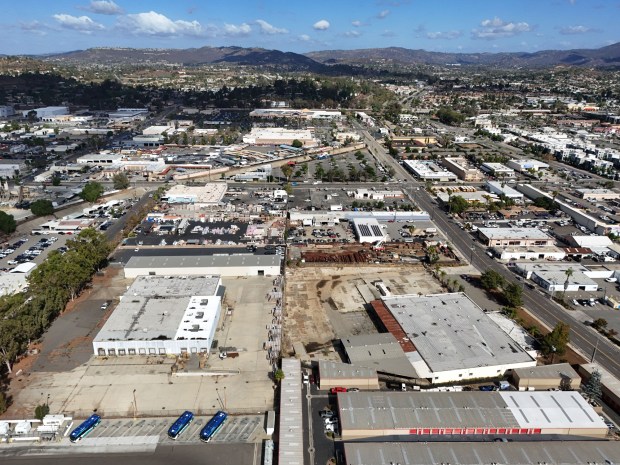 An industrial area near Washington Avenue and Quince Street is seen on October 13, 2026 in Escondido, CA. (K.C. Alfred / The San Diego Union-Tribune)
Escondido
Year: 2009
Location: Industrial properties near Interstate 15 and Route 78.
Acreage: A contemplated 30- to 60-acre assemblage; stadium and surface parking could consume most of it.
Estimated stadium cost: No final site-specific budget was established; Chargers officials estimated that ancillary development would need to cover most or all of a $500 million financing gap.
Public mechanism: City assistance assembling land and facilitating development incentives.
Development component: Offices, retail and housing intended to subsidize construction.
Key advocates: Interested local officials, but no sustained coalition for a completed deal.
Chargers contribution: No fixed amount.
Biggest obstacle: Fragmented ownership, the costs of assembly and uncertain development value.
Why it failed: No workable land assembly or financing emerged.
What’s there today: Industrial and commercial properties; no single successor project because no definitive stadium parcel was assembled.
Downtown becomes the financing plan
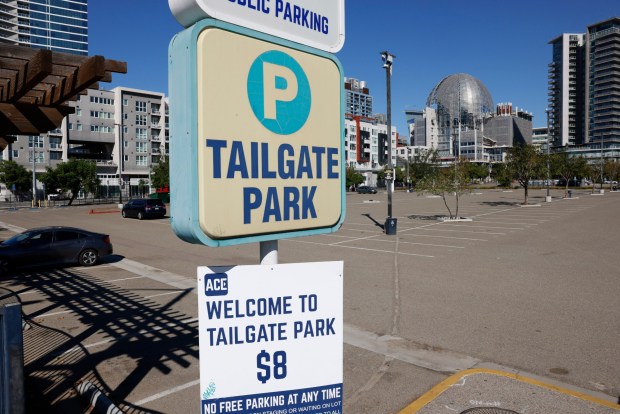 Tailgate Park is seen on Oct.14, 2026. (K.C. Alfred / The San Diego Union-Tribune)
East Village, first version
Year: 2009-14
Location: Tailgate Park, the MTS bus yard and former Wonder Bread property east of Petco Park.
Acreage: Roughly 10-15 acres.
Estimated stadium cost: $700 million-$800 million initially; near $1 billion by 2013, or $1.2 billion for a stadium-convention concept.
Public mechanism: With little adjacent land to sell or develop, substantial public funding was necessary; redevelopment revenue disappeared when California abolished redevelopment agencies.
Development component: Eventually a joint stadium-convention facility, not a sprawling mixed-use district.
Key advocates: Mayor Jerry Sanders supported studying downtown; Mark Fabiani advocated it for the Chargers.
Chargers contribution: By 2014, discussions envisioned $400 million in team/private funds, $200 million from the NFL and $400 million from the city.
Biggest obstacle: Financing, property acquisition, relocating MTS operations and competing convention-center plans.
Why it failed: No financing agreement emerged. Redevelopment funding disappeared, and in 2013 the Coastal Commission approved the Port’s separate contiguous waterfront convention-center expansion.
What’s there today: East Village development and the former Tailgate Lot, where a previously approved mixed-use project has faced litigation and an uncertain future.
Back to Mission Valley, then one last vote
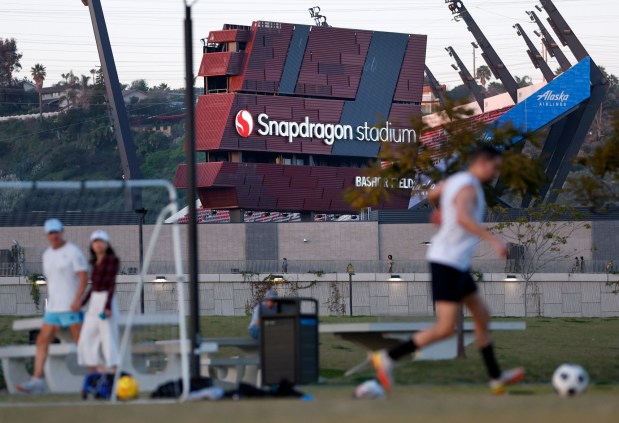 People play soccer at SDSU Mission Valley River Park on February 3 26, 2026 in San Diego, CA. (K.C. Alfred / The San Diego Union-Tribune)
CSAG Mission Valley
Year: 2015
Location: Qualcomm Stadium site
Acreage: 166 acres, with about 75 proposed for sale and redevelopment.
Estimated stadium cost: $950 million for a 65,000-seat stadium; about $1.1 billion including infrastructure.
Public mechanism: About $7 million annually from each of the city and county over 30 years, estimated to support $121 million apiece in upfront financing; an estimated $225 million from selling 75 acres; and other stadium revenues. No tax increase was proposed.
Development component: Mixed-use redevelopment of 75 acres; projected land-sale proceeds, rather than speculative future property taxes, would support core stadium financing.
Key advocates: Mayor Kevin Faulconer, Supervisor Ron Roberts and Day.
Chargers contribution: A proposed $300 million from the team, plus future rent projected to support $173 million in additional financing; another $200 million was expected from the NFL.
Biggest obstacle: Time, damaged relations and legal questions about expedited environmental review.
Why it failed: The plan never became a binding agreement; the Chargers rejected Mission Valley and pursued downtown and Los Angeles.
What’s there today: Snapdragon Stadium and SDSU Mission Valley.
Measure C
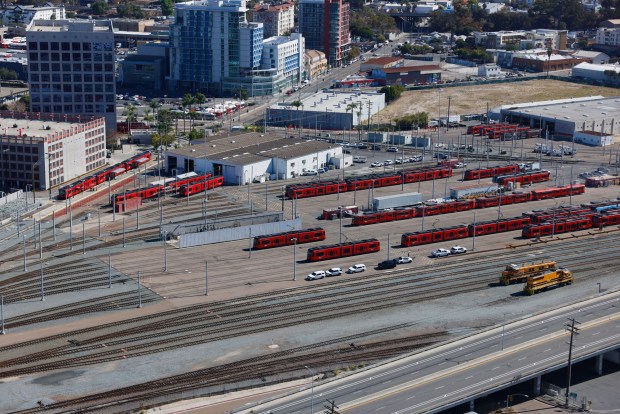 The San Diego Metropolitan Transit System (MTS) rail yard in downtown is seen on October 14, 2026 in San Diego, CA. (K.C. Alfred / The San Diego Union-Tribune)
Year: 2016
Location: East Village around the MTS bus yard and Tailgate Park.
Acreage: A compact downtown footprint.
Estimated stadium cost: About $1 billion for the stadium; $1.8 billion including convention facilities.
Public mechanism: A six-percentage-point hotel-tax increase, from 10.5% to 16.5%, with five points dedicated to facility costs through cash financing and hotel-tax-backed revenue bonds. The measure also would have eliminated a separate 2% tourism-marketing assessment for many hotels, changing their combined burden from 12.5% to 16.5%.
Development component: Integrated stadium and convention facilities.
Key advocates: The Chargers and Dean Spanos; Faulconer endorsed the initiative late.
Chargers contribution: $350 million from the team, $300 million from the NFL.
Biggest obstacle: Public cost, opposition from tourism and civic groups and the presumed two-thirds approval requirement.
Why it failed: Voters rejected Measure C on Nov. 8, 2016, with about 43.6% supporting it; the team announced its departure two months later.
What’s there today: No NFL stadium; previously approved mixed-use plans for the Tailgate Lot have faced litigation and an uncertain development status.
Editor’s note: Almost 10 years have passed since the Chargers ended their 56-year run in San Diego and moved to Los Angeles. Over the course of this NFL season, this series will trace the stadium fight and decisions that led to the move, revisit the fans and community left behind, assess the Chargers’ decade in Los Angeles and San Diego’s life without them, and explore whether the NFL could ever return.