
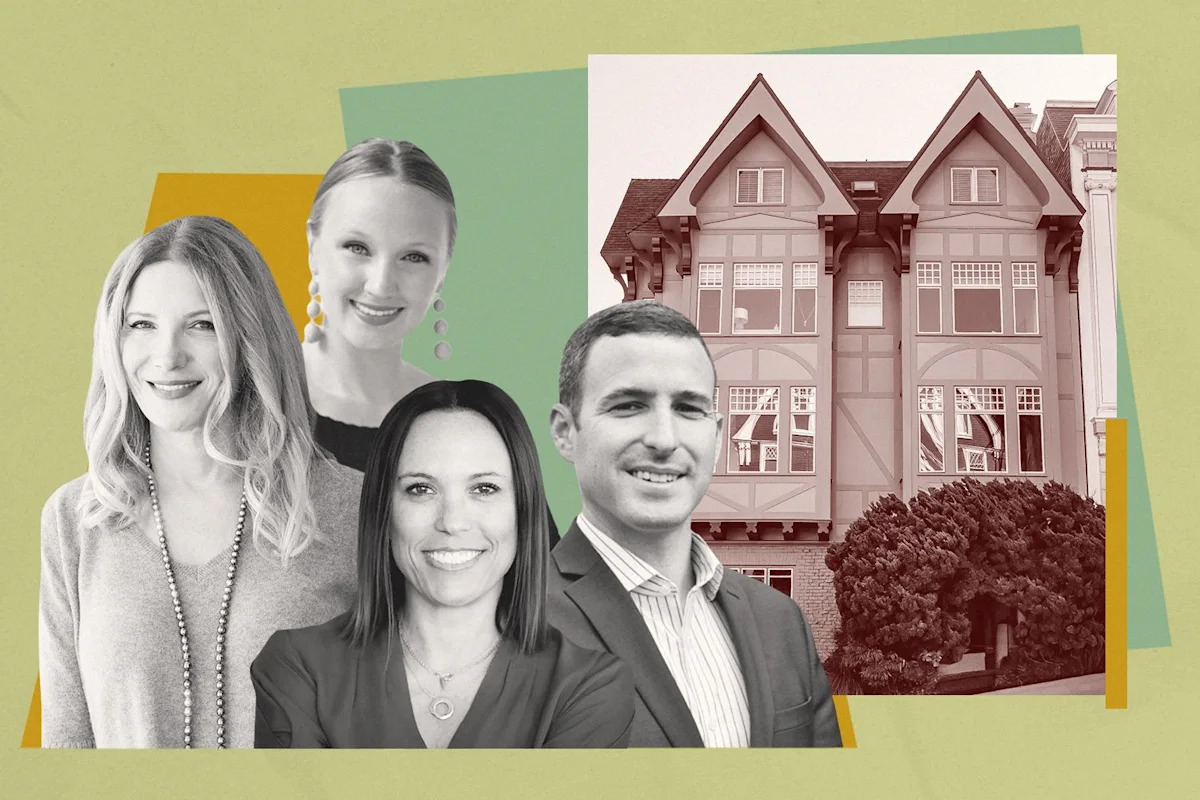
 Compass’ Helena Zaludova and Ali Healy, The Agency’s Laura Pallin and Compass’ Justin Goldberg with 2670 Pierce Street (Helena Zaludova, Laura Pallin, Goldberg Group, Tam Lontok)
Amid the slew of eye-popping residential sales in San Francisco this year, local and national news headlines have characterized the Golden City’s market as “off the rails,” in a state of “hysteria,” “absolutely bananas” and getting “crazier and crazier.”
It’s an understandable depiction given the stories — like the roughly 6,000-square-foot home in Sea Cliff that sold for more than $5 million above asking in just a week.
But to Compass’ Helena Zaludova, million-dollar overbids are sensible.
“It’s not ‘crazy’ — the result of what we’re experiencing is actually a rational market response to our conditions,” said Zaludova, a luxury agent focusing on the north end of San Francisco. She pointed to “unprecedented liquidity” and an influx of enriched buyers, drawn in by the city’s booming AI industry, who are running up against limited supply.
“So the market response of overbids and competition is actually really rational,” she said.
In the third quarter of this year, 87 percent of homes sold in San Francisco traded above their asking price, according to a market report from Sotheby’s International Realty. Last month, homes in the city sold for an average of 131 percent of their list price — the highest of any month so far this year.
AI-enriched buyers are coming in hot — willing to drop million-plus-dollar premiums to secure a place in San Francisco’s most sought-after neighborhoods at a time when supply is so limited, the market has fallen into a “mansion shortage.” And those in the industry don’t foresee the supply changing.
“We have an inventory issue, and we always will have an inventory issue,” The Agency’s Laura Pallin said.
In response, high-end agents are along for the ride of their professional lives, trying to figure out how to price a property in a constrained market that’s moving rapidly and spending wildly.
“Reverse” card
With no ceiling in sight, brokers trying to price right are realizing they were low-balling without intending to do so — resembling deliberate strategies most used in more entry-level markets.
“San Francisco’s typical pattern is that entry-level homes attract competing buyers and bidding wars, while luxury buyers generally have less competition and more room to negotiate,” Compass’ Mike Simonsen and Janel Evans-Anderson wrote in a September market report. “This fall it is the reverse.”
Take Compass’ Ali Healy, who facilitated the sale of a Noe Valley home that closed at more than $2 million over asking last month, becoming the ritzy neighborhood’s priciest resi trade of the year. The $9.1 million deal followed an asking price just shy of $7 million, with the seller accepting the AI buyer’s offer just seven hours after the listing went online.
Healy said she didn’t strategically underprice the home, and though she knew that the competitive market may lead to an overbid, she didn’t expect it to go that far.
Pallin, who focuses on north and northwest neighborhoods, echoed this sentiment, noting that while overbids are expected, it’s no longer predictable just how far they’ll stretch.
That’s because the industry is dealing with a larger, evolved buyer pool. In 2024 and 2025, Zaludova said luxury buyers were vacillating.
“They were on the sidelines — waiting, waiting, waiting,” she said. “Now they don’t wait anymore.”
That was certainly the case for Healy. She said the buyer in her deal had recently lost out on another home and didn’t want to take any chances.
“They were like, ‘I mean, if it’s $8 million or $9 million, we don’t really care at this point,’ because they know their colleagues are the ones they’re competing with,” Healy said in a September interview with The Real Deal.
The market seems to be blowing away any pricing strategy at the high end — but still, brokers try.
For Zaludova, pricing her listings is all about the data. She said she never intentionally underprices and instead tries to “nail it.”
“You need to be intimately familiar with every single sale in that segment and every property,” Zaludova said. “You have to be aware of what other choices buyers have.”
It’s also crucial to know how many active buyers there are for the kind of home you’re listing, she said. And where data is limited, you must rely on market intelligence that comes from relationships with other agents.
Still, in a market like this, you can’t always foresee what something will command, as exhibited in Zaludova’s sales.
On Friday, Zaludova nailed it — closing on the longtime Pacific Heights home of late Grammy-winning conductor Michael Tilson Thomas for exactly what she listed it for: $9.9 million.
Meanwhile, in the spring, Zaludova represented the seller of a seven-bedroom mansion in San Francisco’s North of Lake Street neighborhood, receiving a premium. She listed the property at 10 5th Avenue for $12 million and sold it for $13.5 million about two weeks later.
Second homes and IPOs
In the luxury condo realm, Compass’ Justin Goldberg, who sells near AI office hotspots, has his own strategy: pricing condos two to three months ahead of the upward-moving market. He’s finding they sell for about asking or 5 percent above.
That premium comes as a good chunk of his buyer pool shifts toward AI investors looking for second homes, trying to keep an eye on the action. And right now, San Francisco is waiting in anticipation, as AI giants Anthropic and OpenAI prepare IPOs expected to bring new waves of wealth to the market.
Goldberg specializes in San Francisco’s South Beach and South of Market — the latter earning the nickname “AI Alley,” as it hosts the headquarters for Anthropic, along with offices for Databricks and other AI players. The area’s office-leasing streak and return-to-office dynamics are propelling the nearby residential markets, Goldberg said.
“These people are willing to pay a little bit more above market because they know in six to nine months when these AI companies [go public], they’re going to be in a much more aggressive environment,” he said. Anthropic and OpenAI are each expected to be valued at over $1 trillion, and the potential windfalls to their current and former employees could allow them to buy nearly one-third of all homes in San Francisco, according to a July report from Redfin.
So far this year, Goldberg said he’s sold 74 listings, noting that high-end condos are receiving offers immediately after coming online — a much faster pace than in years past. He estimated around 30 percent of his sales are to second-home buyers, who tend to have more liquidity and are more comfortable paying a premium.
It’s not just Goldberg inking deals in the area. San Francisco’s 9th District — which includes SoMa, South Beach, Mission Bay, Dogpatch and more — saw 271 condo sales in the third quarter, according to Sotheby’s report. That was higher than any other district, with the neighboring 8th district coming in second, with 146 deals.
No one can predict the future. Anthropic’s and OpenAI’s IPO dates are yet to be set, and OpenAI’s Sam Altman delayed the public listing to 2027 amid AI safety concerns.
But Goldberg, Pallin and Zaludova aren’t expecting a slowdown for the city’s residential market, especially given the high cost of new construction keeping supply at bay.
“Demand boils down to liquidity, market confidence and the supply,” Zaludova said. “If the confidence is there and the liquidity is there and the supply remains this constrained, then you can anticipate that this is not about to stop.”
Read more
This article originally appeared on The Real Deal. Click here to read the full story.