
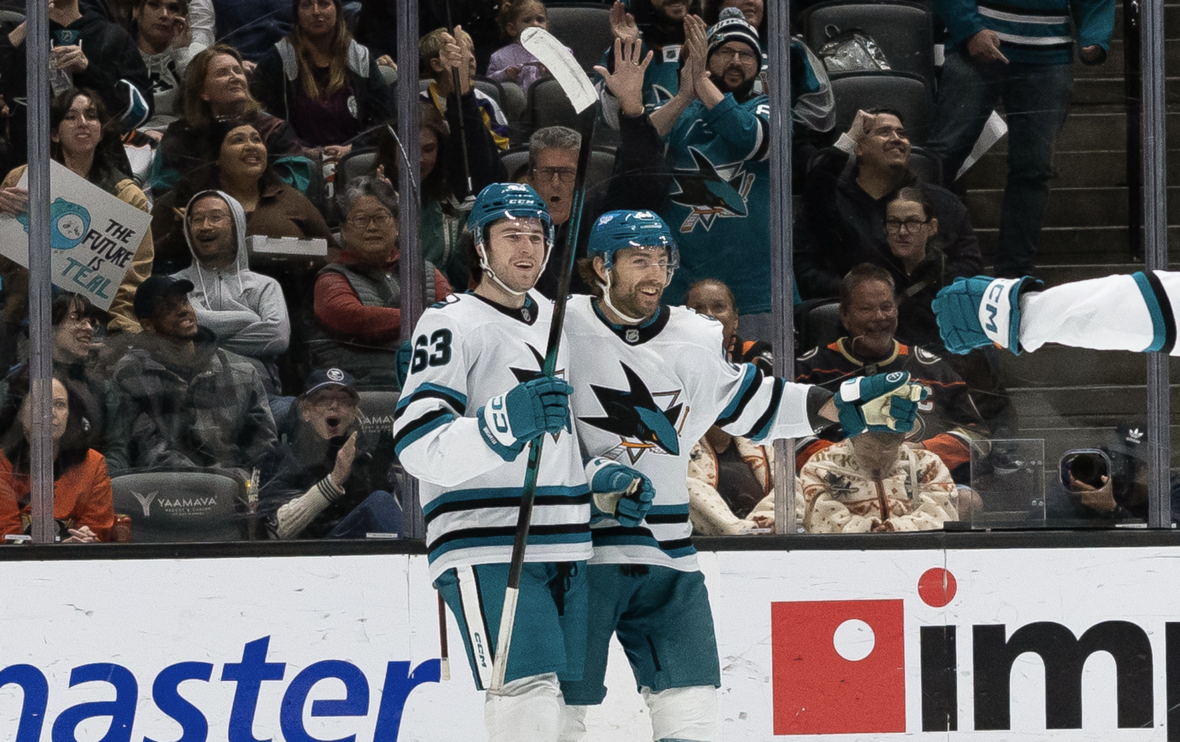
DETROIT — Why do the San Jose Sharks keep blowing late leads?
On Saturday, for the fourth time this season, and for the second-straight game, the Sharks blew a two-goal lead in the third period.
This time, San Jose did not escape with a victory, dropping a 4-3 shootout decision to the Detroit Red Wings. On opening night against the Florida Panthers and Oct. 3 against the Los Angeles Kings and Oct. 15 at the Nashville Predators, the Sharks were able to overcome themselves and eke out two points.
Sharks tools
Ex-Toronto Marlies assistant coach and hockey tactics expert Jack Han does think the San Jose Sharks are playing differently with the lead. For what it’s worth, he puts it more on the players than the coaching staff.
“Looks to me they just started playing safer on their own,” Han said.
It’s natural for players to be more conservative with a late lead, and it’s not like they went into a shell.
At 5-on-5, between Emmett Finnie’s goal that cut the Sharks lead to 3-2, and the game-tying Alex DeBrincat goal, San Jose actually out-attempted Detroit 9-5.
Han saw it more as a problem of the Sharks shifting, after going up 3-1, from what’s their relative strength, offense, to their relative weakness, defense.
“Per SPORTLOGiQ, the San Jose Sharks had an edge in controlled entries and recovered dump-ins in periods one and two, but Detroit had more in the third,” Han said. “So quantitatively, the Sharks did sit back more and gave the Red Wings some momentum. It’s not unusual, [that’s] score effects.”
While San Jose had more 5-on-5 shot attempts, no doubt, Detroit got inside more. But the Sharks failed to handle that pressure.
“The problem is that the Sharks are not the best team in its own end,” Han said.
That’s suggested by defenseman Dmitry Orlov getting beat by Finnie, then what Han saw as defenseman Sam Dickinson not being as effective as possible in the lead-up to DeBrincat strike.
“The most important KPI for this team is can they generate more successful entries?” Han opined. “Which they did up until the third period when they started became more passive defensively and less interested in continuing to build their NZ transition advantage.”
So if there’s anything that you want to put on the coaching staff here, it may be that they should encourage the Sharks to keep attacking and taking risky chances even when up 3-1. It’s counterintuitive to what most hockey coaches would do, would bite them back at times, and probably is not a formula for playoff success, whenever San Jose gets there again, but led by Macklin Celebrini up front, that is probably what the team is best at.
As for Dickinson, he’s a 20-year-old blueliner who’s shown growth recently, highlighted by a career-high 24:39 played against the Predators, but defending 5-on-6 is still a work in progress.
At Nashville, with 12 seconds left and a 2-1 lead, Dickinson played a puck in the corner, which was not his coach’s preference.
“12 seconds left,” Warsofsky said, “we should probably eat that puck in the corner.”
Steven Stamkos would tie it with literal seconds left in regulation.
At Detroit, Han didn’t like a couple things from Dickinson (6).
“Not a great retrieval and pass to Wennberg to get hemmed in. Then, it was Dylan Larkin who went under his stick [with the pass] to Lucas Raymond on the quick re-entry. Detroit had the puck until the goal.”
With Dickinson’s size, mobility, length, and puck-moving chops, these are plays that Han expects the young defenseman to learn from.
It’s important to note that the Sharks’ recent 5-on-6 defending woes aren’t all on Dickinson, but he’s just one illustration of where they can be better.
One more thought about what happened last night to the San Jose Sharks.
No, Warsofsky did not double-shift his fourth line to try to finish off the Red Wings. Not quite. That’s an online inaccuracy that I’ve seen.
Up to about four minutes to go, the Sharks had been rolling four lines.
Then, Barclay Goodrow came over the boards to join Macklin Celebrini and Collin Graf. On an ensuing faceoff, Alex Wennberg joined Zack Ostapchuk and Graf.
It’s not unusual, at critical end-of-game faceoffs, for head coaches to have two centermen available for the dot, in case one gets kicked out.
With about three minutes to go, Goodrow and Celebrini and Kiefer Sherwood jumped over the boards. After a full shift, Wennberg-Ostapchuk-Graf came out again, and they were on the ice when DeBrincat tied the game with Detroit’s goalie pulled.
Defensive pairings stayed the same for the Sharks, Darnell Nurse-Michael Kesselring and Dickinson-Jacob Trouba being leaned on.
So what Warsofsky did was essentially double-shift his best defensive forwards, Celebrini, Goodrow, Sherwood, Wennberg, Ostapchuk, and Graf. Instead of just keeping his regular fourth line of Goodrow-Ostapchuk-Graf together, Warsofsky seemed to balance his trios, some offense with some defense.
This forced Igor Chernyshov, Ivar Stenberg, Will Smith, Michael Misa, Tyler Toffoli, and Mason Marchment, all more offensive-leaning, to the bench, for just a couple of minutes.
This is the first time this season, I believe, that Warsofsky has been this conscious about protecting a lead, that he basically formed a pair of two-way “super” lines in crunch time.
Obviously, the result was disappointing, but it was perfectly sensible coaching maneuver. Batten down the hatches, for just a couple minutes, with your best two-way forwards.
So why have the San Jose Sharks blown so many late leads?
Han’s basic conclusion probably isn’t satisfying, but it’s true: The Sharks are better, but they’re not that good yet.
My answer to the big question, probably equally unsatisfying to the mob, is that there’s some law of averages going on. As Han noted, the Sharks aren’t an elite defensive zone team. On the other hand, this isn’t 2023-24, I doubt San Jose is going to keep blowing late lead after late lead.
Let’s review this at the end of the season, but I suspect, with more data, that this won’t be a talking point by then.