

Tenants who are facing temporary eviction from a four-story Mission District apartment complex following a fire earlier this year are refusing to move unless the landlord, Mosser Living, meets their relocation and return demands.
Protections under city law for temporary evictions, they say, don’t go far enough, especially for the many low-income, disabled, senior, and family renters at the rent-controlled building at 907 Valencia St., a 28-unit rent-controlled complex at 20th and Valencia streets.
The tenants’ demands appear aimed at ensuring that the landlord has an incentive to complete the renovation work quickly.
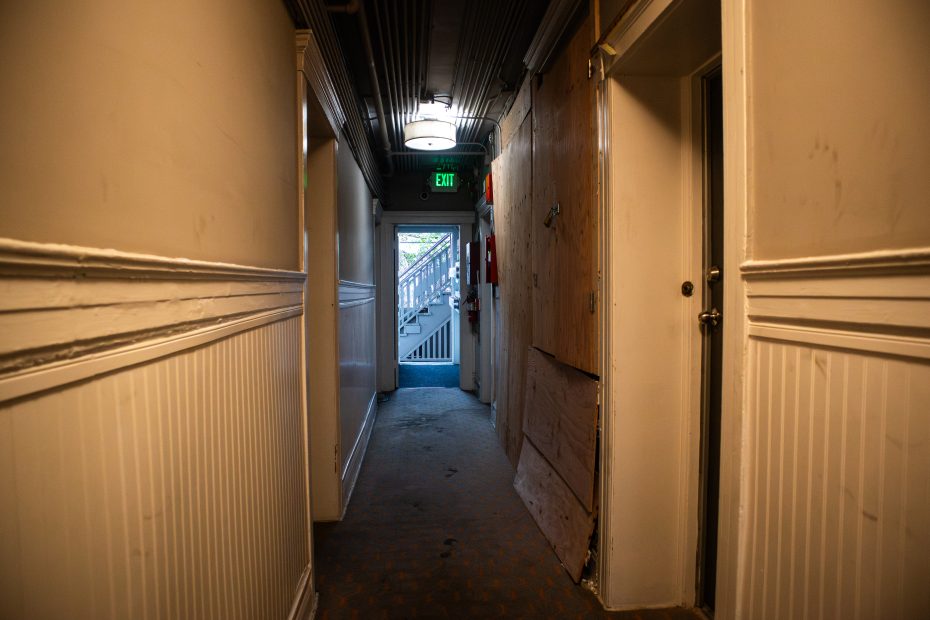 The hallway on the first floor of Mosser Living is boarded up on Oct. 22, 2025. Photo by Mariana Garcia.
In documents obtained by Mission Local, Mosser said that all tenants have to move out for health and safety reasons. During construction, the company said the utilities will be shut off. The work seems to focus on the hallways: carpets will be replaced and new sheet rock and panels will be added.
Mosser is in the process of getting a permit for more than three months of construction — a requirement for temporary evictions. Mosser said the project will take about a year.
The fire initially displaced tenants in two of the 28 units. Angel Meza, one of those tenants, said that after 10 days at a hotel, the company secured him housing at the same rate until his unit is renovated.
Tenants who remain in 14 of the units want assurance from Mosser that they will be relocated to another Mosser-owned unit with the same rent for the duration of construction. City law requires landlords pay relocation expenses for so-called capital improvement evictions, but the tenants worry it is too little.
These are set at $8,062 per tenant. Seniors, people with a disability, and minors under 18 receive that $8,062 plus an additional $5,375. Pay outs are capped at $24,184 per unit.
But median rents as of Nov. 10 in San Francisco are $3,300 for a one-bedroom apartment and $4,545 for a two-bedroom apartment, according to Zillow.
Of the 28 tenants still living in those 14 units, three have lived there for more than 30 years and six for more than 20 years. There are also seven residents with disabilities, including four disabled seniors and two children.
Mosser did not reply despite repeated requests for comment.
Joseph Tobener, a tenant attorney with nearly 30 years of experience at Tobener Ravenscroft LLP, said that even though tenants have the right to return at the same price under temporary capital improvement evictions, landlords often count on tenants finding other housing arrangements. That leaves the landlord free to raise the rents for new tenants.
“Oftentimes, the displacements last for a very long time, and the tenants end up giving up on the units, or the landlord will pay them a nominal sum to waive their right to return,” said Tobener.
Tobener added that despite the right to return being secured under city law, delays in negotiations between landlords and insurance companies, the permitting process, and, at times, foot-dragging by landlords can make the process very slow.
The city’s Rent Board does not collect data on how many people return to their homes following a temporary capital improvement eviction.
The fire took place on Feb. 10 after a guest, tenants say, discarded a cigarette into a lightwell from the rooftop. A fire report of the incident lists the cause of the fire as unknown, but points out that a naked man was detained at the scene.
On April 25, Mosser issued 23 capital improvement eviction notices — a temporary eviction served when construction is planned. Tenants then formed the 907 Valencia Tenants Association and sought help from the Housing Rights Committee, the nonprofit currently representing them. Some of the tenants moved out, but 14 units remain occupied.
The 28 tenants who remain have refused to accept any relocation checks from the landlord. Their demands for temporary housing at their current rate have been ignored and negotiations appear to be at a standstill. Tenants also say they want to see the construction permits to verify that all of the units need to be evacuated. City rules require permits prior to serving eviction notices.
Tenants say the April eviction notices took them by surprise, as their landlord had failed to communicate with them following the fire despite smoke, mud, and debris at the property.
The group drafted a list of 11 demands. The company agreed to many, which were already required by city code. Others — including allowing three contractors who are tenants to inspect the damage, the assurance of temporary housing at the same rate, and the translation of notices into Spanish — have proved more contentious.
Tenants say that at a meeting with two Mosser employees on July 7, Maria Villegas, the property manager, verbally agreed to all their conditions.
Two days later, however, in an email obtained by Mission Local, Mosser’s lawyer Dave Wasserman informed the tenant association that the company would not sign the agreement. The law, he said, did not require them to do so.
Wasserman’s response angered tenants, who argued Mosser was acting in bad faith by walking back much of the agreement.
Under city law, however, the company only has to meet the provisions for capital improvement evictions. Tenants say that gives them no guarantee of temporary housing they can afford.
Landlords have to give displaced tenants half the relocation payment at the time the eviction notice is served, and the other half when the unit is vacated. Tenants rejected the checks and said the amounts were below the required minimum.
Linda Lewis, 74, and her son Russell Lewis, 53 are disabled, entitling them to relocation payments of $13,437 each. But Russell Lewis said that at the time the eviction was served, only one $4,000 check came with their eviction notice. They declined to take it. Finding another place to live, they said, would be difficult.
“It would be devastating,” said Russell, whose family has lived in the building for more than 50 years. “It bothers me to no extent the way they have come at us and tried to disrespect us by thinking that we would just take the money and go and not say nothing.”
Moreover, tenants said they don’t trust the landlord because earlier dealings with them have been disappointing. Repairs, they said, have not been done for problems including broken mailboxes, overflow of garbage, a leaky refrigerator and other issues.
 The carpet at Mosser Living on Valencia St. has not been changed in 40 years, according to tenants on Oct. 22, 2025. Photo by Mariana Garcia.
Five complaints have been filed with the Department of Building inspections this year at 907 Valencia St., including fire damage, leaky rooftops and fixtures, garbage not being picked up, rodents in the garbage area, mailboxes not working, damages to common floors and the need to renew a boiler permit. Only two of the cases have been closed.
The building also recorded fire code violations on April 30 for fire extinguishers and their sprinkler system.
“We don’t trust them. We don’t trust what they say,” said Russell Lewis. “We want something in writing to feel safe.”