
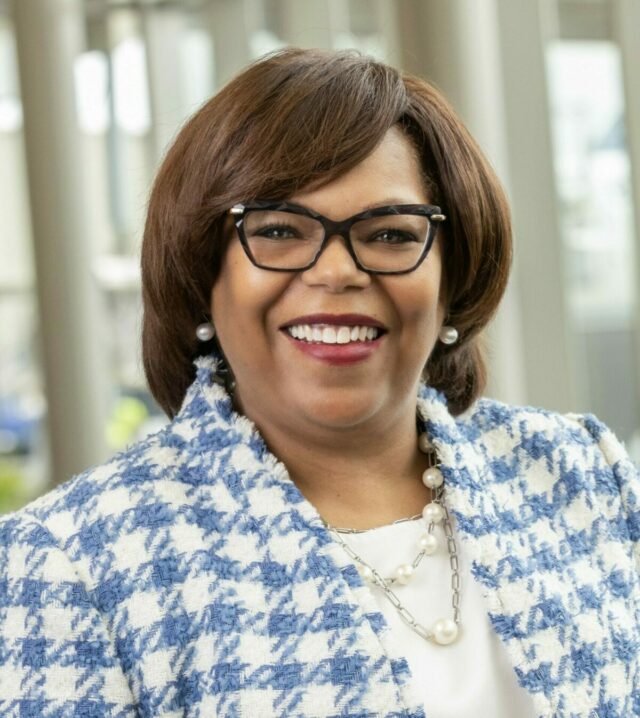
Editor’s Note: Charlene Reynolds, director of John Wayne Airport in unincorporated Orange County for the last four-plus years, was the keynote speaker during the Business Journal’s recent 32nd-annual Women in Business Awards. Reynolds was also a 2024 Women in Business award winner. Following are excerpts based on her speech, which drew a standing ovation from the crowd of more than 700 at the Irvine Marriott.
At 60, I have more road behind me than I have in front of me. And when I look back over six decades, from growing up as one of five sisters in Detroit to becoming the airport director at John Wayne Airport, I realize my career has been less about climbing a ladder and more about learning when to change direction.
I have been a receptionist, a technical specialist, a manager and an airport executive. I have been an overachiever, a perfectionist, a wife, a mother, a widow and, at various points, someone who had to learn how to ask for help.
Lessons came from all of it.
I grew up in a working-class family in Detroit. My parents divorced when I was 12. My mother became seriously ill and my grandmother became our primary caregiver. At a time when I wasn’t sure what my future held, a seventh- and eighth-grade teacher named Miss Johnson saw something in me that I couldn’t yet see in myself.
When I was accepted to an elite Michigan high school, she gave me a photograph with a message on the back: “You and I both know you have great potential. Use it wisely for your gain, not to the detriment or harm of others. Throughout life, you will find many situations where you have power. Use your power to advance others.”
I have carried those words throughout my career.
In the 1980s, I moved to Phoenix, got married, became a mother and started my career as a receptionist at a bank. It was a different era. Women were expected to fetch coffee for male executives and conform to dress codes that included skirts, heels and pantyhose.
I learned an early lesson: Other people may try to define you, but you ultimately have to decide who you will become.
TOUGH DECISIONS
That lesson became more complicated in my 30s.
I joined an engineering firm and worked my way into management and corporate contracts. Eventually, I earned a seat at the table and discovered I was the only woman there. I felt like an impostor, so I responded by becoming an overachiever.
I worked 50- and 60-hour weeks. I earned raises and bonuses. From the outside, I was succeeding. Inside, I was unraveling. My hair started falling out. I suffered severe headaches. After medical tests found no underlying cause, my doctor gave me some blunt advice: Something in my life had to change.
So, I quit.
It was one of the hardest and best business decisions I ever made. I took several months off, reconnected with my family and friends and did something as simple as driving my son to school. I learned that sometimes the smartest career move is to stop, take stock and start again.
That experience changed how I approached leadership. When I returned to work, I became more intentional about what I wanted to learn and where I wanted to contribute.
At the city of Phoenix, I moved through several departments and took on projects far outside my previous experience. I led the city’s first bike-share program and oversaw the replacement of 92,000 streetlights. I knew nothing about lumens or Light dispersion when I started the streetlight project.
But the best opportunities don’t always arrive in the form of jobs for which you are perfectly qualified. Sometimes they are problems that need someone willing to learn.
That philosophy eventually took me into aviation.
I joined Phoenix Sky Harbor International Airport and ultimately became assistant aviation director. I learned that an airport is not simply a place where airplanes take off and land. It is an economic engine, a customer-experience business, a workplace, a collection of small businesses and a critical piece of regional infrastructure.
I eventually became interim CEO, but when l was prevented from pursuing the permanent CEO position, I had a choice. I could view the setback as the end of the story, or I could find another route.
That route eventually brought me to Orange County.
UNCOMFORTABLE CHANGE
When I arrived at John Wayne Airport, my goal was not simply to manage an organization. It was to continually improve the business of running one.
That means investing in the customer experience. It means understanding that restaurants and retail aren’t peripheral but are part of the airport experience. It means supporting the employees who deliver that experience. It means creating opportunities for small businesses. And it means recognizing that innovation sometimes creates resistance before it creates results.
Over the past two years, we have worked to improve the terminal experience through projects including new escalators, expanded food and beverage offerings and a children’s play area, while continuing to focus on the basics that matter to travelers: efficiency, cleanliness, service and reliability.
The work has also brought recognition. John Wayne Airport has received back-to-back recognition from J.D. Power as the top-ranked large airport in its customer satisfaction study.
But the most important lesson is that improvement requires a willingness to change what worked yesterday. That can be uncomfortable for employees, customers and leaders alike.
I know something about uncomfortable change.
CREATING OPPORTUNITIES
Eight months after arriving at John Wayne Airport, my husband of 36 years died suddenly. I was in Orange County. He was in Phoenix. I returned to work a month later because I believed that was what strong women at the top were supposed to do.
I was wrong.
I eventually learned that resilience isn’t pretending you’re fine. It is knowing when you aren’t and having the courage to ask for help. That lesson applies to organizations, too.
Companies and institutions can become so focused on appearing strong that they fail to acknowledge what isn’t working. Real resilience requires honest assessment, trusted relationships and the willingness to change.
Today, at 60, I often think about Miss Johnson’s message.
Leadership is not ultimately about the title on your business card, the size of your organization or the number of people who report to you. It is about what you do with the power and opportunity you have been given.
I have learned that starting over isn’t failure. Sometimes, it is how you find the path you were meant to take. And perhaps the greatest privilege of leadership is not simply reaching the table. It is making room for someone else to sit there when you arrive.