
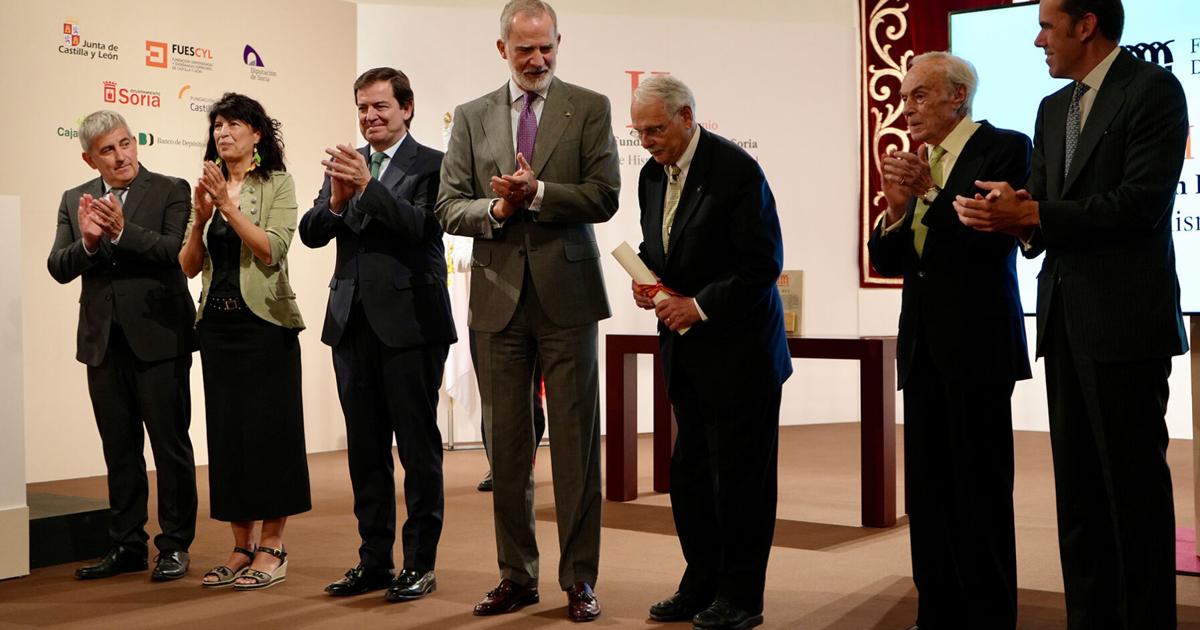
Within the Convent of La Merced in Soria, Spain, UC Berkeley professor emeritus Charles Faulhaber stood shoulder-to-shoulder with King Felipe VI, the current king of Spain.
Faulhaber came to Soria on Sept. 25 to accept the Second Duques de Soria Prize for International Hispanism, which he was granted for the nearly 50 years he has spent as the director-at-large of PhiloBiblon, a database of medieval Romance language texts from the Iberian Peninsula. The award from the Duques de Soria Foundation for Hispanic Science and Culture came along with a grant of 50,000 euros, or about $56,142, to support the project and honors excellence in research into the culture and history of Spain.
Fulhaber felt “Surprised and gratified” when he was granted the award, he told The Daily Californian in an email.
The PhiloBiblon project is a pioneer in the field of digital humanities, which applies digital tools and technologies to studies of the humanities. According to the academic director of PhiloBiblon, UC Berkeley lecturer in Spanish studies Óscar Perea Rodríguez, the team behind the database was employing digital tools in its studies long before the term “digital humanities” was coined.
“PhiloBiblon is by far the longest-running project in the digital humanities in the Hispanic world,” Faulhaber said in Spanish when accepting the award.
The PhiloBiblon project — named after “The Philobiblon,” the 1345 treatise on the value of book preservation and collection in libraries — came after the “Bibliography of Old Spanish Texts,” or BOOST, a register of Spanish language manuscripts. The first edition of this register, published in 1975, contained a mere 966 records. Today, PhiloBiblon holds about 328,000 records.
Faulhaber got involved with BOOST in 1981 after he sent a long letter of additions and corrections to the early editions of the register to then-director of the project, University of Wisconsin professor Lloyd Kasten.
Faulhaber studied with Kasten while getting his master’s degree in Spanish language and literature at the University of Wisconsin. Kasten, alongside his pupil John Nitti, who is currently the professor emeritus of Spanish and Portuguese at Wisconsin, asked Faulhaber to take over BOOST.
“I rashly said yes, and I have been leading the project from then until now,” Faulhaber wrote in an email.
Since then, PhiloBiblon has expanded from just Spanish-language texts, adding Catalan texts in 1986 and Galician-Portuguese texts in 1989.
All works included in PhiloBiblon’s database were originally written during the medieval period, between roughly 1454 and 1520.
“(PhiloBiblon) brings the love of books to the realm of digital humanities in a truly spectacular, breathtaking and pioneering way, locating and describing manuscripts of medieval Spanish literature preserved in libraries all around the world,” King Felipe VI said in Spanish at the ceremony. “Generations of Hispanists have thus contributed to create the largest open-access bibliographic database dedicated to texts written in the three medieval Romance languages of the Iberian Peninsula.”
Maria Morras, a UC Berkeley alumna and tenured lecturer in Spanish literature at the Universitat Pompeu Fabra in Barcelona, has now taken the reins as coordinator of PhiloBiblon.
Perea Rodríguez noted how the PhiloBiblon project demonstrates the evolution of technology: from the first three physical editions of BOOST, to a transition to the CD-format register in 1992, a switch to the Windows website in 2002 and this year, a wiki site, which allows anyone to contribute records to PhiloBiblon.
“Now, if you are in the middle of nowhere in a very dark library and find a manuscript, you can enter it,” Perea Rodríguez said. “We don’t keep the secret, we don’t want the things we know to be kept in the dark so that we’re the only ones who know … The moment we know something, we put it at the disposal of the project.”
With the grant, Faulhaber hopes to clean up the data held in PhiloBiblon and integrate AI into the website as a way of streamlining the research process for users.
Perea Rodríguez emphasized how the PhiloBiblon team, like many others involved in the digital humanities, is figuring out how to navigate the use of AI in the project.
“There is always the temptation of integrating an impressive set of tools into our work, but we are extremely hesitant to do it,” Perea Rodríguez said. “What has guided us to this moment is human interaction.”