
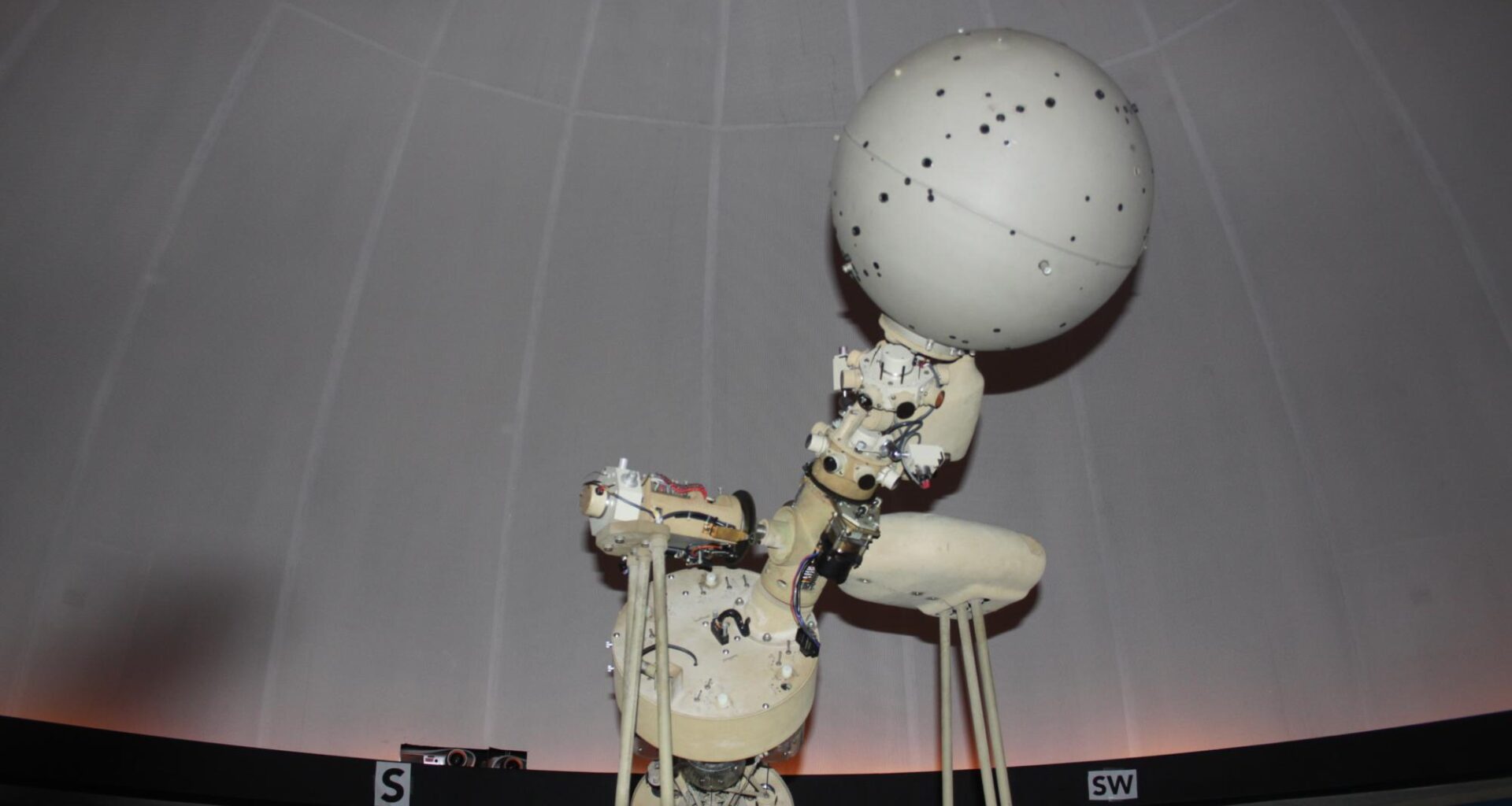
San Francisco State University’s Charles F. Hagar Planetarium held its final show before closure for renovation on Oct. 13, marking a transitional period for a space that has served the campus for more than 50 years.
During the last show, “Tracing Humanity Through the Stars,” astronomy graduate student, Gillis Lowry, used a red laser pointer to trace the sun’s orbit across the planetarium dome before discussing constellations. Lowry’s presentation gave visitors a final opportunity to experience the planetarium before renovations begin during the spring semester.
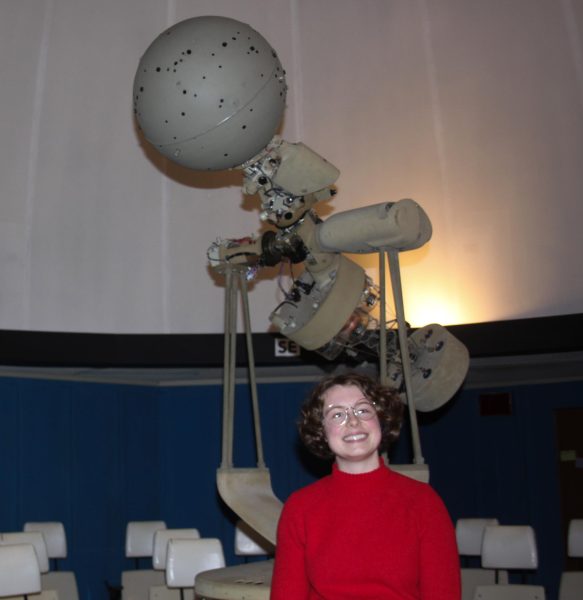 Gillis Lowry asked for one last photo in front of the planetarium’s star projector on Tuesday, Oct. 13, 2026. (Lily Regan / Golden Gate Xpress)
Lowry, who began presenting planetarium shows at SFSU in October 2025, hopes visitors leave with a sense of connection to the natural world.
“I think it’s really important as human beings to take a moment to connect to the world around us,” Lowry said.
The renovations will replace the planetarium’s current star projector. Plans also include a video projection system that would allow presenters to display astronomical images and simulate travel to other planets.
Physics and astronomy professor, Dr. Adrienne Cool, has led the renovation planning. According to Cool, the project has been in development for three years. While the existing planetarium has served its purpose for decades, it needs updating.
“Quite a few planetariums have gone to just pure video,” said Cool. “We made a conscious decision not to do that. One is that you can see the quality of the sky and reproduce the night sky better with a dedicated star projector.”
The department hopes to reopen the planetarium for the fall 2027 semester, but its timeline depends on how quickly funds are raised.
The planetarium received a donation from San Francisco-based foundation, Heising-Simons Foundation. The Heising-Simons foundation funds advancements in climate and clean energy, early childhood education, fundamental physics, astronomy research and human rights.
Despite the foundation’s donation, the planetarium still requires additional funds for a full renovation.
The college of science and engineering is currently raising money for new seating and dome lighting, which are necessary for the planetarium’s reopening. Cool added that fundraising for the video projection system will follow, allowing for the feature to be installed later if necessary.
The planetarium, named after Charles Hagar, serves multiple purposes at SFSU. Astronomy students use the space for laboratory classes, while the site also offers free public shows, including programs for schoolchildren.
For Chris McCarthy, an adjunct assistant professor of exoplanetary science, the planetarium has been part of his life for years. As a former SFSU student, he trained to use the space during his master’s program. Now McCarthy teaches an astronomy laboratory course that uses the planetarium.
“The planetarium represents an opportunity for people to connect to the night sky,” McCarthy said. “It’s a profound way to allow for that connection, especially here in San Francisco, where it can be hard to see the night sky with all the fog and light pollution.”
During the facility’s temporary closure, instructors will need to adjust how classes operate. Cool points to introductory astronomy laboratory courses because students will no longer be able to meet in the planetarium.
However, Cool referenced instructors’ experience teaching without the facility from the COVID-19 pandemic. One alternative is Stellarium, a free online software that simulates the night sky.
“Even though there’s an obvious downside of no planetarium for a while, there’s an upside as well that they’ll learn to use that software and have something at their fingertips that they can use whenever they want,” Cool said.
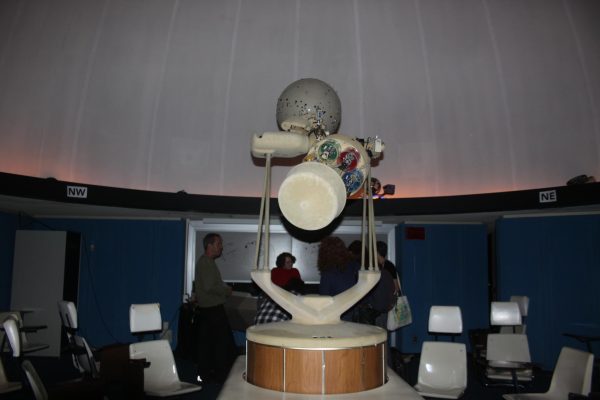 Attendees of the planetarium event gathered behind the star projector and spoke about the show after it ended on Tuesday, Oct. 13, 2026. (Lily Regan / Golden Gate Xpress)
Jim Muyo, director of Development Communications and SFSU alumnus, attended the Oct. 13 show. Muyo remembers gathering with his classmates at the planetarium because of their shared interest in astronomy.
“It was an attraction to come,” Muyo said. “This would be a place that we would come to and gather anytime there was a show.”
Muyo said the final presentation on Oct. 13 taught him about the moons of Jupiter and Saturn.
“It was an opportunity for me to learn things today, which was great,” Muyo said.
The renovation intends to preserve the planetarium’s interactive format while adding new features.
The university chose the new Zeiss star projector because of the quality of the night sky projection it produces. While the planetarium implements the Zeiss projector to supplement digital video, it will retain a dedicated star projector.
The planned video projection system for the Zeiss projector would complement the star projector by displaying images from sources such as the James Webb Space Telescope and allowing presenters to take visitors on simulated journeys across the surfaces of planets and moons.
Lowry looks forward to the combination of the two systems in the evolution of the planetarium.
“There’s a lot we’re going to be able to do in pointing the view back at Earth from space and show us how this is a little pale blue dot in the sky that’s worth protecting,” Lowry said.
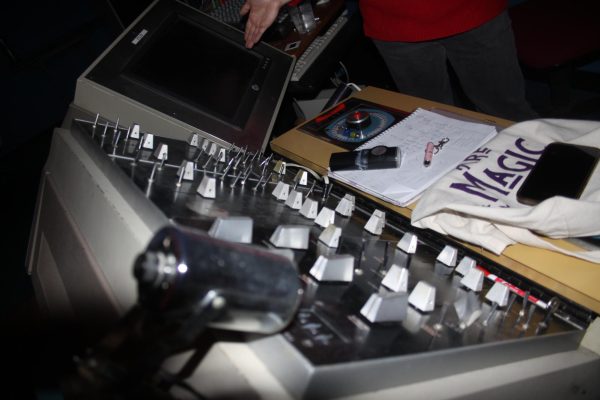 Gillis Lowry used the original planetarium control panel and led an astronomy show about Halloween-themed constellations on Tuesday, Oct. 13, 2026. (Lily Regan / Golden Gate Xpress)
The renovation also considers preserving the existing projector as a piece of the planetarium’s history. Lowry hopes the equipment will be displayed in the renovated space rather than discarded.
For Muyo, returning to the planetarium decades after graduating offered a chance to revisit a familiar space while learning something new. The planetarium’s offered experience of looking up at the projected sky can also provide perspective on life beyond Earth.
“You realize how tiny Earth is and how tiny California is and how tiny our communities are,” Muyo said. “It does kind of give you that perspective that there’s a whole giant universe out there.”
The temporary closure will interrupt the planetarium’s role in university classes and public programming, but the planned renovation aims to preserve its educational uses while expanding what presenters can show visitors when it reopens. The college of science and engineering hopes to reopen the Charles F. Hagar Planetarium before the Fall 2027 semester.