
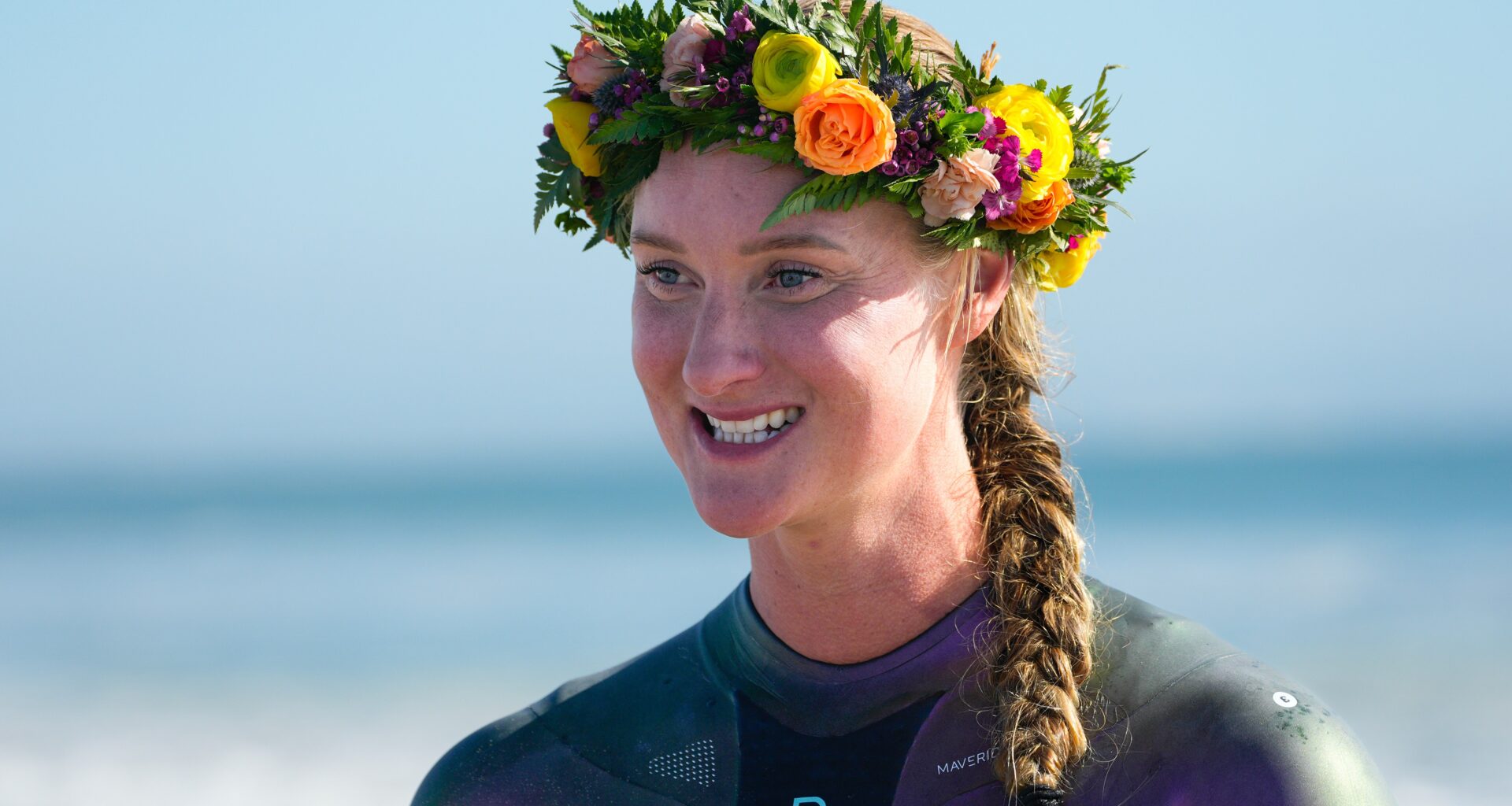
By William Rinehart for the Santa Cruz Sentinel and Austin Murphy of The Press Democrat
SAN DIEGO — Open water swimmer Catherine Breed has completed Swim California, her audacious 900-mile swimming expedition from the Oregon border to Mexico.
After nearly four months freestyling through the Pacific’s cold, heavy seas and often unpredictable currents, Breed logged 9 ½ miles Sunday, the penultimate day of her 400-mile odyssey. That left her fewer than three miles to swim Monday — “a victory lap,” as she described it — to complete her quest.
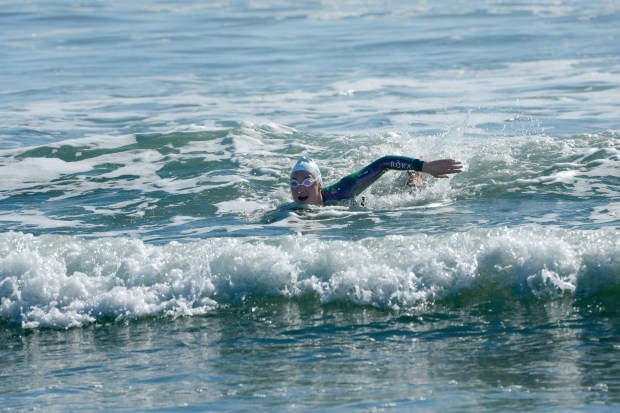 Catherine Breed, 33 from Marin County, reaches the beach at Coronado on Monday, Oct. 19, 2026, in Coronado, CA. Breed began her swim from Brookings, Oregon, to the Mexico border, taking 111 days from the start until Monday, October 19th, and completing nearly 900 miles. (Nelvin C. Cepeda / The San Diego Union-Tribune)
She swam ashore Monday afternoon at Coronado Bay, a ceremonial finish to cap her 111-day adventure.
The expedition is believed to be the first completed staged swim of California’s full coastline, with formal ratification subject to review of its supporting records.
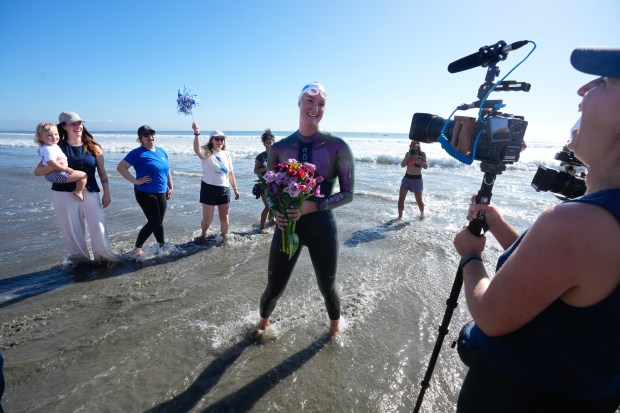 Catherine Breed, 33 from Marin County, reaches the beach at Coronado on Monday, Oct. 19, 2026, in Coronado, CA. Breed began her swim from Brookings, Oregon, to the Mexico border, taking 111 days from the start until Monday, October 19th, and completing nearly 900 miles. (Nelvin C. Cepeda / The San Diego Union-Tribune)
Breed, a 33-year-old Pleasanton native and Mill Valley resident, began the expedition on July 1. She completed the route in stages, supported by a boat and crew, with GPS waypoints linking successive swims and observers documenting her progress.
“For months, I measured my world in the next few miles,” Breed said. “This was harder than I expected, and there were days when I was exhausted and overwhelmed. My team saw those moments and met me with so much patience, encouragement, and care. Every message from someone following along, every person who came out to cheer, helped me get back in the water. I’m still taking in what we’ve done, but mostly I keep thinking about how grateful I am. So many people helped me keep going.”
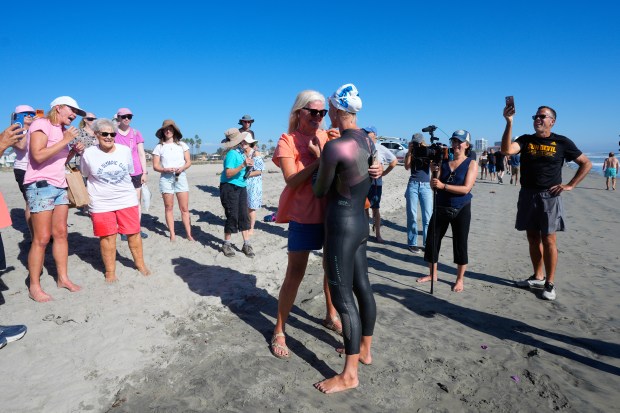 Catherine Breed, 33 from Marin County, is greeted by family and friends after completing her California coast swim. Earlier Breed reached the beach at Coronado on Monday, Oct. 19, 2026, in Coronado, CA. Breed began her swim from Brookings, Oregon, to the Mexico border, taking 111 days from the start until Monday, October 19th, and completing nearly 900 miles. (Nelvin C. Cepeda / The San Diego Union-Tribune)
A former NCAA champion at UC Berkeley, Breed’s collegiate swimming career ended in 2015. She still loved swimming. “But I did not want to look at that black line anymore,” she told The Press Democrat on August 9, Day 40 of Swim California, when she came ashore at Bodega Harbour to update a group of 200 enthusiastic supporters at Westside Regional Park.
She joined the famed San Francisco-based Dolphin Club, whose members urged her to swim the English Channel.
As a warmup to that iconic crossing, she swam the length of Lake Tahoe, 21.3 miles from Camp Richardson on the south shore to Incline Village, Nevada, on the north shore, in the process breaking a 40-year-old record. Since then, Breed has swum the 21-mile English Channel, and the notoriously rough and frigid North Channel between Ireland and Scotland, and the treacherous 30.2-mile crossing from the Farallon Islands to the Golden Gate Bridge.
Breed stepped away from a career in medical technology sales to undertake Swim California. Her journey carried her past the remote North Coast, past the Golden Gate Bridge, across Monterey Bay, along Big Sur and around Point Conception before continuing through Southern California to the Mexican border.
Progress depended on much more than physical fitness.
Weather determined when the team could move. Long stretches of exposed coastline offered few places to shelter. Boat transits, interrupted sleep, nutrition, and recovery added to the demands of returning to the water day after day. Before entering Big Sur, the crew waited in Monterey Bay for a suitable weather window, then advanced through the remote stretch, averaging more than 10 miles of swimming a day.
The expedition also offered encounters few people experience. In her dispatches from the water, Breed described a humpback mother and calf passing beneath her, swimming among dolphins, and watching marine life gather along the coast. She also documented floating litter and the daily decisions required to travel safely through an unpredictable environment.
“I have spent my life loving this coast. Swimming it gave me hundreds of new reasons to protect it,” Breed said. “I saw whales beneath me, plastic beside me, and communities giving their time to look after these places. I hope people who followed this journey choose one place they love and find a way to take care of it.”
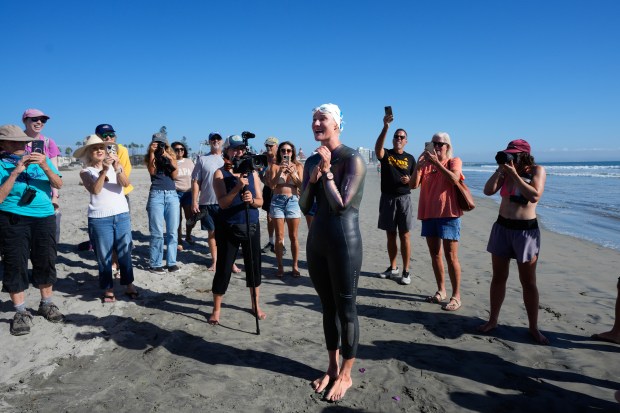 Catherine Breed, 33 from Marin County, reaches the beach at Coronado on Monday, Oct. 19, 2026, in Coronado, CA. Breed began her swim from Brookings, Oregon, to the Mexico border, taking 111 days from the start until Monday, October 19th, and completing nearly 900 miles. (Nelvin C. Cepeda / The San Diego Union-Tribune)
Through her nonprofit, Sea Dreamers, Breed connected the expedition with community gatherings and conversations about kelp forests, marine wildlife, water quality and public access to the coast.
At Bodega Harbor in August, she introduced Maria Brown, vice president of the Greater Farallones Association, who explained how an extreme marine heat wave starting in 2013 led to an epidemic of sea star wasting disease. The resulting explosion in the population of purple urchins, in turn, wreaked havoc on the kelp forests that are the “foundation of our ecosystem here,” Brown said.
Brown then explained how the association, working with scientists at the Greater Farallones and Cordell Bank National Marine Sanctuaries, tribes and the commercial fishing industry, have worked to turn the marine disaster into “a story of recovery.”
“Swimming out here,” Breed told her audience on August 9, “you look at the fog and you look at the dark, murky water, and you think, ‘Oh, there’s nothing there.’
“But it is so the opposite. You guys, this is like swimming in an aquarium out there.”
On that day, Breed pre-emptively broached the subject of sharks.
“They are there. They are fish,” she said.
“The reality is, I’ve got a 52-foot sailboat that I’m one to two meters from, and another boat on the other side of me.
“So I am tucked in between two very large, noisy vessels that any fish is going to try to avoid.”
On Sunday, Breed swam past Imperial Beach, she recounted on social media, “right near the mouth of the Tijuana River where there is a sewage and pollution crisis.
“It is some of the dirtiest water in the United States, if not the world.”
Breed had fortified herself with antibiotics, and was swimming more than two miles offshore. But the water still “felt gross.” At one point she told her crew, “I’m so uncomfortable right now – I feel like I’m swimming through sewage.”
She reflected “on how everyone’s so fixated on sharks, and how interesting it is that we are so scared about these animals that live in the ocean and have no interest in us. And we are more fearful about that than we are about the damage and destruction we are causing to our own home.”
The women serving aboard the expedition also became central to its story. Experienced captains and crew members managed navigation, safety and the changing demands of life at sea. Breed wrote about the confidence she drew from their preparation, clear communication and ability to find joy during an exhausting undertaking.
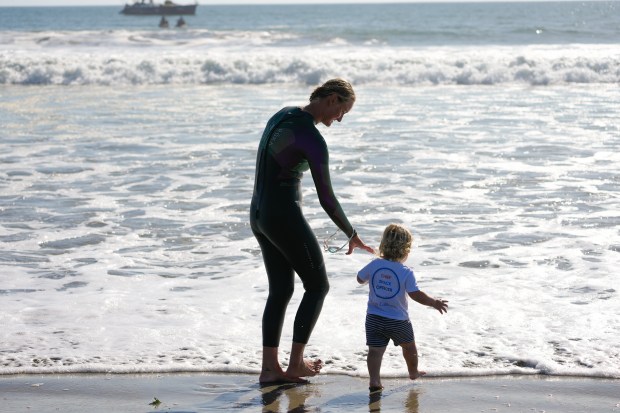 Catherine Breed, 33 from Marin County, enjoys a moment with her nephew, Leon Breed, 2. Earlier Breed reached the beach at Coronado on Monday, Oct. 19, 2026, in Coronado, CA. Breed began her swim from Brookings, Oregon, to the Mexico border, taking 111 days from the start until Monday, October 19th, and completing nearly 900 miles. (Nelvin C. Cepeda / The San Diego Union-Tribune)
“I hope a girl watching this sees a future she hadn’t considered for herself,” Breed said. “I was surrounded by women who could navigate a boat, make a tough call and find something to laugh about afterward. I want more girls to have that kind of confidence in themselves and in each other.”
This story includes reporting by William Rinehart for the Santa Cruz Sentinel.