
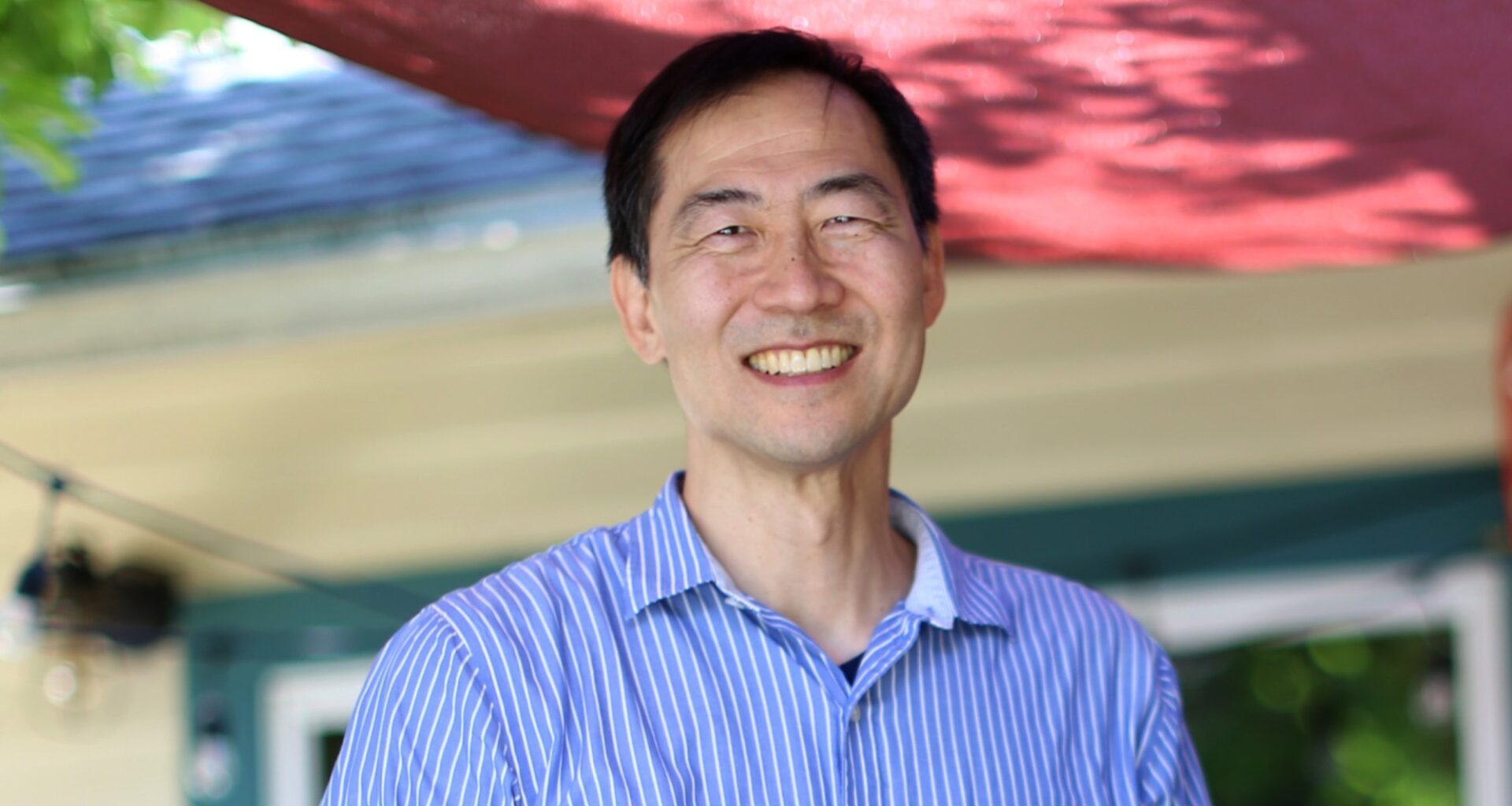
David Pan is one of the most intelligent candidates for the U.S. House of Representatives I have interviewed. He is a professor of German at the University of California, Irvine.
His favorite German author is Heinrich von Kleist (1777-1811), who isn’t well known in English translation. Kleist, a contemporary of Goethe, Hegel and Beethoven, wrote stories that “are fairy tales, but always kind of shocking,” Pan said. He recommended “St. Cecilia; or the Power of Music.”
Pan has a tough road running as a Republican against incumbent Democratic Rep. Lou Correa, whom I interviewed earlier this year, for California’s 46th Congressional District. It includes Santa Ana, Stanton, most of Anaheim and parts of Fullerton and Orange. In 2024, Pan lost to Correa, 63% to 37%.
One of Pan’s distinctive issues is his stance on a universal basic income. It’s different from 2020 Democratic presidential candidate Andrew Yang’s Freedom Dividend UBI, which would create a new $12,000 annual benefit financed largely by a 10% value-added tax.
Instead, Pan’s UBI proposal would replace much of the welfare and entitlement system with an income-adjusted payment of up to $16,000 a year. Existing benefits would continue for those receiving them. But programs would close to new applicants and disappear through attrition.
I asked how his idea held up to free-market criticism that what he’s proposing is socialism. Pan countered his plan is “the opposite of Yang’s. It’s dismantling this huge part of our federal government and giving the cash back to people.”
He further pointed out that his idea isn’t totally alien to free market-enthusiasts. He points to the negative income tax proposal by Nobel economics laureate Milton Friedman, one of my favorite free-market economists. Friedman’s NIT proposal would replace traditional welfare programs with direct cash payments given to poor people through the tax code.
Pan’s website links a 1966 Friedman lecture, which argued the idea was “more compatible with the philosophy and aims of the proponents of limited government and maximum individual freedom.” At the very least, it’s something to think about.
On the $40 trillion national debt, growing at $2 trillion a year, Pan said savings from his plan and higher economic growth would help the federal government better “manage the deficit.” If his proposal indeed trimmed the fat from the bloated entitlement and welfare programs, it certainly wouldn’t hurt.
In related matters, Pan also wants to simplify the tax code by, among other things, eliminating the home mortgage interest deduction and the tax exclusion for employer-sponsored health insurance. While everyone likes deductions, getting rid of them would allow for broader cuts in overall tax rates. Such discussions are verboten in the current Congress. But talking about them is useful to get people thinking.
Given his scholarship, I asked about the rise of the Alternative for Germany political party in recent elections. Usually it’s called “far-right” by the mainstream media. But Pan argues it’s more a doppelgänger to the Make America Great Again movement than anything else.
The four main planks in the AfD’s 2025 platform are restricting immigration; reducing Germany’s “climate change” policies; taking power back from the European Union; and ending Berlin’s support for the Ukraine War. To the latter point, Pan himself supports Ukraine, but backs President Donald Trump ending U.S. financial support in the Russia-Ukraine war.
Speaking of matters of war and peace, I personally agree with Rep. Correa that the Iran war is a disaster. Pan supports the war. “I wish Trump had never let up on the Iranians,” Pan said of the April 8 ceasefire. “I think the seesaw was a big mistake. Once we got in there, we needed to see it through.”
Currently, he said, due to ammo limitations and an “aversion to ground troops,” economic sanctions are the best strategy. He “basically” supports Trump’s actions, but “his vacillations have been a problem.”
On immigration, Pan said “shutting the border is a big win” and is “the prerequisite for reform of our immigration system.” He supports a reform that “doesn’t necessarily mean a pathway to citizenship for everybody who’s here, but certainly some pathway to legal residency for people who are law-abiding…” That could be a future compromise.
On tariffs, he supports “mostly free market policies.” But like Adam Smith, he said, he would make exceptions for national security, such as rare earth minerals.
Although I disagree with Pan on many issues, it would be useful to have somebody über-smart in Congress. Correa is undeniably the favorite to win, but Pan and his ideas are worth considering.
John Seiler is on the SCNG Editorial Board