
Sonja Mihailovic had been looking for an apartment in San Francisco for six months when she decided she was fed up. She’d been in contact with at least 36 different places and “was just so angry.” That’s when her boyfriend encouraged her to share her story on Reddit. Her post, titled “This housing market is insane,” skyrocketed to more than 1.5 million views in just three days and prompted more than 1,000 comments.
With SF rents up 25% since last year, it’s not hard to find a story like Mihailovic’s. As a scientist searching with her friend, a nurse, they have stable jobs with decent salaries, yet they can’t find a place to live that meets their needs. They’re not looking for anything particularly fancy or novel, or even in a specific neighborhood, but every time they show up to view a place, at least 10 people are there, too, desperate to compete in a market that shows no sign of relenting. Rental prices started to climb in 2024, but in 2026, amid fervor from the artificial intelligence boom, the cost to rent a two-bedroom has topped $6,000 a month. It’s the first time that’s ever happened, according to rental marketplace Zumper. No city is experiencing anything quite like what’s going on in San Francisco when it comes to rents, and it’s even spreading throughout the Bay Area.
Mihailovic is one of many hopeful SF residents who have turned to social media to vent their frustrations with renting in today’s market as a “regular person” – in other words, someone not in tech.
“I thought I did everything right that I was supposed to do, and I still can’t afford to step foot in the city,” Mihailovic said.
‘It’s just greed’
Mihailovic moved to the Bay Area, a major hub for the biotech industry, in 2024 to pursue a career in cell therapy, rooming with a co-worker in Belmont while she got settled. But commuting to her office in South San Francisco five days a week – and sometimes six or seven, due to the need to check on her experiments – has been grueling. Plus, she wanted the energy of city life and to embed herself in a community she’d always heard so much about.

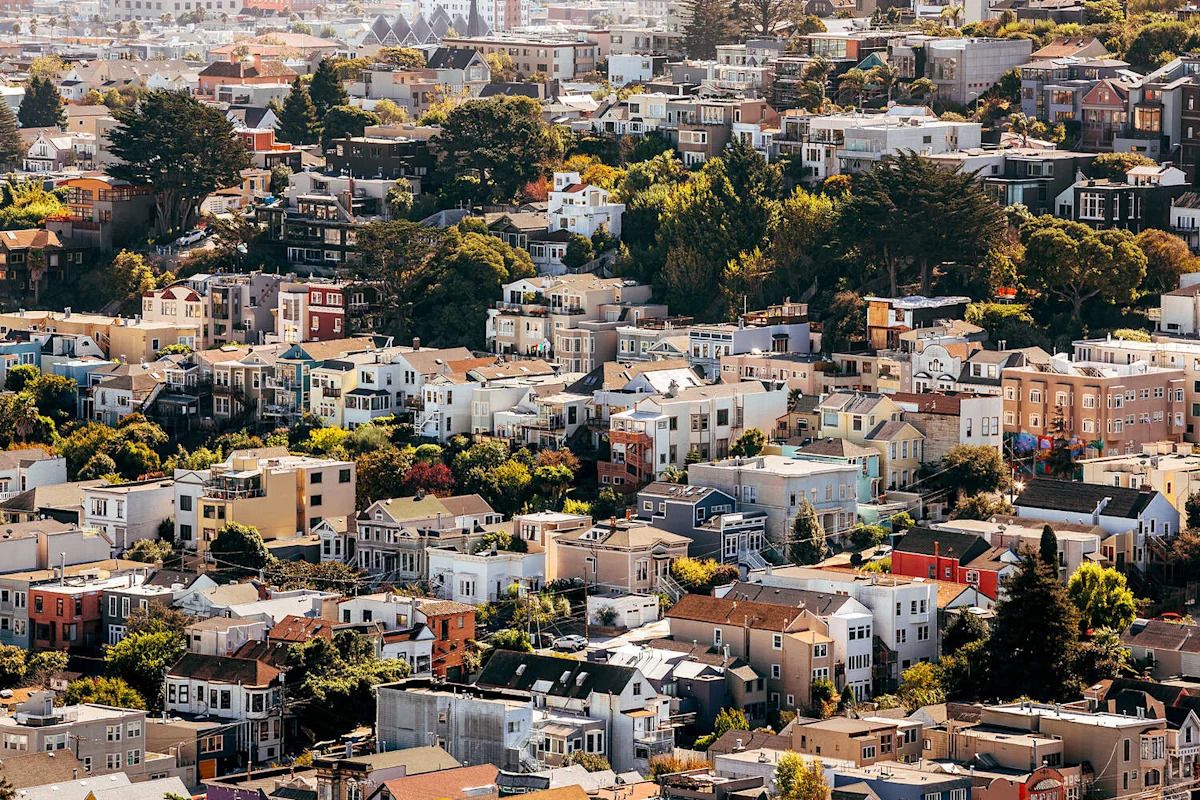
Houses are seen in San Francisco’s Sunset District. (Thomas Winz/Getty Images)
Her frustration peaked after the duo submitted an application for a home in the Inner Sunset and the landlord messaged them to say that, due to “an unexpectedly strong response, with many strong applications,” they were raising the rent $250 from the original list price. In 2024, the same home rented for $1,500 less.
Past rental amounts are public for homes advertised on sites like Zillow, and this wasn’t the first time Mihailovic had seen rents jump, sometimes thousands of dollars in just a few years. “It’s just greed,” she said.
AI is an easy scapegoat, Mihailovic admits, but inflated tech salaries combined with a massive undersupply of housing are creating a culture that’s “degrading,” she said. Even between now and when she moved here, she said SF had a reputation of “being alive, quirky and diverse, and it no longer feels that way.”
The comments on her Reddit post summed up the issue well, she thought. There’s a massive wealth gap, a lack of affordable housing, a pathetic construction pipeline and an industry taking over a town. “This inequality is becoming unreal and unsustainable,” she said.
No end in sight
Mayor Daniel Lurie declared a rental emergency in San Francisco last month and has introduced a package of laws aimed to fight it. In an address to residents, he said the proposed ordinances were designed to keep teachers, nurses, artists and restaurant workers in the city.
“The people who make San Francisco what it is. … There is no recovery without them,” he said.
Yet several experts told SFGATE that while Lurie’s efforts may keep people housed, apartment rents will remain unaffordable. Meanwhile, eviction notices are on pace to hit the highest number in a decade, up 44% this year.

A view of the Glen Park neighborhood on Tuesday, Sept. 30, 2025. (Charles Russo/SFGATE)
Zorica Bruic, the nurse who was searching with Mihailovic, lives in a small studio in San Francisco. She had hoped to find a bit more space, but she also wants to be able to save money to one day buy a home, something that feels increasingly unattainable. She feels stuck. “We’re not making close to what people in tech make,” Bruic said.
Still, she hasn’t given up, and she has done a bit of passive searching on her own since Mihailovic decided to take a break.
“I was attracted to the area obviously for my career, but also because of the great reputation of SF, the social part, beautiful weather, and it reminded me of that European feel, but now it’s really starting to deter people like us because, I mean, if you can’t afford to live here, you’re gonna leave, right?” Bruic said.
You can’t go home again
For those who grew up in and around the city, rising rents may mean never being able to move back home. Sean Taylor was born in the Outer Sunset, the neighborhood both of his parents grew up in. After college, he lived in the city off and on, bouncing between atypical housing situations – such as accessory dwelling units, basements and attics – to make it work.
When COVID-19 hit, he decided to pursue his Ph.D. in North Carolina. That’s where he met his girlfriend, a fourth grade teacher; they decided to move back to San Francisco in June. They found housing through a house-sitting platform while they searched for an apartment, with the plan of living in the city, since Taylor has two brothers here, including one who recently had a baby. “The goal really was to be back home to be near my family,” Taylor said.

Sean Taylor, left, and Isabel Trew pose for a portrait outside their apartment in Mill Valley, Calif., on Oct. 16, 2026. (Lizzy Myers/SFGATE)
They toured plenty of apartments and submitted many applications, but he felt like they kept getting passed over for people with higher salaries. Some tours were outright dispiriting. He said his girlfriend once went to a showing where, after telling the real estate agent they were both teachers, the agent laughed at her and then told her not to bother applying, since the place was going to go to the highest-salaried individuals. At another tour, they found themselves being lectured by an agent about student debt.
After months of searching, Taylor posted on Nextdoor explaining their situation. It “went crazy viral,” he said. Mostly, “people were incredible,” and it was a “wave of support,” but there were also plenty of rude, unhelpful messages.
Ultimately, they found a place in Mill Valley the old-fashioned way, on Craigslist, and he said he thinks they were chosen because the owner “wanted to give a young couple a chance.”
Most Read
Two stabbed inside Bay Area’s largest corn maze
Advice
| My crush on a co-worker might be going too far. What should I do?
News | Man found dead in a barrel in Lake Mead was visiting Vegas
Culture |The real villain in ‘You Can See Everything’ isn’t Elizabeth Holmes
Read our stories ad-free on the new SFGATE app.
He said they are happy to have finally found something, but it’s small, expensive – and not in San Francisco. The process felt wholly different from any of the other times he’s looked for a place to live in the city. “It feels more sinister,” he said.
Especially for people who have no connections in the city and aren’t in tech, he said, finding a rental is beyond daunting. People he grew up with who have “regular” jobs, like working in construction, have only been able to succeed in finding housing due to family connections. He said the hardest part is knowing that people he loves are going to have to make these calculations as their families grow, and “it’s not going to be somewhere that we all stay for forever.”
He’s happy to be back in the Bay Area, but “there’s kind of a deep sadness that I feel when I walk around,” Taylor said.
A familiar story
Both of these stories struck me because they were so similar to my own. I had left San Francisco for personal reasons three years ago and recently had the opportunity to move back. Searching from Los Angeles, where my family and I were living, was proving difficult, even as gracious friends still in SF went to tours for us last minute, to show how serious we were. Applications went unanswered. We saw listings disappear and then reappear at inflated prices. That’s not to mention the difficulty of finding a dog-friendly rental (a word to the landlords of SF: My two children under 5 are much more likely to damage your hardwood floors with their Hot Wheels than my sweet, nap-loving 9-year-old dog is).

San Francisco’s soaring rents are forcing scientists, nurses, teachers and families to compete for scarce housing or give up on living in the city. (Moelyn Photos/Getty Images)
Out of desperation, I took to social media, posting on a Facebook moms group where a wonderful woman reached out to say they were moving in the summer. She gave me a tour of her rental on FaceTime, and we immediately submitted an application, only to have the landlord reply to say she hadn’t realized there had been such “an adjustment” in the market. She raised the proposed rent nearly $2,000. It was a price we just couldn’t afford, especially as non-techies with two children still in daycare.
After much back and forth, we ultimately struck a deal with the landlord after she held an open house. She told me she was shocked by the number of single, male tech employees applying for her single-family home in the Sunset – and offering way more than she had advertised. In the end, she had a heart, even if the rent did go up to a level we could barely accept, and frankly, we’re still struggling to make it work.
And, like most San Francisco renters in a non-rent-controlled place, we live with a certain ever-present anxiety. My landlord may decide to sell the house one day. She may decide one of her kids needs to move into it. God forbid she passes away, and the person with the heart isn’t making the decisions anymore. (Concern about a landlord dying is very real in SF, something I hear repeatedly from friends and co-workers and read in online posts.)
‘It should be enough’
Around 70% of San Francisco’s rental housing is rent-controlled, according to the San Francisco Tenants Union. For those in single-family homes or apartments built after 1979, the frenzied market has sometimes led to egregious price increases. Scientist Dunja Mrdjen was already stretching her budget to justify a one-bedroom apartment in Potrero Hill when her landlord taped a piece of paper to her front door this summer. Her rent would soon increase by $1,000 a month, the notice said.
The price had risen modestly the previous three years she’d lived in the building, which was built in 2016, but this was an adjustment she couldn’t afford. Ninety days may have previously been ample time to find a place, yet after two months of searching, she was getting nowhere. She checked Zillow multiple times a day and looked at an average of five places a week, in every neighborhood.
“It’s never been easy to find a place, but now it just feels impossible,” Mrdjen said.

An aerial view of San Francisco’s Mission Bay neighborhood. (JasonDoiy/Getty Images)
Since her apartment was near Mission Bay, where many AI companies are headquartered, she said she felt like she’d seen the boom firsthand by observing who’d been moving into her apartment building and eavesdropping on conversations in nearby cafes. She suspects the owners of her unit saw the proximity to these HQs as a golden ticket.
“I have an OK salary. It’s not a tech salary, obviously, but it should be enough,” Mrdjen said.
Eventually, she found a place in Pacifica and, for now, said she enjoys the peace and quiet.
“I guess I needed a break from the city because I felt like I was getting pushed out, and I couldn’t even afford to live there,” she said. “I was so stressed out.”
“I love San Francisco, you know, I was really sad to leave,” she continued.
For Mihailovic, hearing other people’s stories has made her feel less alone, even if it hasn’t made her feel less angry.
“I really wish the mayor would hear all of our cries and pleas,” she said.
More Local
– The rise and fall of SF’s 21st century power couple
– San Francisco’s most desirable street is a giant construction site
– Bay Area scientists see rare shark entourage as El Niño looms
– Wealthy Bay Area town is once again the most expensive in the country
Get SFGATE’s top stories sent to your inbox by signing up for The Daily newsletter here.
This article originally published at Desperate SF renters are going viral. Their stories reveal a city at its limit..