
Published Oct. 20, 2026at6:01am
Regular readers of this column know I regularly inveigh against California’s nonsensical ballot-initiative process, which asks citizens to vote on purposely confusing and overly complicated matters that would be better left to lawmakers. This year’s batch of state, local, and regional measures is no exception. San Francisco voters will pass judgment on creating a public bank, enacting complex issues involving real-estate transfer taxes, imposing a tax on billionaires, funding cancer research, and many more.
It’s too damn much. Even I can’t devote the time necessary to understanding it all, and it’s my job to do so.
From a cup-half-full perspective, though, I am amazed at the amount of time and energy “civilian” voters put into analyzing the ballot and then sharing their learnings with friends. Each election cycle, I receive homegrown voter guides that are the result of hours and hours of diligent work.
Take my neighbor Lisa Acree, who decided to make a guide, complete with her personal picks, when her eldest child approached voting age. “I wanted to help her learn about voting, evaluating ballot measures, who funds what and why that matters, and what endorsements tell us,” she told me after I snagged a copy of her elaborate, color-coded spreadsheet that records the recommendations of many ideologically diverse groups. This enabled me to see, for example, that there is nearly no opposition to San Francisco’s Proposition C, which would double the size of the city’s affordable housing trust fund. No further research needed on my part.
(Shameless plug: The Standard’s voting guide pulls off this neat trick as well, but in a neutral fashion that lets you decide for yourself how to vote. It displays a roundup of endorsements from across the political spectrum for each candidate and race, as well as gorgeous graphics that detail who is contributing to what campaigns. If you need a one-stop shop for figuring out the election, this is it.)
What follows are my thoughts on a handful of ballot entries I either feel strongly about or at least took the time to understand. That does not include such snoozer state races as lieutenant governor, treasurer, attorney general, and controller, where Democratic stalwarts will dominate, or either of San Francisco’s Assembly races, where the incumbents also will cruise to victory. Ditto Board of Supervisor races in District 2, 4 and 6, where incumbents Sherrill, Wong, and Dorsey face token opposition.
My advice for those looking for opinionated guidance on every candidate and measure is to choose a voter guide that fits your political persuasion. If, like me, you lean moderate, Grow SF’s guide (opens in new tab) is as thorough as they get. Are you a good-government urbanist? Read (opens in new tab)SPUR’s always-earnest analysis (opens in new tab), which will help you on ballot measures but not candidates. Would you be a Republican if you lived anywhere but here? (opens in new tab)Blueprint SF (opens in new tab) is for you. For progressives, the hands-down best, and funniest, voter guide is from the (opens in new tab)League of Pissed Off Voters (opens in new tab). “We like to say it’s thoroughly researched and thoroughly biased,” its authors write. I disagree with almost everything they recommend, but I respect the honesty.
Now, to my picks.
Congress: Scott Wiener, emphatically Source: Amanda Andrade-Rhoades/The Standard
I have weighed in twice now on why I support state Sen. Wiener over District 1 Supervisor Connie Chan to succeed Nancy Pelosi in Congress. The Chronicle (opens in new tab)said it best (opens in new tab) in its atypically strident endorsement, calling Wiener “arguably the nation’s most accomplished state legislator” while deeming Chan’s legislative record “as spotty as it is sparse.”
This race is close because Pelosi chose to make it so, putting her formidable political muscle behind Chan. Whether or not Wiener was rude to launch his candidacy before Pelosi announced her retirement is a question that does not interest me in the least. We are voting to send our next representative to Washington, not to assuage the hurt feelings of our current one.
Anywhere else in America, Wiener, who would be San Francisco’s first gay representative in Congress, would be part of the progressive wing of his party. In this city’s tribalism, he is the pro-business, pro-housing, pro-common-sense candidate. Chan, who would be the city’s first Asian American in Congress, is the progressive favorite. She also is a housing obstructionist who marches to the drumbeat of organized labor. If you know which side you’re on along those lines, then you know who to vote for.
Governor: Xavier Becerra, while holding back yawns Source: Morgan Ellis/The Standard
This summer, after throwing away my vote on Democratic San Jose Mayor Matt Mahan, I had hoped the British political savant Steve Hilton, a Republican and naturalized U.S. citizen, might inject some excitement into the race to succeed Gavin Newsom. He hasn’t. (Though his “Just try it, California” ad (opens in new tab) certainly raised a fuss.) California needs new ideas in Sacramento, and there is little evidence that Becerra, a seasoned politician with no obvious defining accomplishments to show for his many years of public service, has any. (For an amusing portrayal of Becerra’s blandness, watch my colleague Sophia Garrow’s razor-sharp interview with him.) Yet polling suggests he will win easily, California’s Democratic voters being in no mood to back a Trump-endorsed candidate. It’s a bit shocking that the race for one of the most important positions in the country is so boring, but there you have it.
Insurance commissioner: Ben Allen
I am not an expert on California’s maddeningly complicated insurance policies. Neither is Jane Kim, the popular progressive former member of the San Francisco Board of Supervisors. Mostly based on the arguments of failed candidate Patrick Wolff, someone who does know about insurance, I’ll cast my vote for veteran legislator Ben Allen, who plans to continue reasonable reforms already underway, rather than the suspect new system Kim envisions.
Prop. 38, for cancer research: No
An $8.4 billion bond to fund immunology research sounds like a great idea. It isn’t. The TL/DR is that the measure is a perfect example of one person, Gary Michelson, gaming the system to convince voters to back his medical institute, which would benefit most from its passage. Read the details and decide for yourself, but the good news is that a broad coalition of typically opposed groups is against this one.
Prop. 39, voter ID requirements: No
Resist this MAGA trap. Voter fraud is not a significant problem in California, or anywhere else in the United States, and restricting access to the ballot is a bad idea, whatever form it takes.
Prop. 40, the billionaires tax: No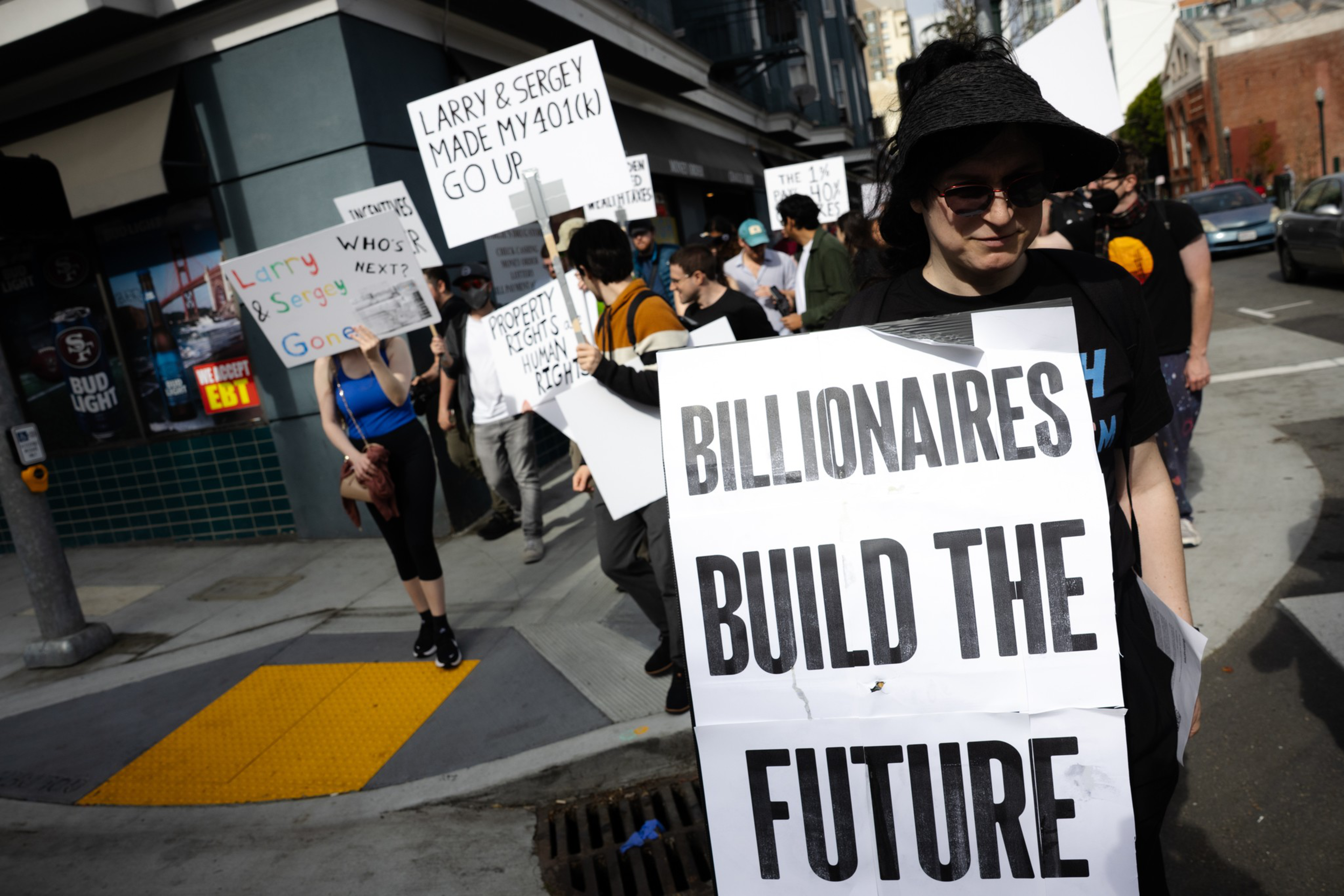 An organizer participating in the March for Billionaires on Feb. 7. | Source: Manuel Orbegozo for The Standard
It is no exaggeration to say the world is watching this proposed 5% tax on the assets of a small group of California billionaires. Enacting it would be an own-goal policy mistake for the state. It is true that the very rich are adept at avoiding taxes because so little of their income comes from wages, which are taxed progressively. We should address this issue, but not with this tax. Journalist Joe Matthews, a clear-eyed analyst of all things California governance, opines (opens in new tab) that Prop. 40 is “how you would write a wealth tax if your goal was to discredit the idea of wealth taxes.” His syndicated column also scorches most of the other statewide measures on the ballot for the perversion of tax-writing policy they are.
There’s been much screaming that Prop. 40 would chase away some of the state’s most accomplished citizens. That’s no idle threat. (The Standard’s chairman, Michael Moritz, who opposes Prop. 40, (opens in new tab)told The New Yorker’s Nicholas Lemann (opens in new tab) he won’t leave if it passes but might’ve thought differently if he were younger.) Moreover, collecting the tax would provoke a tsunami of litigation, meaning the state would be picking a fight with a group of people who love to hire lawyers as much as they hate the idea of paying wealth taxes.
Props. A, D, E, F, and H, to restructure the city’s governance and bail out Muni: Hell yes, yes, yes, yes, and clothespin-on-my-nose yes A bus on the SFMTA’s 38 line struck and killed a pedestrian on Tuesday. | Source: Paul Chinn/The San Francisco Chronicle via Getty Images
Prop. A codifies the restructuring that survived the sausage grinder of last year’s Commission Streamlining Task Force, which recommended trimming the number of commissions and moving the governance of several out of the city’s charter. This is high on the (opens in new tab)goo-goo (opens in new tab) agenda, and I have been gaga about this effort throughout.
I devoted a column to Mayor Daniel Lurie’s three charter-reform measures, Props. D, E, and F. These are good, modest efforts to improve San Francisco’s governance, and they will benefit the city long after Lurie leaves office.
I also wrote about my agony over Prop. H, which I’m supporting grudgingly because I think Muni can find more money in the city’s budget and because a 15-year property tax allows Muni to avoid a fight with its unions, which might entail making cuts it ought to be considering anyway. I am voting yes because it won’t cost me (or most voters) much, and I’d rather keep Muni generously funded while the city continues its economic recovery.
Prop. G, on closing Sunset Dunes: No, with prejudice Source: Tâm Vũ for The Standard
Please can this be the last time San Francisco voters are asked to vote on what to do with the section of the Great Highway between Sloat Boulevard and Lincoln Way, now the glorious park known as Sunset Dunes? Voters rejected Prop. I in 2022 to keep the road open all the time, then passed Prop. K in 2024, which closed the road permanently. There has been litigation, a recalled supervisor, and much agita over this stretch of pavement.
Prop. G, put forward by west-side residents, would open the road during the week, effectively transmogrifying what is becoming a jewel of the city’s park system. This issue continues to run hot in the Sunset. The rest of the city, and many in the outerlands too (including former supervisor and permanent-road-closure opponent Gordon Mar (opens in new tab)), love this park. The spat has garnered (opens in new tab)national attention (opens in new tab). As an east-sider who understands this doesn’t affect my neighborhood but rather benefits the entire city, I have been for Sunset Dunes all along. I still am.
District 10 supervisor: Theo Ellington Source: Heather Diehl for The Standard
I live in D10, so I have a vested interest in choosing its supervisor. This is one where tribal loyalties, rather than a deep knowledge of policy positions, will guide me. There are three candidates considered to be viable, based on having raised real money. DJ Brookter is the choice of the outgoing incumbent, Shamann Walton, a thorn in Lurie’s side. J.R. Eppler has the support of Aaron Peskin, former president of the Board of Supervisors and the progressive wing’s champion of political gamesmanship. Ellington has a varied public- and private-sector background and the backing of the city’s moderate camp, including Lurie and, lucratively, the megadonor Chris Larsen. The League of Pissed Off Voters calls Ellington “the biggest threat to keeping this seat progressive.” He has my vote.
School board: The Democratic slate of Phil Kim, Autumn Brown Garibay, and Tim Tung Source: Noah Berger for The Standard
As with so many citywide races, the fight for school board members breaks down along tribal/ideological lines. The United Educators of San Francisco — the teachers union that I associate with three board members recalled during the pandemic for not paying attention to education — supports one slate. The moderate-dominated Democratic Party establishment supports another, which I am voting for. Incumbent President Kim and PTA stalwart Garibay are the consensus candidates for moderates. Tung, brother of Democratic County Central Committee President Nancy Tung, has an impressive municipal finance background that should prove useful on the board.
There’s a twist, though. SF Parents Action, which played a key role in the recall fight, endorsed incumbent Alida Fisher before Tung entered the race. Fisher was cast off the UESF island for not sufficiently tormenting Maria Su, the SFUSD superintendent, during a recent teacher strike. That earns her my respect, if not my vote.
***
For the rest of the ballot, I will again refer you to The Standard’s voter guide, which will equip you with context and arm you with data. A political tracker (opens in new tab) produced by the elections guru Paul Mitchell shows that barely 6% of San Francisco voters have returned their ballots so far. Election Day is two weeks away. It is time to exercise your civic duty! Item ID: 13295572333