

This story was produced by El Tímpano, a civic media organization serving and covering the Bay Area’s Latino and Mayan immigrant communities.
Liseth M. tucks her 10-year-old son Mateo into bed and kisses his forehead every night. As she turns to leave, she hears the same question he’s asked since the summer.
“When is dad coming back?”
In early July, Liseth said men who identified themselves as immigration agents knocked on the family’s door in the East Oakland neighborhood where they live. They told her they were searching for a person who no longer lived in the building, but when they checked the family’s IDs, the agents found her husband had re-entered the U.S. illegally more than two decades ago.
Liseth, her 10-year-old and 17-year-old sons, and her 18-year-old daughter are applying for asylum. She has asked to be identified by only her first name and last initial for fear of retaliation.
According to Liseth, immigration agents arrested her husband that day in July and took him to an immigration detention center in Bakersfield. In September, he was deported to his home country, Honduras.
Since then, a crisis has unraveled at home. Ten-year-old Mateo has skipped school multiple days because of mental health issues. Liseth is struggling to pay the rent, college-related fees and other basic needs. Next month, they may risk eviction.
Liseth and her children are among a growing number of Bay Area families struggling to pay rent and other basic expenses after a head of household is detained or deported. In response to a growing crisis, a network of mutual aid organizations and a regional foundation have stepped in with financial relief for rent, food, transportation and legal fees. But resources are running out, forcing them to scale back support for rent and other needs in the Bay Area, where the cost of living ranks among the highest in the country.
“We’ve had to turn folks away,” said Angel Ibarra-Nuñez, Alameda County Immigration Legal and Education Partnership co-director at Centro Legal de la Raza, an Oakland legal aid organization that has provided rent assistance to immigrants who are victims of deportation or detention since last year. “We have a backlog of applications because we’re running out of funds.”
Immigration arrests skyrocketed across the country, and in the Bay Area, this past summer. In July, immigration authorities arrested more than 49,000 people across the country, including more than 10,000 in just five days. In August, the number rose to nearly 51,000 and is expected to keep climbing. In Northern California, ICE made 890 arrests in July. That’s more than a 60% increase since February, the last month for which this data was previously available, according to a KQED analysis. Lisbeth’s husband was among those detained in July.
As the Trump administration ramps up its immigration crackdown, including an unconfirmed 45-day enforcement surge called “Operation Safe California,” ahead of the midterm elections, Bay Area immigrant families have fewer places to turn to for support.
When Liseth’s husband was arrested in July, she said she only had $200 cash in her pocket to get by. As a construction worker and mechanic, her husband was able to cover $2,000 in rent for their three-bedroom apartment, groceries and daily transportation. Liseth divided her time between selling goods at La Pulga, Oakland’s largest flea market, and taking care of her children. Her 18-year-old daughter is a first-year college student on scholarship.
After her husband’s detention, mutual aid organizations helped Liseth cover two months of rent and gave her a $500 grocery gift card. But after his deportation, his absence became permanent, and the short-term help was insufficient. She’s struggling to get enough work hours for November’s rent, and the organization that helped her has run out of funds.
Her landlord has offered not to charge her for water and trash until she is stable again, but she said he told her she will need to leave the apartment if she can’t pay rent in full.
“Our lives changed completely because our head of household is no longer with us.”
Liseth M. of Oakland, whose husband was deported
“Our lives changed completely because our head of household is no longer with us,” said Liseth, sitting in her living room on a Saturday morning. Liseth said the days her husband wasn’t called to a construction site, he’d find work as a day laborer.
“He never stopped, so we didn’t have the need we have right now.”
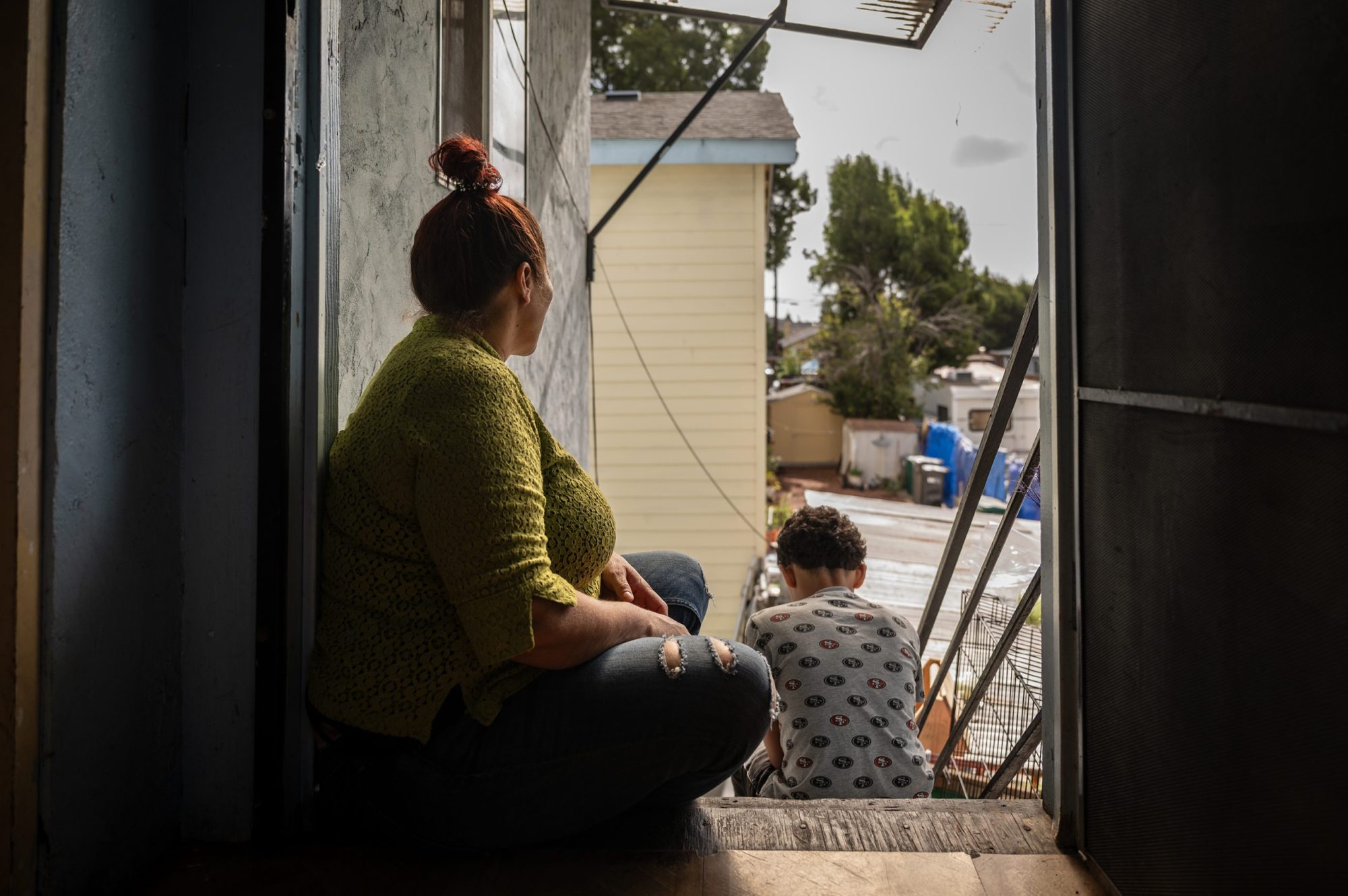 Liseth M. sits beside her son, Mateo, on Saturday, Oct. 10, 2026. Since her husband’s deportation, Liseth has struggled to cover the family’s $2,000 monthly rent. Credit: Hiram Alejandro Durán/El Tímpano
Liseth and her three children are all undocumented, and they don’t qualify for federal rental assistance like Section 8 or public housing because of their immigration status. The Trump administration has also proposed to cut U.S. citizens off from these programs if they live in a mixed-status household, leaving people with fewer places to turn to for help.
Aid runs out
Last year, when Trump threatened to deploy the National Guard and immigration agents in the Bay Area, regional political leaders and the San Francisco Foundation — an El Tímpano funder — came together to launch the Stand Together Bay Area Fund. The initiative gives urgent financial assistance to eligible families who are unable to pay rent or buy food after the deportation or detention of a breadwinner, as well as people who have lost income because fear of enforcement is keeping them from work.
The San Francisco Foundation administers the fund and distributes it in grants to trusted community-based organizations. So far, the fund has raised $3.6 million, over a third of its $10 million goal, Judith Bell, San Francisco Foundation’s chief impact officer, said in an interview. As of August, 626 households and at least 2,000 individuals across the region have received assistance, according to a Foundation spokesperson.
But this year fewer donations have come in and as a result, the foundation is scaling back fund distribution across its partners. “This is part of the tragedy that’s underway,” Bell said. “We don’t have enough resources, so we have given as much as we can.”
Alameda County Supervisors Nikki Fortunato Bas and Elisa Marquez contributed $50,000 each to the fund from their county discretionary budgets last year. Although a number of high-profile leaders like Oakland Mayor Barbara Lee, San Francisco Mayor Daniel Lurie and San Jose Mayor Matt Mahan promoted the initiative and pledged to support the fund last September when it was launched, city funds have not been allocated to the fund.
 An open bible rests near a window in Liseth’s home.
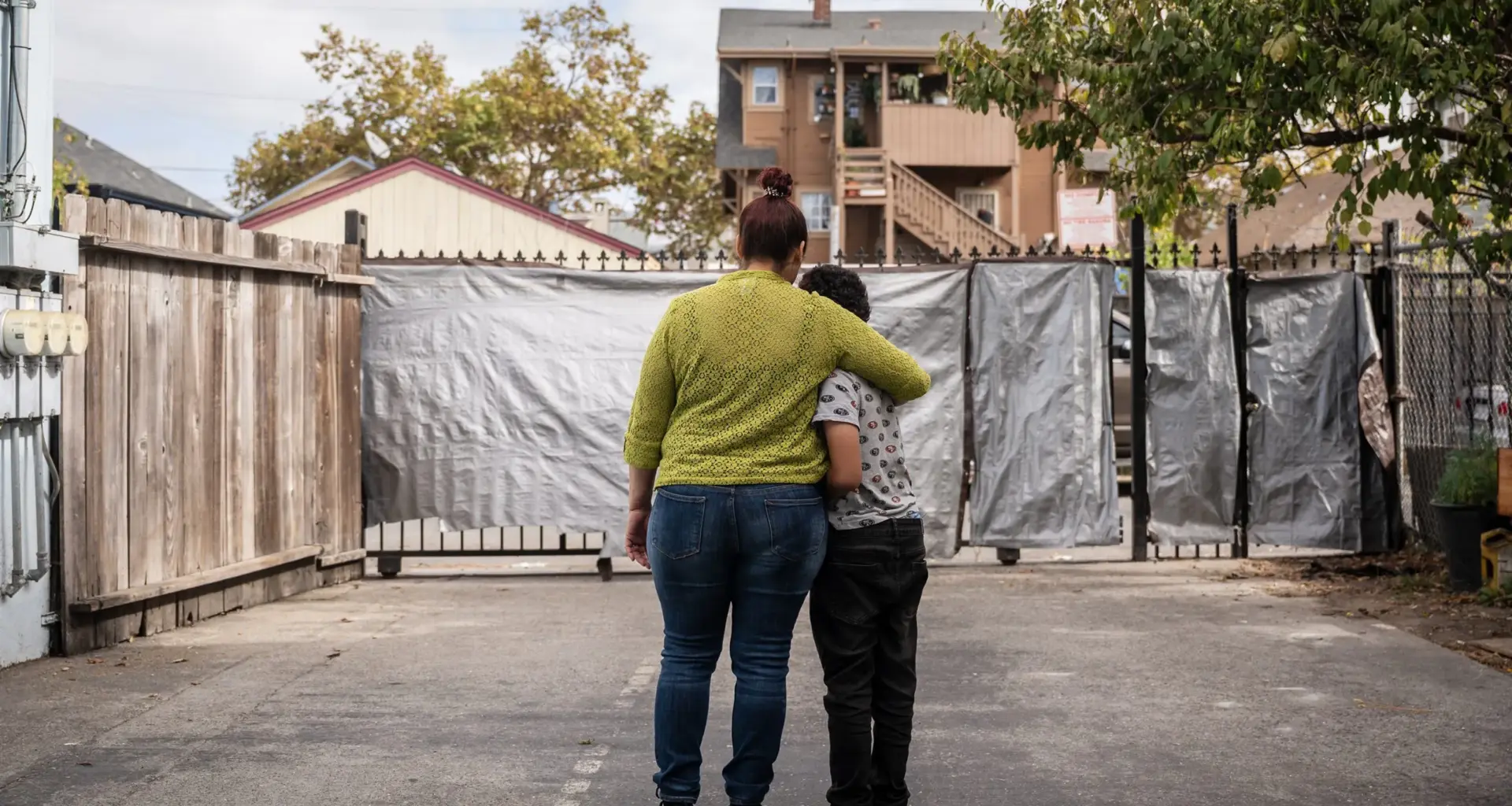
 Liseth M. and her son Mateo embrace.
Credits: Hiram Alejandro Durán/El Tímpano
In response to questions about fund contributions to Stand Together and rent relief efforts for families impacted by detention or deportation, Shelby Weiss, a spokesperson for San Francisco, and Tasha Dean, who works in the office of Mahan, the San Jose mayor, said city funds were never part of the commitment, but rather that the mayors pledged to help raise funds in other ways.
Sarah Henry, a spokesperson for Mayor Lee, said the mayor had raised $100,000 for the regional fund earlier this year, “and is actively fundraising with private and philanthropy partners.”
All three cities pointed to their own city-funded efforts underway, including deportation defense, legal clinics, family emergency planning and one-to-one financial counseling. In San Francisco, anyone, regardless of immigration status, can apply for a broader rental assistance program, which prioritizes city residents at imminent risk of eviction or homelessness.
A quiet crisis
In recent months, the Trump administration has changed its detention and deportation strategy. Instead of high-profile raids like the ones seen in Minneapolis or Los Angeles, the administration quietly arrested more people in July and August than at any other time during the president’s second term.
Immigrant advocates say the administration’s revamped strategy is playing out in courthouses, at scheduled appointments and during check-ins with immigration officials across the Bay Area. Many of these cases take place far from the public eye.
“If you are not connected to, or in, an immigrant community, you’re just not as aware of how significant the crisis is,” Bell said.
Ibarra-Nuñez of Centro Legal de la Raza said the absence of visible high-profile detentions has diminished the sense of urgency that can help leverage more resources in the region, forcing community-based organizations to choose who they can support.
“When we first started, we were paying a full month’s rent for townhomes, and now it’s looking like we’ll need to cut that back a little bit to see how or what we should prioritize,” Ibarra-Nuñez said. Centro Legal de la Raza received $130,000 from the San Francisco Foundation last year, but he said because of lack of funds, they will be receiving less than half this year.
In response to similar immigration sweeps, Los Angeles County opened an emergency rent relief program to assist individuals or families impacted by detention or deportations since last September. The funds cover up to six months of unpaid rent or $15,000 per rental unit.
“We’re left with absolutely nothing. I don’t know what we are going to do.”
Liseth M., whose husband was deported
The county deposits the funds directly into a bank account, and families can apply regardless of immigration status as long as they submit some documentation that proves they have been affected by immigration detention, according to the Los Angeles County Department of Consumer and Business Affairs website.
There are no such programs in the Bay Area, but immigrant advocates said the region needs a long-term solution to address the crisis. “There is almost a nonexistent funding source for this type of support. One that is flexible, that can be provided to undocumented families outright,” Ibarra-Nuñez said. “The regional counties should get together and really think about the impacts the deportations are having on immigrant families.”
On a Saturday morning in October, Mateo reaches up to Liseth to give her a tight hug. It’s been just a few weeks since her son started to smile again.
“He was depressed, but he’s a little calmer now,” she said.
After several days of skipping school because he missed his dad, the 10-year-old boy returned to class. When Liseth M. told his teacher her husband was deported, the school responded with mental health counseling for her son and a gift card to pay for groceries.
Still, Liseth wakes up every morning worried about how she’ll pay rent in two weeks. And the clock is ticking.
“We’re left with absolutely nothing,” she said. “I don’t know what we are going to do.”
Additional reporting by Vanessa Flores.
“*” indicates required fields