
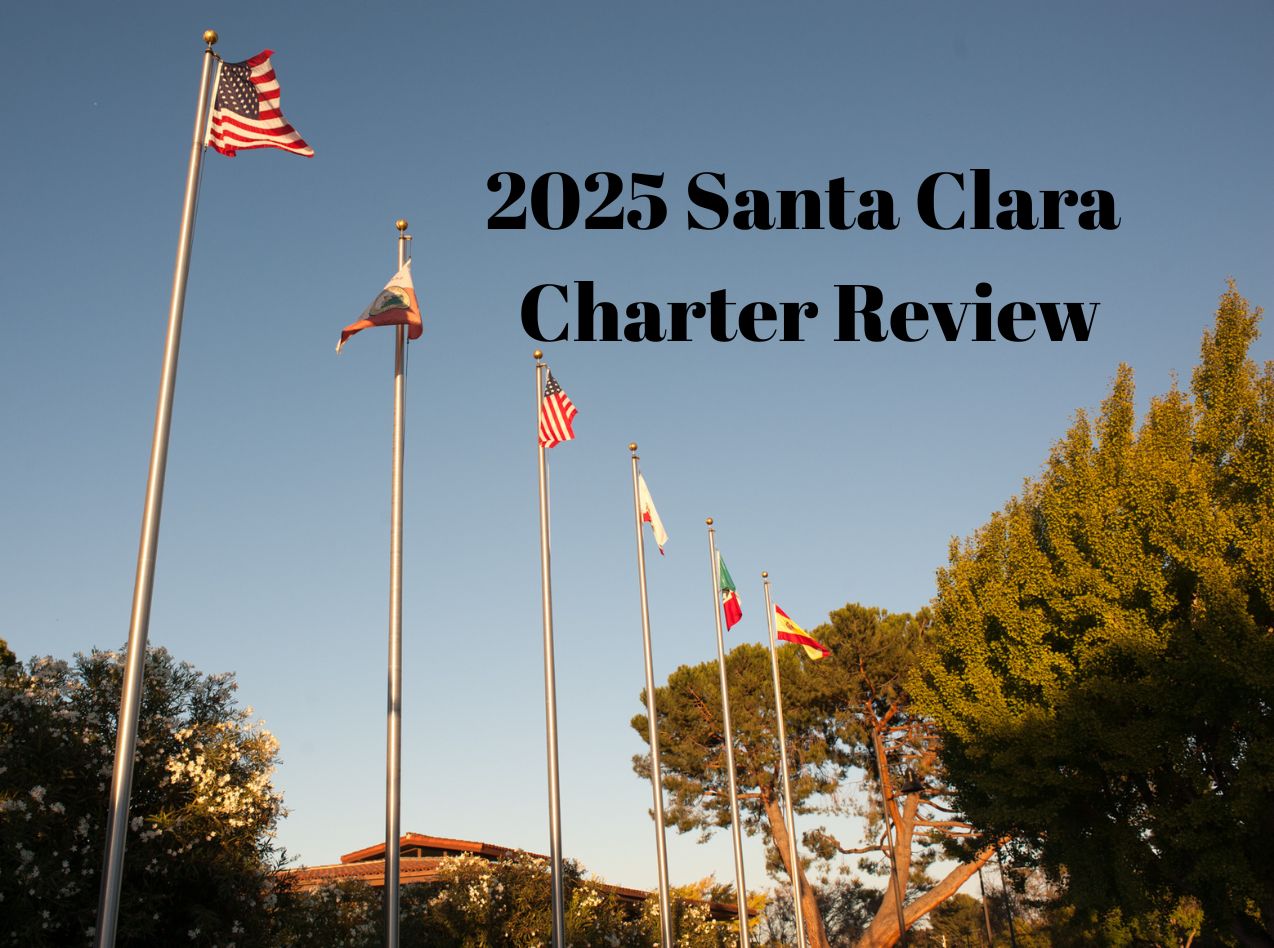
The first two meetings of Santa Clara’s new charter review committee were focused on organization, process and putting together a work plan.
City council approved the creation of the committee at its July 15 meeting and appointed the 13 members at the Sept. 16 meeting. The committee’s goal is to complete its work next June, in time for a Nov. 2026 ballot measure.
The council appointed: Mark Boeckman, John Brooks, Eric Crutchlow, Lauren Diamond, Burt Field, Eric Jensen, Steve Kelly, Mohammad Naveed, Pat Nikolai, Susan Peters, Holly Rhea Roberts, Joe Sosinski and Bernard Thamsey.
SPONSORED

SPONSORED

At its first meeting last month, the committee elected former police chief Pat Nikolai as chair and Joe Sosinski as Vice Chair.
At the second meeting, the group formed six subcommittees that will focus on specific parts of the charter. Unlike past charter reviews, this effort is a comprehensive overhaul of the entire charter, and the goal is a single 2026 ballot proposal for a comprehensive revision.
Santa Clara’s charter was written in 1950, and time has rendered some of its provisions outmoded — for example, the charter requires council approval for expenditures over $1,000 — that would be about $13,500 in 2025 dollars. Other provisions don’t reflect current city practices or contemporary best practices in public administration, according to City Attorney Glen Googins.
The proposed changes will be brought to the city council in three groups: Level 1 changes are corrections and reorganizations. Level 2 changes are ones that align the city’s operations with accepted best practices. The last group, level 3, are changes so substantial or potentially controversial that Council may wish to consider them separately or not at all.
The city attorney’s office made subcommittee assignments based on members’ preferences when possible:
Powers and Structure of City Government: Rules/Process for Action: Tansey, Nikolai and Jensen
City Council: Elections, Powers and Conduct of Meeting: Kelly, Boeckman, Crutchlow, Roberts and Peters
Senior Officials: Duties and Qualifications: Tansey, Nikolai, Diamond and Naveed
Boards and Commissions: Composition, Powers and Duties: Diamond, Brooks, Field Sosinski
Civil Service: General Rules for Classified and Unclassified Employees, Commission Composition and Duties: Peters, Boeckman, Roberts and Naveed
Fiscal Administration and Procurement: Crutchlow, Brooks and Field
Subcommittees Not Subject to Open Meeting Laws
Ad hoc “advisory” subcommittees aren’t subject to California’s open meetings law, the Brown Act, as long as they are temporary, the members don’t make up a quorum of the whole committee, exist to address a single task —“ad hoc” — and the subcommittee sets its own schedule for meetings.*
Exemption from the Brown Act means they don’t have to publish agendas and minutes, and meetings aren’t necessarily open to the public.
“You don’t [have to take minutes],” said City Attorney Glenn Googins, but “I think it would be a good idea … for someone to make notes of what your meeting consisted of, because that will facilitate your report out to the larger committee.”
Members of the city attorney’s office will attend all subcommittee meetings.
If subcommittee members discuss their work with other members of the larger committee, they risk violating the Brown Act with a “serial meeting” — something that can happen easily with social media.
Resident Michele Ryan raised concerns about committee transparency.
“It was said that the data on the subcommittee preference was shared with the committee and it was made public,” said Ryan. “But it is not available online to the public. Materials that were provided to the committee are not available to the public. So that, I think, needs to be corrected.”
City Attorney Googins explained that this information was distributed to the committee at the meeting and would be “available as soon as possible.”
Conflicts of Interest?
Ryan had a second question, saying that it was “concerning that the former chief of police [Nikolai], who may still have strong connections, is assigned to the group that is dealing with senior officials. It seems that that presents an appearance of conflict of interest.”
Nikolai is a close political ally of Mayor Lisa Gillmor, and was a leader in opposing a charter change to appoint, rather than elect, Santa Clara’s police chief. Nikolai, who retired in 2024, was the longtime president of the police union before being elected police chief when the prior chief, Mike Sellers, retired in 2019.
Googins didn’t see a conflict, “certainly not a conflict under the Political Reform Act, because there’s no financial interest. I’m not seeing a conflict that would apply and limit you [Nikolai], at least in the formation of the committees and your appointment to it, Mr. Chair. If you had a one, we could look into it a little bit deeper before you actually participate on that committee.”
The next Charter Review Committee meeting is scheduled for Nov. 19, 2025. The meetings are streamed on Zoom and are available on the city website the following week.
Zoom link: https://santaclaraca.zoom.us/j/86127408402, ID 861 2740 840.
Phone: (669) 444-9171.
*The First Amendment Coalition has a discussion about the application of the Brown Act to ad hoc subcommittees: firstamendmentcoalition.org/asked-and-answered/how-does-the-brown-act-apply-to-ad-hoc-versus-standing-committees/
SPONSORED
