
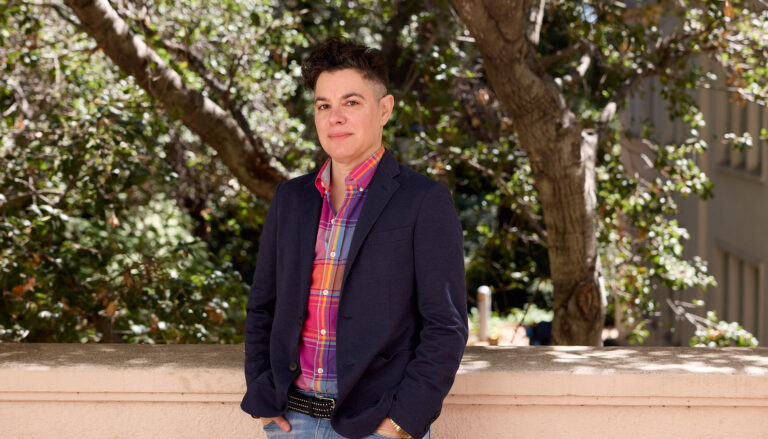
Talmudic culture professor Rafael Neis explores the surprising world of ancient Jewish texts — and finds ideas about gender that challenge modern assumptions.
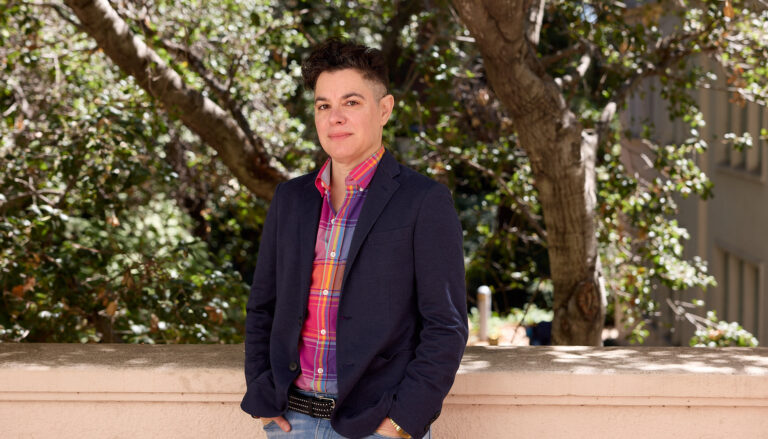
Rafael Neis is a professor of Talmudic culture in UC Berkeley’s Department of Middle Eastern Languages and Cultures. Jen Siska/UC Berkeley
Born in Northwest London into an Orthodox Jewish community, Rafael Neis started reading the Bible in Hebrew before they learned the ABCs. That early immersion grew into a scholarly interest in understanding ancient Jewish texts.
Neis found that the peculiar stories in sources like the Talmud — a vast compilation of law, interpretation and debate from rabbis who lived between the second and seventh centuries CE — were of another world: one where a human might give birth to a different creature altogether and where ideas of gender were more flexible.
“The authors of these stories, ancient rabbis in Roman Galilee and Iranian Mesopotamia, did not live in the world that we live in,” said Neis, who is the Hermann P. & Sophia Taubman Professor of Talmudic Culture in UC Berkeley’s Department of Middle Eastern Languages and Cultures. “They did not assume that there were only two sexes. They knew that people could change, either spontaneously or by their own hand. I want to understand their cultural universe.”
Next semester, Neis will teach an undergraduate seminar on the Talmud and RECUPERATE!, a graduate course co-taught with Roni Masel, an assistant professor of comparative literature and the Norma and Sam Dabby Professor of Jewish Studies. The graduate course will critically examine contemporary efforts to “recuperate,” or recover, supposedly ideal pasts.
Neis, whose research challenges conventional interpretations of ancient rabbinic texts, joined Berkeley’s faculty this fall. They are the latest faculty member featured in After Office Hours, a UC Berkeley News series in which researchers explain the insights and experiences that shape their work. Below, Neis discusses how these texts complicate modern assumptions about gender and what makes us human.
What was your Fiat Lux moment — the breakthrough or new insight that changed your work?
Almost a decade ago, I was reading weird ancient accounts in which rabbis talk about humans giving birth to beings that don’t look human, and of animals who give birth to other species, like a cow who gives birth to a horse. At first I thought I was going to write about abortion and miscarriage, and I still did, but I realized that these births raised much larger questions about the rabbis’ scientific universe. I began to wonder: What was the thinking behind such a world? And what does it teach us about how they understood reproduction and the supposed uniqueness of being human?
People often invoke the so-called Judeo-Christian tradition to claim that the human is sacred to support arguments about how we should live. But the idea of a Judeo-Christian tradition is a modern invention, one that subsumes Jewish teachings into a Christian agenda. My research shows how ancient Jewish sources have a very different understanding of the human, of reproduction, of miscarriage and abortion and life.
What would people outside your field be surprised to learn about your work?
Ancient Jewish sources are often hilarious. The stories are funny, irreverent, odd in our eyes. They are not what you might imagine a sacred religious tradition to be: The rabbis will talk about how many times a day it’s best to defecate, good ways to have sex, magical recipes for various prosaic or otherworldly problems. They also talk about God and how to divide up inheritances. So they range from the transcendent and sublime to the banal and prosaic.
What’s one thing happening right now that your research helps explain?
Many people tend to think of gender in incredibly binary terms. If they’re more liberal, they might be very accepting of trans and nonbinary people, but they nonetheless take cisness as the default. If you meet someone, you assume they’re cis. Trans people need to “come out.” The right might invoke the Judeo-Christian tradition to say, “God created man and woman,” arguing that there have only ever been two genders and that anything else is a travesty. To counter this, trans people resort to proving that they have “always existed,” as the slogan goes.
My work challenges all these positions. It is not that trans people have “always existed” as minority genders alongside normative ancient men and women. Instead, it is the constraining idea of binary and stable sex that is more recent. The rabbis and many others did not assume just two sexes. They knew there was great variety among people. They knew that people could change, either spontaneously or sometimes by their own hand.
I am not saying that the world in which the rabbis lived was a utopia. What we would call sexism, racism and ableism existed alongside ideas of species and gender that seem more flexible to us today. So it’s not about returning to a rosy past. But visiting with it, warts and all, still allows us to see things differently.
What are you working on that you’re especially excited about?
I’m creating a narrative comic called Talmud: The Graphic Novel. The Talmud is part ritual manual, part ethico-legal compendium and part narrative anthology. It contains layers of rabbinic traditions that later editors arranged into literary passages, stylized debates and stories, interspersing them with their own back-and-forth comments.
In a volume called Berakhot, or “Blessings,” for instance, you move from a debate about liturgical blessings to a discussion of miraculous survivals of catastrophe, to a series of health tips, to a manual on dream interpretation, topped off with an anecdote about a conflict between fourth-century CE sages.
The elements of comics — panels, captions, speech balloons and thought bubbles — are perfect for representing this text. I represent the ancient editors who assembled and commented on these teachings as a masked chorus. In ancient Greek drama, the chorus might react, interrupt, interact with or influence the protagonists. In the spaces between panels and in the margins, I add alternative perspectives: ancient women, eunuchs, children or demons dispute or react to the rabbis’ statements or actions. And, occasionally, a version of me interjects and comments, serving as a bridge between the Talmud and the reader.
I want the graphic novel to be for people who have not read these texts. It’s an eclectic introduction to the Talmud that invites readers to take pleasure in its lack of distinction between the profound and the mundane, and in the fascinating and sometimes troubling world it reflects and envisions.