
PG&E has named its official price for San Francisco to buy its grid — and it’s even higher than before.
In a 1,164-page filing sent to the California Public Utilities Commission on Tuesday, PG&E said it would cost the city $22.5 billion to acquire the company’s grid.
The appraisal includes the revenue that would be lost after ending its San Francisco business, and damages from physically separating the grid which is connected to its larger grid throughout the state, the company said.
“A government takeover of our grid is not the right solution for our San Francisco customers,” PG&E CEO Patti Poppe said in a statement. “We have decades of specialized expertise operating San Francisco’s complex electric system. And now our filing shows that a takeover doesn’t make financial sense for customers.”
San Francisco officials have previously called PG&E’s $20 billion estimate “absurd” noting that the utility’s quote exceeds the city’s entire budget.
The city has, over the past century, explored taking over PG&E’s grid and running its own public utility at least 10 times. Those efforts included eight failed bond measures (opens in new tab) from 1927 to 1941 and two failed 2001 ballot measures (opens in new tab). When PG&E previously filed for bankruptcy in 2019, former Mayor London Breed and former City Attorney Dennis Herrera offered to buy the grid for $2.5 billion (opens in new tab), which the utility company declined.
 Patti Poppe, CEO of PG&E. | Source: Photo by Ilya S. Savenok/Getty Images for GE
The biggest cost difference between the city’s and PG&E’s estimates is the “fair market valuation” of their grid assets. The city claimed in April that the infrastructure is worth roughly $3.4 billion, while PG&E claims that its value is around $13.9 billion.
To justify a price roughly four times the city’s estimate, PG&E argued that San Francisco assigned no value to more than 2,000 easements, licenses, and other land-use rights, a choice PG&E said shaved more than $1.7 billion off the city’s valuation.
PG&E also argued that San Francisco lowballed the cost of rebuilding its underground electrical infrastructure, putting it at roughly a quarter of what the work actually costs. That matters because estimating the grid’s valuation is based partly on how expensive it would be to rebuild.
The city estimated that installing an underground conduit, the protective piping that contains power cables, would cost about $247 per foot. PG&E claims comparable projects have cost nearly $1,000 per foot.
Lastly, PG&E said San Francisco didn’t account for the possibility of other government entities, such as the state of California, offering a higher price, something the utility claims the city must do when calculating its own bid.
The arguments were scattered across 10 chapters of testimony from 22 witnesses, a nearly 400-page real estate appraisal of the company’s land and easements, an asset-by-asset depreciation study, and a grid-separation engineering report.
“San Francisco’s current proposal rests on an unrealistically low valuation of PG&E’s Assets,” the filing said.
PG&E claims a city takeover would incur $8.6 billion in damages, including from physically separating San Francisco’s grid from the utility’s larger network and eliminating a pool of 400,000 customers that pay into its statewide efforts for grid safety and reliability, as well as wildfire mitigation.
Some $7.6 billion of that amount falls into the latter category of damages, dubbed “business severance” by PG&E. The utility said it’s required to keep rates roughly equal for customers across its service area, both for urban and rural customers, meaning densely populated areas like San Francisco help subsidize rates elsewhere.
Costs for programs like PG&E’s grid reliability and wildfire mitigation are relatively fixed, even if the company stops serving San Francisco. Therefore, it argues, the city should pay the utility to account for that cost.
The remaining $1 billion comes from physically separating the systems. The city’s proposal includes PG&E’s Martin Substation in Daly City, which also provides power for customers outside San Francisco. PG&E says the city would foot the bill for a new substation — likely in San Mateo County — to replace it, along with a new service center, and reconfigured power lines to serve demand in the Peninsula.
“Separating the subject assets in and serving electric customers in San Francisco is tantamount to carving a hole in the middle of PG&E’s integrated grid,” PG&E president Carla Peterman wrote in the filing.
Poppe added in a statement that a takeover could reassign up to 600 workers, who would be sent to work on other parts of PG&E’s grid.
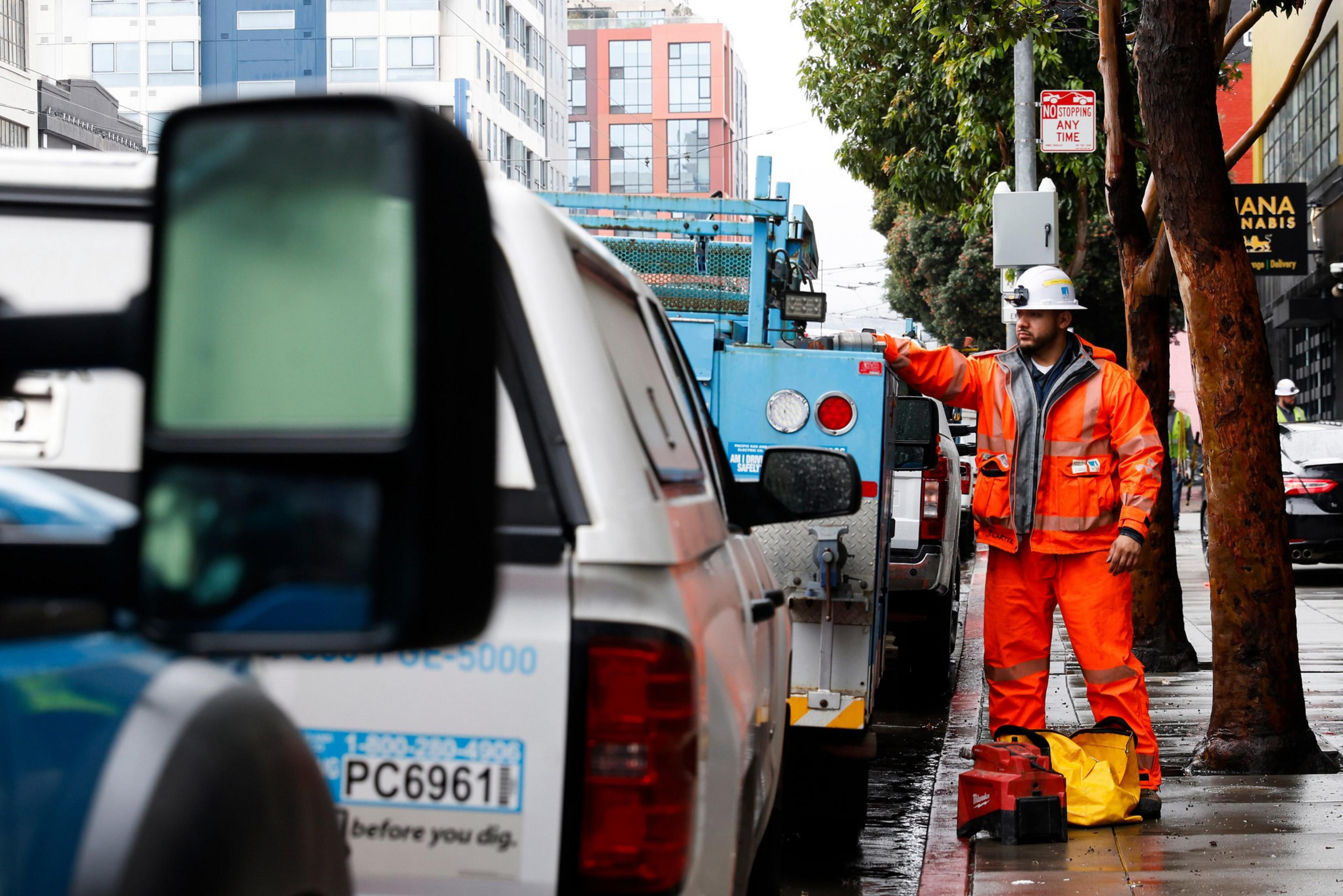 Pacific Gas & Electric crews walk around the substation building at 8th and Mission streets in San Francisco. | Source: Jessica Christian/SF Chronicle/AP
Calls for San Francisco to take over PG&E’s grid were reignited after a Dec. 20 power outage left one-third of the city without power, with many residents left in the dark for days. Since then, there have been 40 smaller outages.
Any takeover would have to be approved by the CPUC, the regulator that oversees the legal process of eminent domain — the government’s mechanism to force the sale of private property for public use.
Using eminent domain in San Francisco requires approval from at least two-thirds of the Board of Supervisors, which would have to vote in favor of authorizing the action. If a purchase agreement cannot be reached with PG&E, then the city would have to file a lawsuit to establish its justification.
To force a sale, the city would have to prove the necessity of such an action in court and pay PG&E fair market value for its assets and loss of business. The property owner can contest or dispute any findings made by the city in the trial.
Advocates for acquiring PG&E’s assets (opens in new tab) say the city could finance the transaction by selling bonds to investors who would be repaid over time with revenue derived from customers paying their electric bills.