
A kitchen table is covered in plastic. In the middle, a small glass vase holds freshly cut flowers alongside two salt shakers, the kind you might find at a secondhand shop. A plate of Mexican sweets sits to the right, a jar of salsa to the left, surrounded by all the familiar fixings of a kitchen where loved ones gather, stories are shared and nothing feels particularly out of place.
It’s the kind of kitchen where pancakes are made — really good ones, according to those lucky enough to have eaten them — and where the smallest objects seem to know exactly where they belong.
Except this isn’t a kitchen at all.
The table sits inside an 8-by-8-foot space at Hollywood Forever Cemetery. In 2021, two brothers recreated their mother Irma’s East Los Angeles kitchen as an ofrenda after she died during the COVID-19 pandemic, carefully piecing together the room through the foods, flowers and familiar objects that made it hers.

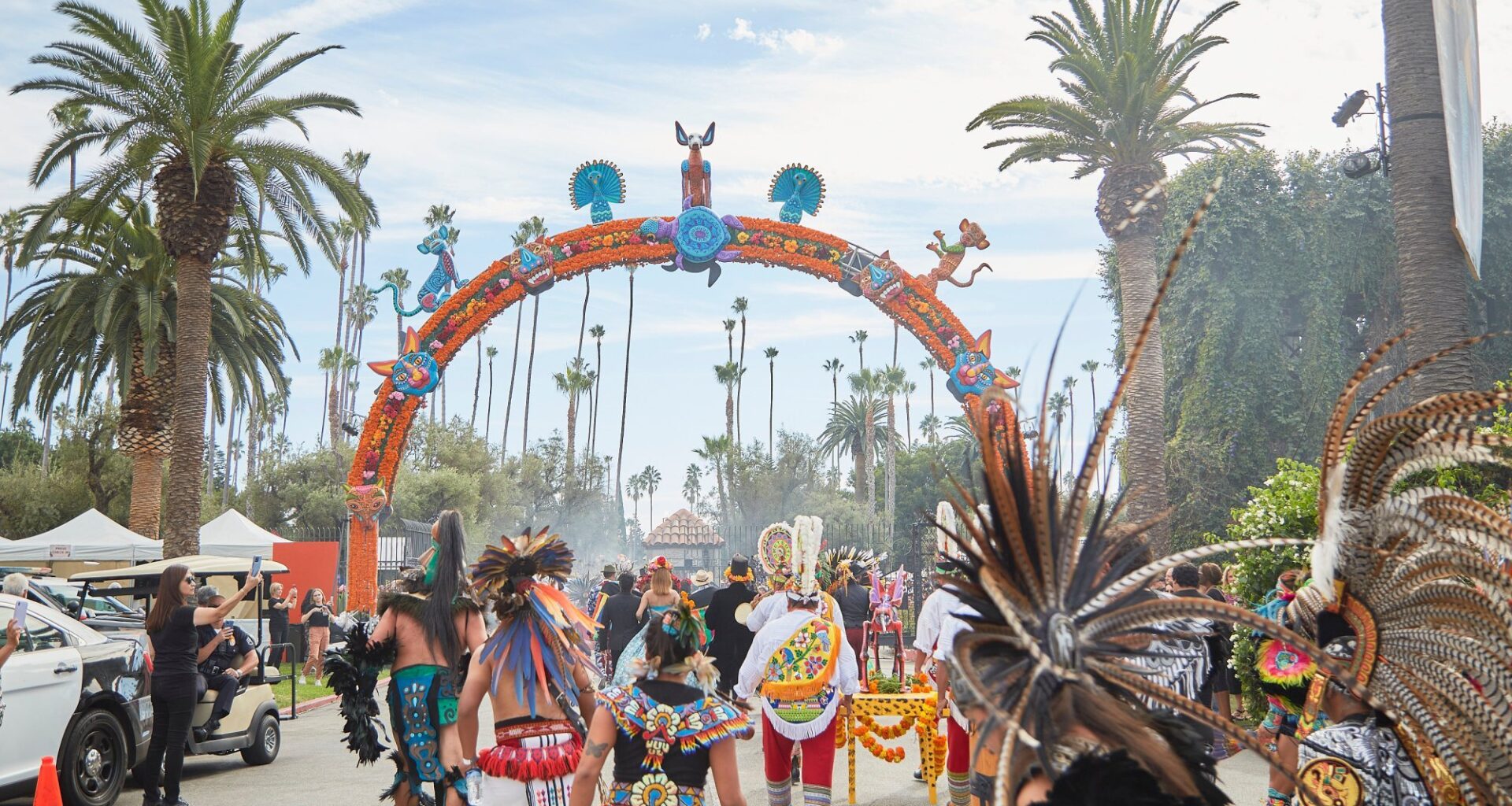
Hollywood Forever will welcome back its Día de los Muertos celebration on Saturday, Oct. 24.
(Photo by Mauricio Hoyos/Hollywood Forever)
Show Caption
1 of 1
Hollywood Forever will welcome back its Día de los Muertos celebration on Saturday, Oct. 24.
(Photo by Mauricio Hoyos/Hollywood Forever)
For Angie Jimenez, Hollywood Forever’s Altar Program Coordinator and Director of Altars for its annual Día de los Muertos celebration, there was something unexpectedly familiar about it.
Jimenez had known Irma years earlier. She recognized her sons, but more than that, she recognized the kitchen they had rebuilt, a place where she remembered sitting and eating some of the best pancakes she’d ever had. Now, years later, she was standing in a cemetery looking at pieces of that kitchen again, recreated by two sons determined to bring their mother and the home she made for them back to life for a day.
“It just felt like you were in Irma’s little kitchen,” Jimenez recalled with a laugh.
That feeling extended beyond Jimenez’s own memories of Irma. Each year, judges walk among the community-built ofrendas before selecting those that stand out in the celebration’s altar competition. In 2021, both found themselves lingering at Irma’s kitchen.
“When it came time for the judges to deliberate, they both had that ofrenda on their lists,” Jimenez said. “They had stood in front of it for a while and were really taken aback by it. It didn’t have all the elements of a traditional ofrenda, but that’s exactly what it’s about. They put all the things that Irma loved on that table.”
Irma’s kitchen is one of the altars that has stayed with Jimenez through nearly a decade of overseeing the program, where remembrance is built from the seemingly ordinary things that made a person’s life distinctly their own.
On Saturday, Oct. 24, 70 ofrendas will fill the grounds of Hollywood Forever for its 27th annual Día de los Muertos celebration, held this year under the theme All Under One Sky, or Bajo un Mismo Cielo. Nearly 300 Aztec and folklórico dancers will take part in the celebration, alongside its traditional Ceremonial Procession and a day of live music led by DannyLux, Trish Toledo, Tropa Mágica and Los Shadows, with DJs Que Madre, JOAQU.N and Dro Barlo.
But for Jimenez, the ofrendas remain the “heart and soul” of it all.
At its core, she said, creating one is an act of welcome. Families gather photographs, prepare favorite foods and drinks and place belongings that carry the imprint of the person they are honoring. Marigolds, or cempasúchil, are traditionally used to help guide spirits back with their distinct aroma. Water is offered after the journey, while photographs invite the person being remembered back into the space.
“Think about it as if you’re throwing a party,” Jimenez said. “You’re going to lay out your loved one’s favorite food, their special drink, their favorite things. The idea is that, just for a day or two, they come and visit us. We’re the ones who are still here, breathing and living. It’s a symbol of the circle and cycle of life.”
For some families, Jimenez has watched the act of creating that space become part of grieving itself, a chance not to leave sadness behind, but to let love, joy and memory exist beside it.
“It can be very comforting and healing for families who have never experienced this,” Jimenez said. “It shows them that grieving doesn’t always have to happen through tears or pain. You can also grieve by celebrating someone, honoring their memory and creating a space that feels like you’re welcoming them back.”
Jimenez knows that feeling intimately.
Born in the United States and raised in Guadalajara, Mexico, Jimenez grew up with Día de los Muertos as part of her family’s traditions. She’s worked with Hollywood Forever for more than 13 years, but over time, the cemetery and the celebration she helped steward became intertwined with her own experiences of love and loss.
In 2015, Jimenez’s sister was ill when she attended Hollywood Forever’s Día de los Muertos celebration. She fell in love with what she saw there, with families gathering among the graves and music and celebration filling a place so often associated with mourning. Before she died the following year, she had already decided where she wanted to rest.
“She came to the event and loved it,” Jimenez recalled. “She told me, ‘When I pass, I want to be buried back there where the party happens.’ When she passed in 2016, we buried her right around where the main stage is, and we’ve created an ofrenda for her ever since. Then my dad passed away three years later. We buried him right next to her, and now we create the ofrenda for both of them.”
What began as the work of helping other families remember their loved ones had become something Jimenez and her own family needed, too. Her sister was her “first best friend.” Her father loved to sing and play guitar. And nearly a decade after her sister’s death, Jimenez has no desire to reach some point where missing either of them disappears.
“I always tell people I never want to feel like I don’t miss them, because I think the minute I no longer miss them is when I start to forget them,” Jimenez said. “When I read the applications, some people are honoring someone who passed decades ago, but you can tell through their stories that person is still very much present.”
Jimenez has witnessed that same kind of remembrance take shape among families she may have only recently met. A few years ago, a grieving mother approached her after losing her son, who is buried at Hollywood Forever. Jimenez arranged for the family to create an ofrenda near where he rests.
Later, as Jimenez made her way through the celebration, she passed the ofrenda and found the family gathered around it, laughing and trading stories about him as one memory gave way to another. It’s something she has come to think of as the “evolution of their grief.”
“I couldn’t believe the woman who first came to me asking if they could do this was the same person I saw in the middle of the event,” Jimenez said. “The whole family was there talking about him, ‘Remember when this,’ ‘Remember when that.’ They experienced that transformation themselves, just through the act of creating this ofrenda for their son.”
It’s in that coexistence of grief and joy that the spirit of Hollywood Forever’s celebration takes shape each year. Not everyone resting at the cemetery is Mexican or celebrated Día de los Muertos during their lifetime, but after so many years of watching the grounds transform, Jimenez has come to feel as though they are all part of the tradition now.
“It always feels like they’re getting ready, too, like they’re anticipating this day,” Jimenez said. “They’ve become part of this tradition, and it really feels like we’re getting ready for a big celebration.”
For now, the cemetery sits in the quiet before what Jimenez calls a “beautiful storm.”
This year’s All Under One Sky theme carries that sense of connection beyond any one family or altar. Jimenez said the idea grew from conversations among the team about the moments that can bring people from considerably different places and backgrounds together. At Hollywood Forever, she sees it happen each year as strangers meet through the altar program and, for a day, become neighbors, each arriving with someone they want to remember.
“We’re all here under this one big umbrella, and you see how interconnected we really are,” Jimenez said. “That’s what happens at Día de los Muertos. Regardless of race, gender or political beliefs, you have this space where, just for a moment, you come together to celebrate.”
For first-time visitors on Oct. 24, Jimenez hopes they allow themselves to experience those stories rather than simply admire the altars from a distance.
“Be ready to listen to their stories,” Jimenez said. “Families will often welcome you into the space, and if you’re looking at the images of their loved ones, they’ll tell you about them. Each person being honored has a story, and they’re the reason these families are coming to this event.”
“You’re not going to feel like you’re walking into a cemetery,” she continued. “You’re walking into a celebration of a lot of lives.”