
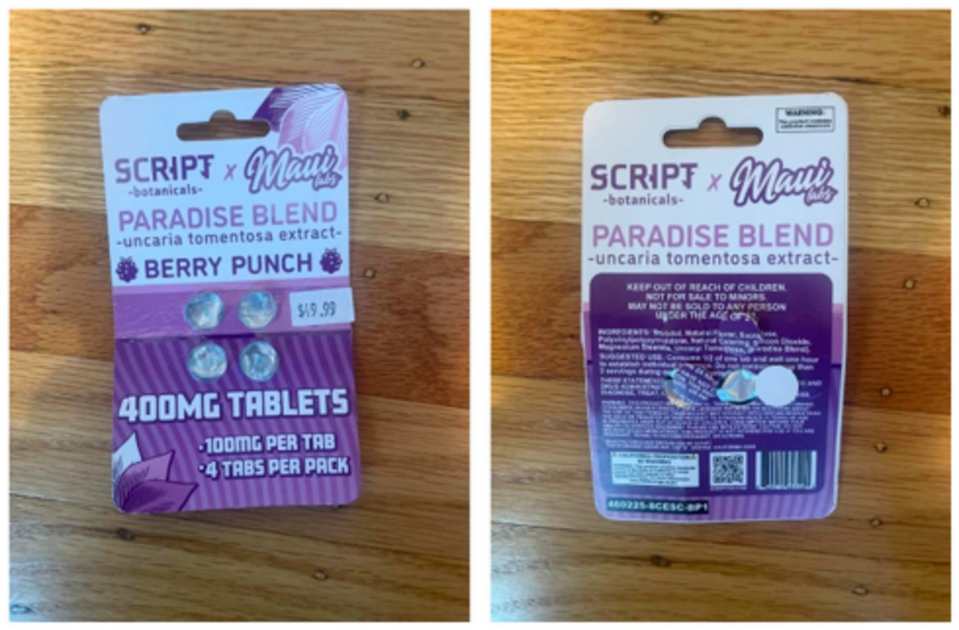
A San Francisco resident has died from an overdose involving MGM-15, a powerful opioid sold in gas stations and smoke shops that’s estimated to be up to 50 times stronger than morphine, city health officials said Wednesday.
The late-September death marked the city’s first fatal case linked to the drug, which is derived from kratom and typically sold as a supplement.
The medical examiner detected MGM-15 in the victim’s system and inside the packaging of a supplement the person appeared to have consumed. Sold under the brand Script Botanicals x Maui Labs, the product makes no mention of kratom or its potent derivative 7-hydroxymitragynine (7-OH) on its packaging, according to the San Francisco Department of Public Health. Details about the person who died were not immediately available.
This is the second time this year that San Francisco has reported an overdose death involving a new synthetic opioid.
In April, a 16-year-old died after taking what he thought was a Xanax pill that contained cychlorphine, another ultra-potent synthetic opioid. That incident prompted local health officials, Mayor Daniel Lurie, and law enforcement leaders to issue public warnings about the risks of taking counterfeit pills.
In September, San Francisco police arrested four suspects and seized more than 20,000 fake pills following a months-long investigation related to the teenager’s death.
Police have also turned their focus to cracking down on the retail sales of kratom and 7-OH products. Although the California Department of Public Health has banned the products statewide, they remain widely available in smoke shops and gas stations across San Francisco and Oakland.
The San Francisco Police Department said Wednesday that officers recently executed search warrants at several smoke shops, seizing hundreds of kratom and 7-OH products. Authorities did not specify whether those raids were directly linked to the recent MGM-15 death.
Animal tests suggest MGM-15 can pack 15 to 50 times the punch of morphine, leading the U.S. Drug Enforcement Administration in late August to classify it as a Schedule I controlled substance. Yet suppliers still find ways to get it onto store shelves.
Compounds sold under names like “MGM-15” often mask synthetic additives behind vague “proprietary blend” labels, making them easy to market and difficult for toxicology labs to detect, according to a May report (opens in new tab) from the federally-funded toxicology lab, Center for Forensic Science Research and Education.
“The big concern (with these products) is the high potency and the problematic product labeling,” said Alex Krotulski, director of the center. “People have no idea if they’re consuming it or how much of it they’re consuming.”
Krotulski said he’s aware of more than two dozen deaths linked to MGM-15 nationwide, including in California, Nevada, Michigan and Florida.
Kratom, made from the leaves of a Southeast Asian tree, is sold in powders, gummies, capsules, drinks, and concentrated extracts. Low doses can feel stimulating, while higher doses can bring opioid-like effects.
The FDA has not approved it for any medical use, and officials warn it can cause dependence, withdrawal, seizures, and overdose. Researchers like Krotulski are especially concerned about newer, concentrated derivatives like 7-OH and MGM-15.
In a health alert released Wednesday, the San Francisco Department of Public Health urged clinicians to ask patients about over-the-counter supplement use and counsel them on the risks. The department also advised doctors to distribute naloxone to anyone at risk, emphasizing that while naloxone may not fully restore consciousness in complex synthetic overdoses, it remains vital for restoring breathing.