
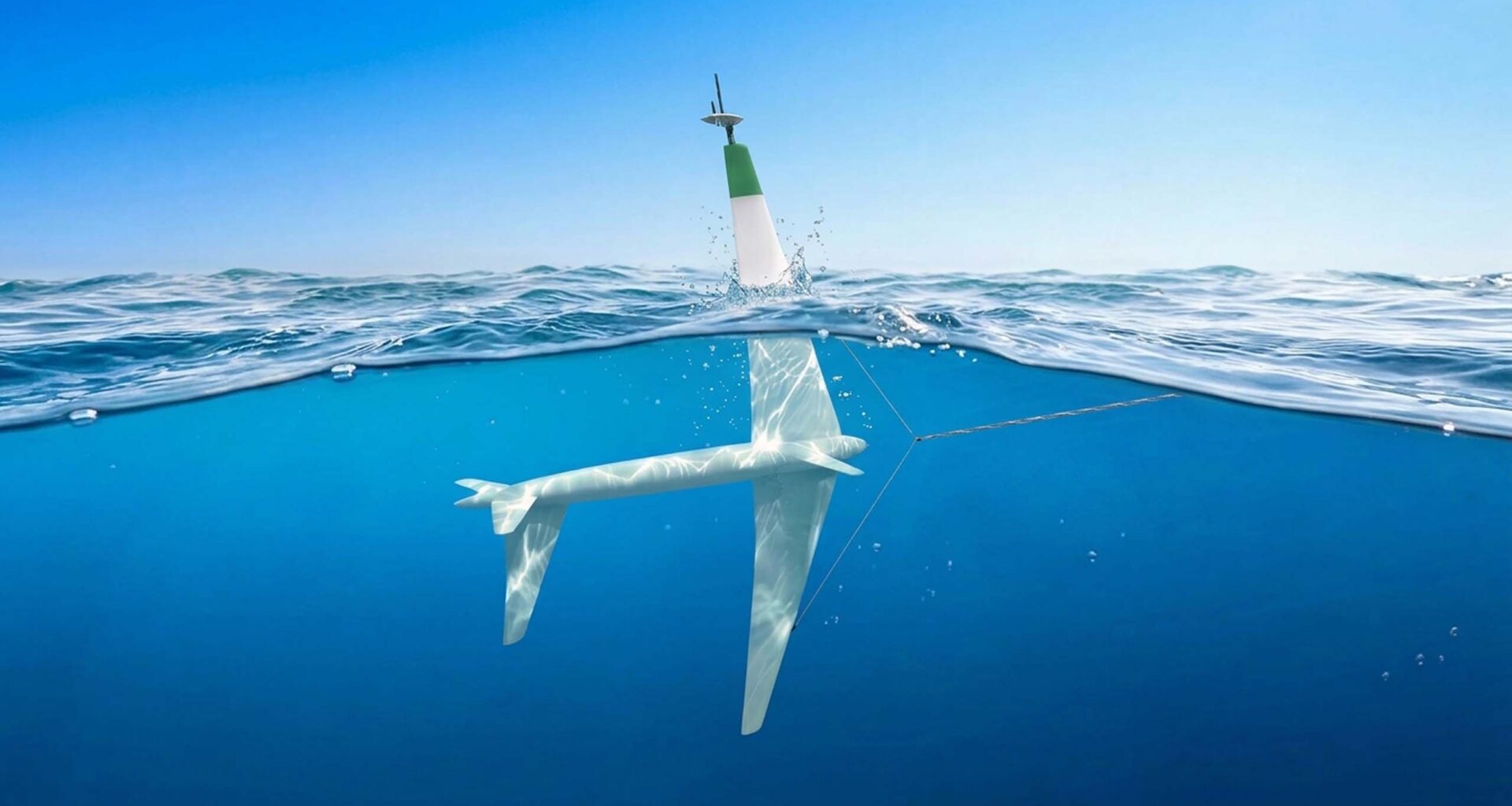
Berkeley engineer Evan Variano explains how underwater kites could expand the world’s renewable energy portfolio
October 21, 2026 by Marni Ellery
To combat climate change, countries worldwide are increasingly turning to clean energy sources such as solar and wind power in place of fossil fuels. Now, civil and environmental engineering professor Evan Variano is exploring another option: tidal energy. Using an underwater kite, he is studying ways to harness the power of ocean currents. Variano spoke with Berkeley Engineering about the potential of this device and what he hopes to achieve through his latest research.
 Evan Variano demos an underwater kite prototype in the FLOW Lab at UC Berkeley’s Richmond Field Station. (Photo by Adam Lau/UC Berkeley Engineering)
What is an underwater kite? And how does it work?
What makes it a kite is that it has a tether, and just as with an air kite, that line helps control its flight. The underwater kite “flies” figure-eight patterns, causing it to pull on the tether in a regular pattern. This pulling on the tether allows us to harness the kinetic energy that the kite is picking up from the tidal currents.
What role do you see underwater kites playing in the field of renewable energy?
Underwater kites could be an exciting complement to the other very good sources of renewable energy, such as solar and wind. Kites shine when you want something that’s very portable. Alternatively, you can take something that looks like a wind turbine, make it waterproof and install that underwater to catch the tides, but it’s quite a construction effort to do so. A kite offers the possibility of the same amount of power in a much smaller package. Also, tidal energy fits into some niches where either solar or wind is not available or not reliable, or where we’ve maxed out solar and wind and need a little bit of extra power.
How do communities stand to benefit from harnessing tidal energy?
Remote coastal communities can use tidal kites to supplement their power or as part of their energy portfolio. Even when the clouds cover the sun or the wind dies down, the tide is coming in and can be predicted well in advance.
For example, a person going out on a boat for several days could carry a bit less fuel onboard and instead toss a tidal kite off the stern when they’re at anchor. As the ocean current goes by, they could then recharge their batteries from the kite, and this energy source would never run out — unlike their fuel reserves.
It’s also important to note that tidal kites could be deployed in areas where people fish or use the water in other ways. So we want to make sure to balance our new technology with existing users of the space. Berkeley researcher Tvetene Carlson [M.S.’20, Ph.D.’25 CEE] is working on that. He recently conducted ethnographic research in coastal Alaska to help us better understand people’s values surrounding water and ways we can share the water as both a fishing resource and an energy-generation resource.
How did you become interested in underwater kites?
I’ve been studying underwater kites for five years. I first became interested in them when a colleague named Tom Libby [B.S.’02, M.S.’12, Ph.D.’17 ME] reached out to me. Tom and I knew each other from his time at Berkeley, when he was a Ph.D. student. We did research together on how living organisms interact with fluid flow. At SRI International, he was working on early plans for an underwater kite, known as the Manta kite, and he invited me to join the project team as a principal investigator for UC Berkeley.
It’s been a good partnership. SRI brings robotic specialty, sensors and autopilot code; I bring fluid-flow expertise, specifically water flow in natural environments.
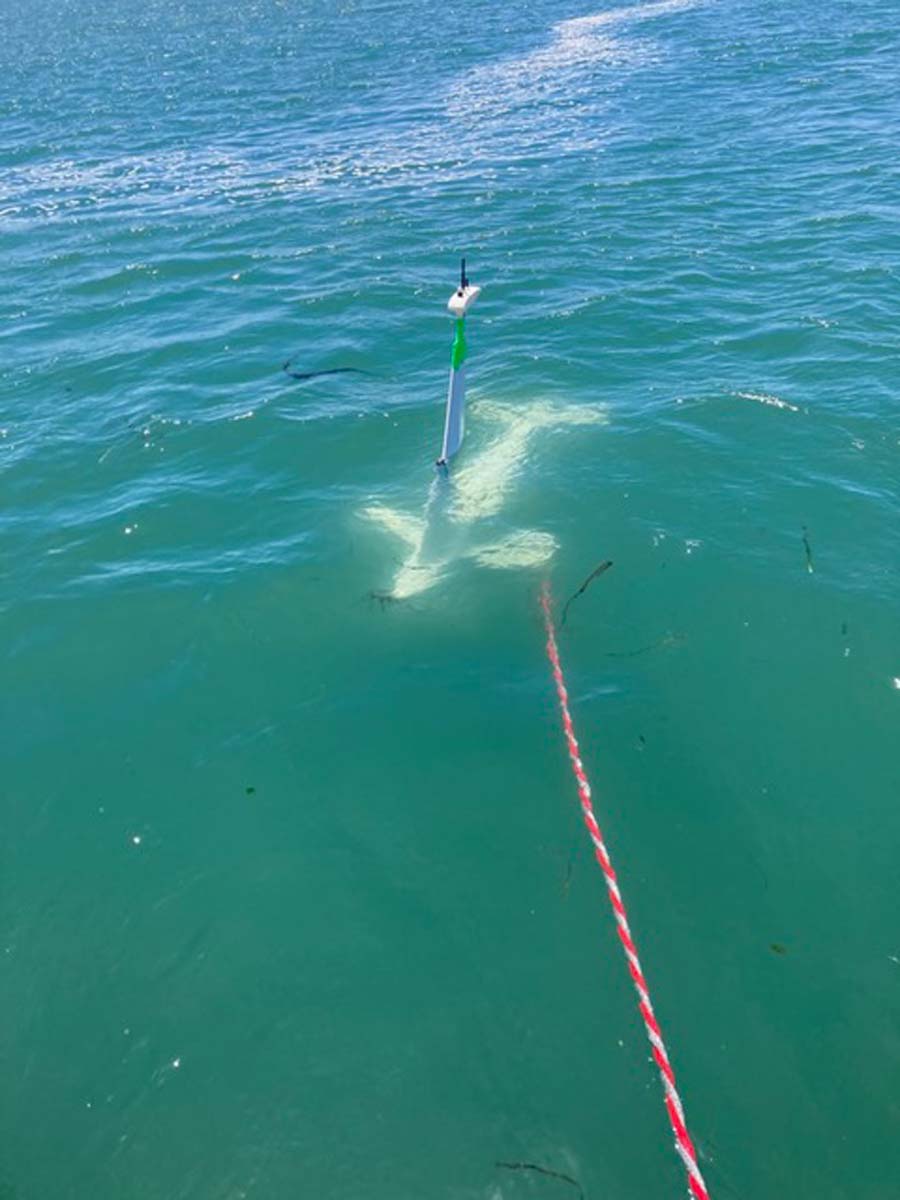 Test deployment in San Francisco Bay. (Photo courtesy Evan Variano)
What are you trying to accomplish through your latest research with the Manta kite?
We are trying to do two things. One, we want to maximize the amount of power we can get. And, two, we want to design an autopilot that keeps this kite flying well and generating lots of power in response to the local details of how the tide comes in, goes out and interacts with the shape of the coastline. Our autopilot is sort of our “special sauce.”
We have a set of sensors that ride inside the kite, tracking where it is and how it’s moving. And then we have a computational brain inside the kite that runs different autopilot algorithms, which helps the kite respond to hazards in the flow and fly a pattern that maximizes power generation.
What’s next?
This is an exciting time when we can look at small changes that may improve efficiency or usability. We get to think about topics such as industrial design and the aerodynamics around the wingtips in our kite. For some of that, I’ve been able to lean on Chris Myers, a product designer and lecturer at the Jacobs Institute for Design Innovation. He’s been a great source of knowledge and ideas as we continuously improve our designs and think about what will be both high performance and marketable. Beyond that, we’re focused on finding investors that will help us do the work that fits this general technology to the needs of specific customers.