
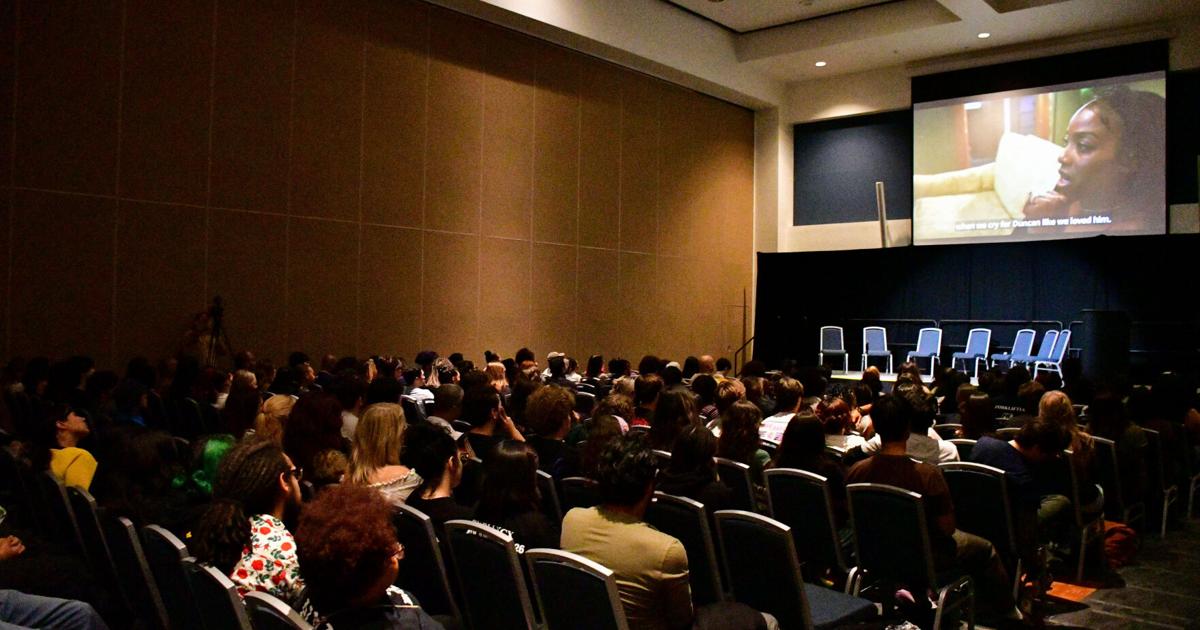
A packed house of Cal State Fullerton students in the Titan Student Union were transported to a Shakespearean rendition of ’90s Los Angeles Monday night with a screening of “Macbeth in Compton,” featuring a Q&A panel with its director, Page Kennedy.
CSUF’s African American studies, English and theatre departments hosted a screening of Kennedy’s 20-minute directorial debut, followed by a discussion with professors and students alongside Kennedy.
A rapper, actor and director from Detroit, Michigan, Kennedy is known for roles in “Six Feet Under,” “Weeds” and the “Meg” film series. His introduction to Shakespeare came in high school when he watched Baz Luhrmann’s “Romeo + Juliet,” not truly connecting with the playwright’s work until a community college professor framed Shakespeare as the “first rapper.”
“I had never looked at it that way,” Kennedy said during the panel. “Once I started to enjoy the language, understand the things that they were talking about, I realized that all of the tropes, thematically, it was all still the same [as today], and I fell in love with it.”
His education continued at Western Michigan University, where a graduate school showcase led him to the University of Delaware’s theater program, providing the opportunity to continue to pursue Shakespeare.
His film, “Macbeth in Compton,” starring Kennedy as Macbeth, Candice Renée as Lady Macbeth and Russell Hornsby as King Duncan—dubbed Mac, Lady M. and Dunc in Kennedy’s rendition, respectively—is the first installment of a larger anthology series project Kennedy is developing called “Tales From The Bard.” The movie aims to reimagine Shakespearean work into settings reflective of different aspects of Black culture and experiences.
This feature serves as a proof of concept — a pilot project before full production — for a planned six-to-eight episode series. It portrays three focused scenes, opening with a ’90s West Coast rap from Lady M., penned by Kennedy, before moving into the crucial conversation between her and Mac.
Kennedy’s setting for the story stemmed from a period commonly considered the “golden age of hip hop.” His art is intended as a love letter to a culture and era that shaped his youth.

Director, Page Kennedy answers Titan’s questions about his film, “Macbeth in Compton” Monday night. (Alexander Martinez / Daily Titan)
“Los Angeles, in the early ’90s, is my favorite zeitgeist of hip hop. Because I’m in Detroit, I’m watching ‘Boyz n the Hood,’ I’m watching N.W.A., ‘Menace II Society,'” Kennedy said. “All of those things shaped me and molded me. I was so immersed in the culture.”
Similar to Luhrmann’s cinematic reimagining of Shakespeare, Kennedy preserved the tragedy’s original early modern English dialogue, supplementing the performances with subtitles in ’90s Compton vernacular to reflect the culture and dialect of the local Black community from that time.
His anthology launched with “Macbeth,” despite his favorite Shakespeare play being “Richard III,” as this story stems from his past experience learning the character for a college community theater program. Beyond his familiarity with the text, he aimed to grab the audience’s attention right away, detailing a natural harmony between the play’s themes and the hip-hop era central to the film.
“It worked competently with Macbeth because of the tropes and the thematic fashion of ambition and greed,” Kennedy said. “That’s why I chose it, because I thought that this is the one that is going to make everyone want to watch this.”
Kennedy said his next iteration of “Tales from the Bard,” has already begun pre-production. It places Othello as the head coach of a college football team under what he describes as the “Deion Sanders trope.”
Aliyanna Matthewson, third-year public health major with a minor in African American studies, was invited to serve as a student panelist for the event after receiving an email from her professor.
Walking into the event, Matthewson cited a sense of wariness about the film’s screening. Concerned with the potential for the characters in the film to fall into stereotypical characterizations of Black people, particularly Black women, often seen in Hollywood, she reiterated the importance of continuing to represent the different experiences of the community.
During the Q&A session, panelists and audience members alike asked Kennedy a vast range of questions, from his connection to rap verse and iambic pentameter, to the characterization decisions made for Lady M.
Liam Coakley, an attendee of the event and Shakespeare lover, shared that he seeks out alternative renditions of the plays, especially those created by individuals with a deep connection to the art.
“I think part of the thing that’s really beautiful about Shakespeare and one of the reasons why it’s persisted for so long is because it speaks to a lot of universal human experiences,” Coakley said. “I really do enjoy seeing people take those and put them in a different context.”
Kennedy closed his speaking session by sharing his desire to show young students of color the importance of education and learning and to engage with the works of literary figures like Shakespeare.
“I wanted to teach young Black and Brown kids that you can be able to think that education, learning, vernacular, vocabulary, that is cool,” Kennedy said. “I think that if people learn and get adept with Shakespeare, they can love deeper; they can be more compassionate.”