
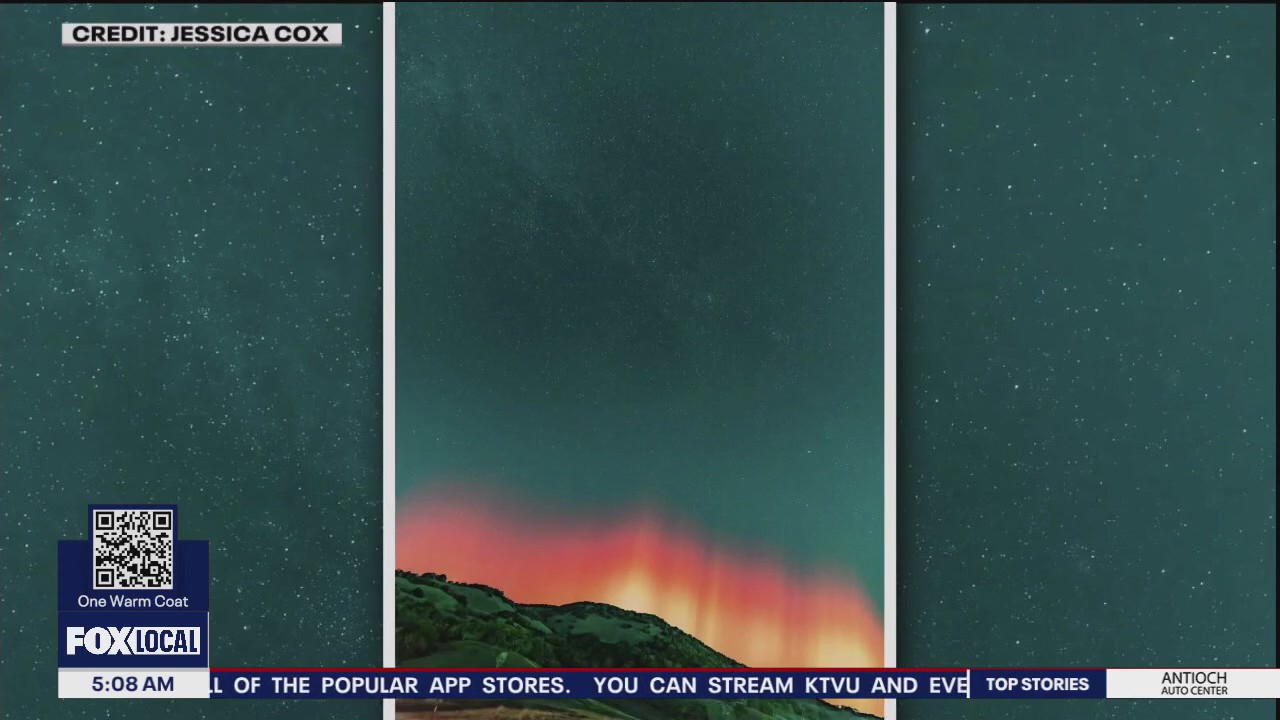
SANTA ROSA, Calif. – The northern lights are putting on a show this week, including splashing over the skies in Novato, Santa Rosa, Petaluma, San Anselmo and San Rafael.
Viewers like Jessica Norelli Cox shared photos of the rare geo-magnetic storm with KTVU and images like this were shared all over the country on Tuesday night.
Meteorologists say the northern lights will continue to dazzle the sky Wednesday night.
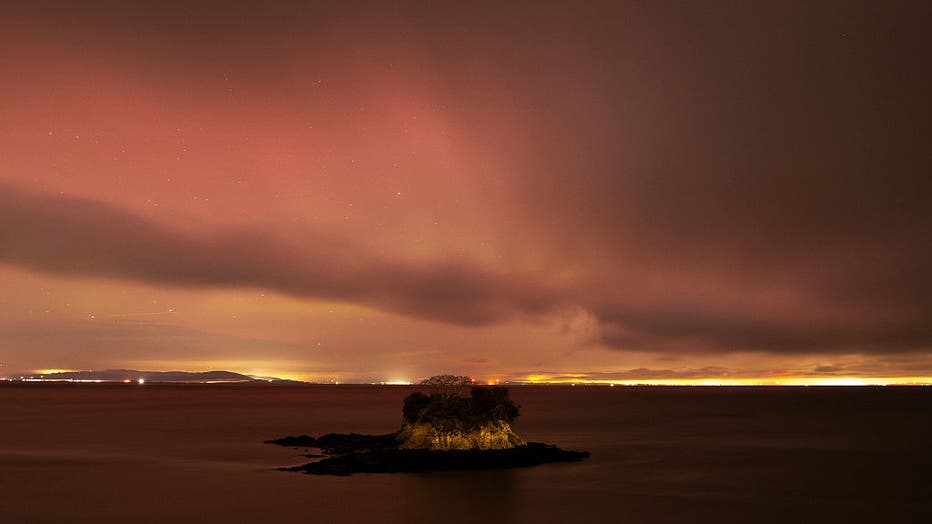
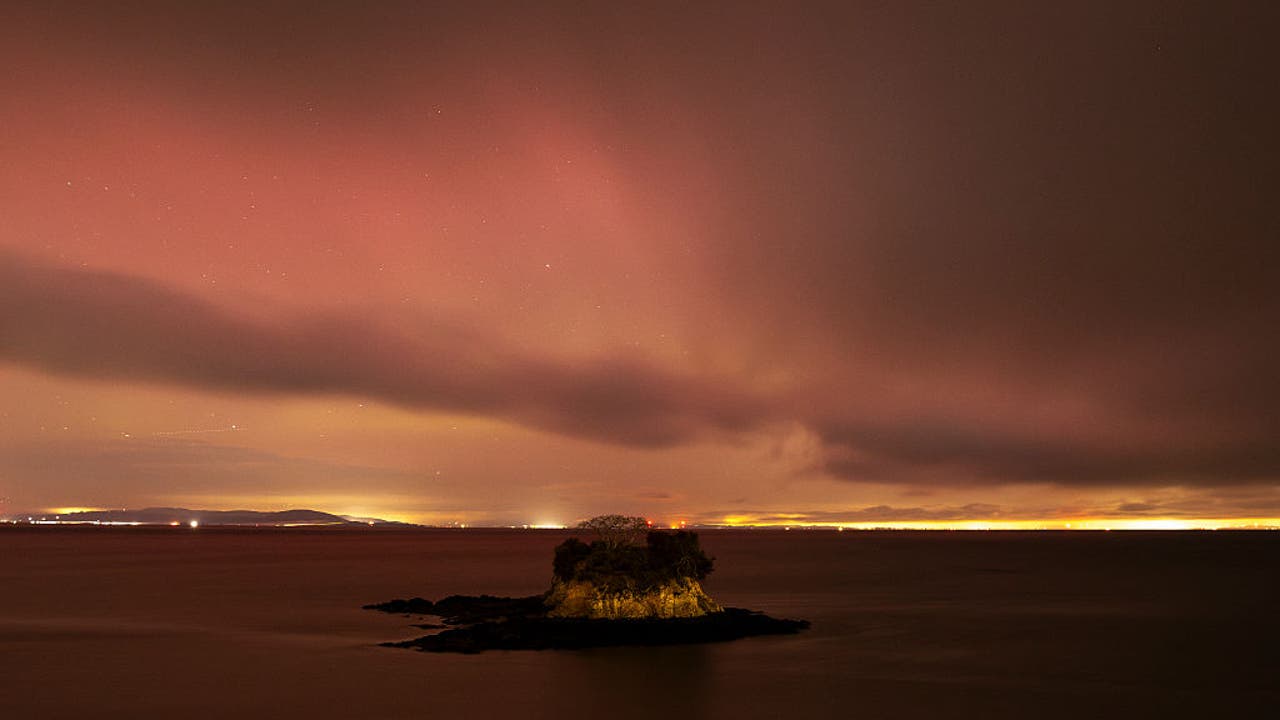
Rat Rock Island is seen at China Camp State Park as the Northern Lights glow above rolling fog in San Rafael, Calif., Tuesday, Nov. 11, 2025. (Photo by Stephen Lam/San Francisco Chronicle via Getty Images)
Northern lights visible in parts of US
Forecasters said the vibrant displays could be visible across much of the northern U.S., and as far south as Alabama to Northern California.
According to NOAA’s forecast, the states with the best chances of seeing the northern lights are Alaska, and the northern states — Washington, Montana, North Dakota, Minnesota, Wisconsin, Michigan, and Maine.
NOAA says areas of the northeast, northern Pennsylvania, upstate New York, northern Massachusetts, Vermont, New Hampshire could see the northern lights and in the midwest, Northern Iowa, Illinois, Indiana, and Ohio have a chance, as well as northern Nebraska.
Some areas further south, Oregon, Utah, Colorado, and Kansas and parts of Oregon and Illinois, have a chance during severe geomagnetic storms.
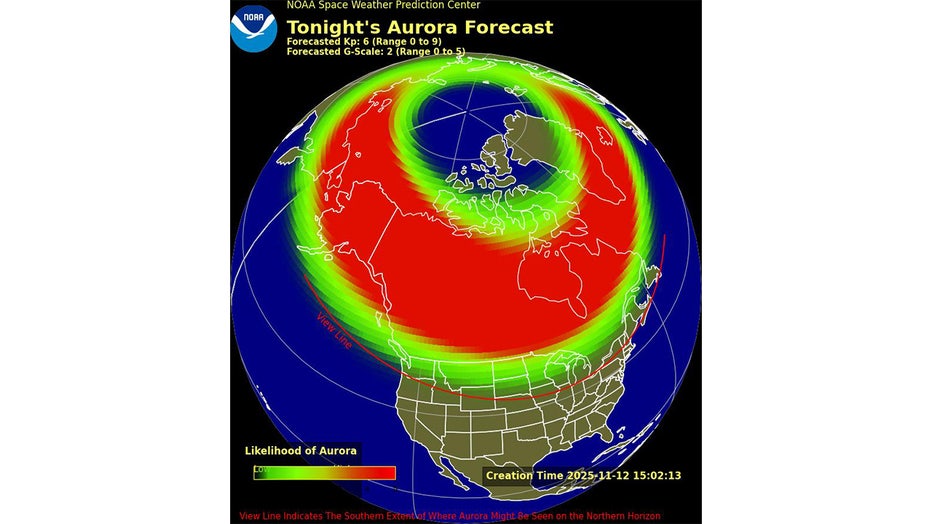
This illustration from NOAA shows the aurora’s visibility for tonight.
The best times to see northern lights in the US
Dig deeper:
NOAA says the best time to potentially see northern lights from the U.S. is from 6 p.m. – 6 a.m. CT.
A geomagnetic storm watch was issued by the NOAA on Tuesday, with predicted storm categories reaching strong and severe.
Nov 12: G4 (severe) category stormNov. 13: G3 (strong) category stormNov. 14: G1 (minor) category storm Tips on seeing northern lights: Try to find an unobscured view and look toward the northern horizon.It must be dark outside, so if you can, go somewhere that has as little light pollution as possible.The best time to see auroras is within an hour or two of midnight, according to the NOAA. Check the weather forecast because clouds can cover up the spectacle entirely.Taking a picture with a smartphone camera may also reveal hints of the aurora that aren’t visible to the naked eye.
On Tuesday night, the northern lights were visible across much of the Lower 48, and social media lit up with people sharing breathtaking pictures of the celestial show lighting up the sky lit up in different shades of green, purple and red; a stark contrast to the colors that we see at sunrise and sunset.
“A lot of it has to do with the light and the spectrum and the refraction of the light. In this case, you’re talking more about those electrons that are coming off of the sun’s surface, big solar flares that erupt,” said FOX Weather Meteorologist Craig Herrera. “They make it to the Earth’s atmosphere, and then they interact with either nitrogen or the oxygen to give us the colors.”
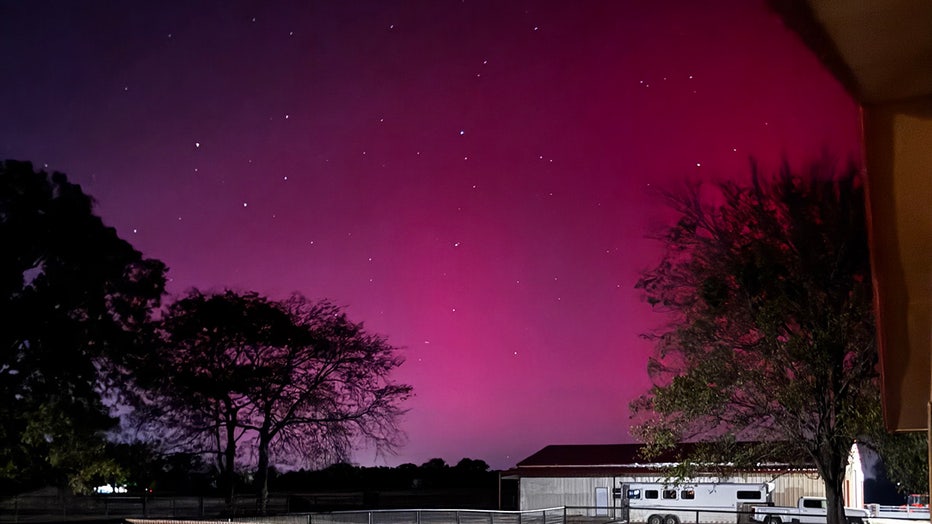
FOX viewer Jenifer Ingram from Golden Texas shared this photo of the northern lights on Tuesday, Nov. 12, 2025.
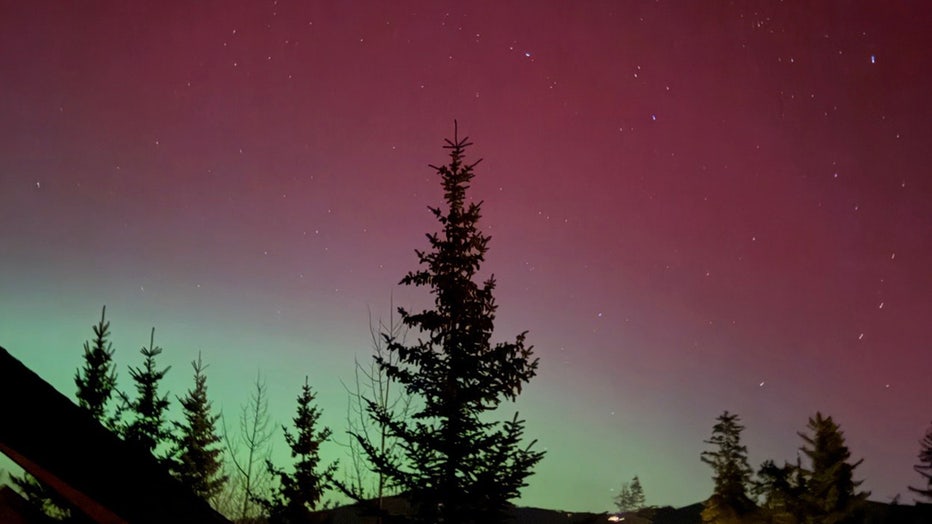
FOX viewer Karissa from Breckenridge Colorado shared this photo of the northern lights on Tuesday, Nov. 12, 2025.
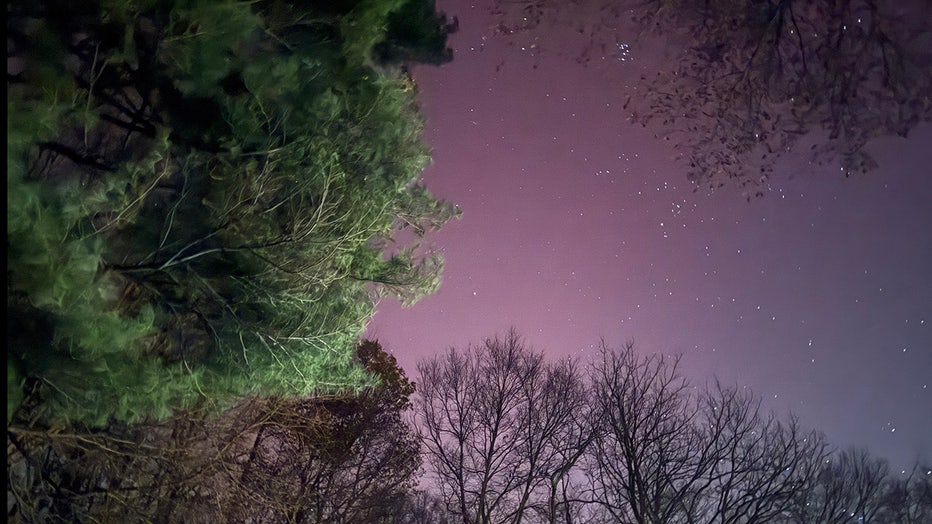
FOX viewer Kathy Howell – Granville Ohio shared this photo of the northern lights on Tuesday, Nov. 12, 2025.
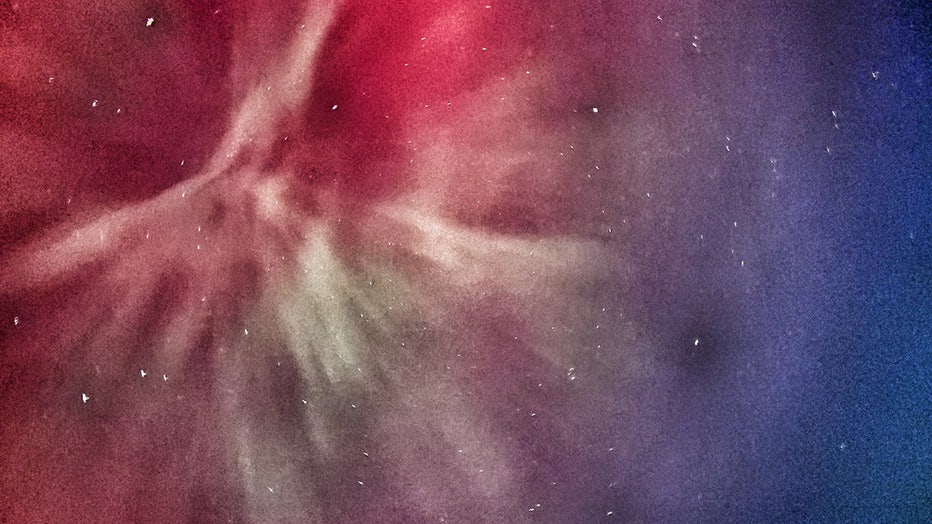
FOX viewer Macy Mommer Fromm Waterloo, Iowa shared this photo of the northern lights on Tuesday, Nov. 12, 2025.
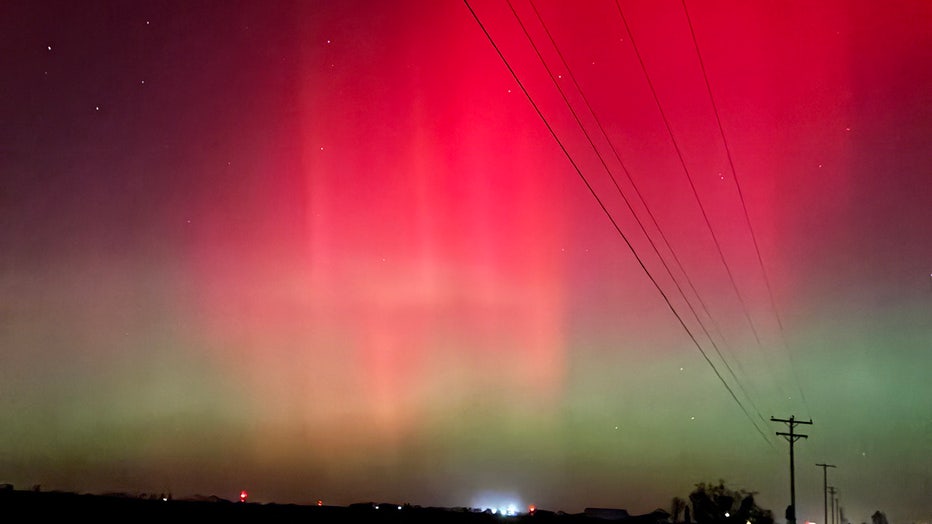
FOX viewer Steven Trine from Paris, Illinois shared this photo of the northern lights on Tuesday, Nov. 12, 2025.
How do the Northern Lights appear?
Dig deeper:
The Aurora Borealis, also known as the northern lights, are caused by a geomagnetic storm when the sun burps out several bursts of energy called Coronal Mass Ejection, ejecting superheated plasma into space which travels through the solar system and reaching Earth in less than a day.
The potential severe geomagnetic storms could disrupt radio and GPS communications, according to forecasters with the National Oceanic and Atmospheric Administration.
How bright the auroras are and how far south they are visible will depend on when the solar bursts get here and how they interact with Earth’s atmosphere. The vibrant displays could be visible across much of the northern U.S., and as far south as Alabama.
Over the last 24 hours, the sun has emitted several powerful solar flares, including one X-class flare (the most powerful category of solar flares), two M-class flares (moderate) and 25 common solar flares.
The sun is particularly active right now and that means there’s a great chance to enjoy some northern lights, if you know where to look.
Northern lights forecasts can be found on NOAA’s Space Weather Prediction Center website or an aurora forecasting app.
The Source: Information for this article was taken from the NOAA’s Space Weather Prediction Center website and reporting by Accuweather, Space.com, and FOX Weather. Previous reporting by FOX Local also contributed to this report. This story was reported from Orlando and San Jose. KTVU also contributed to this report.