
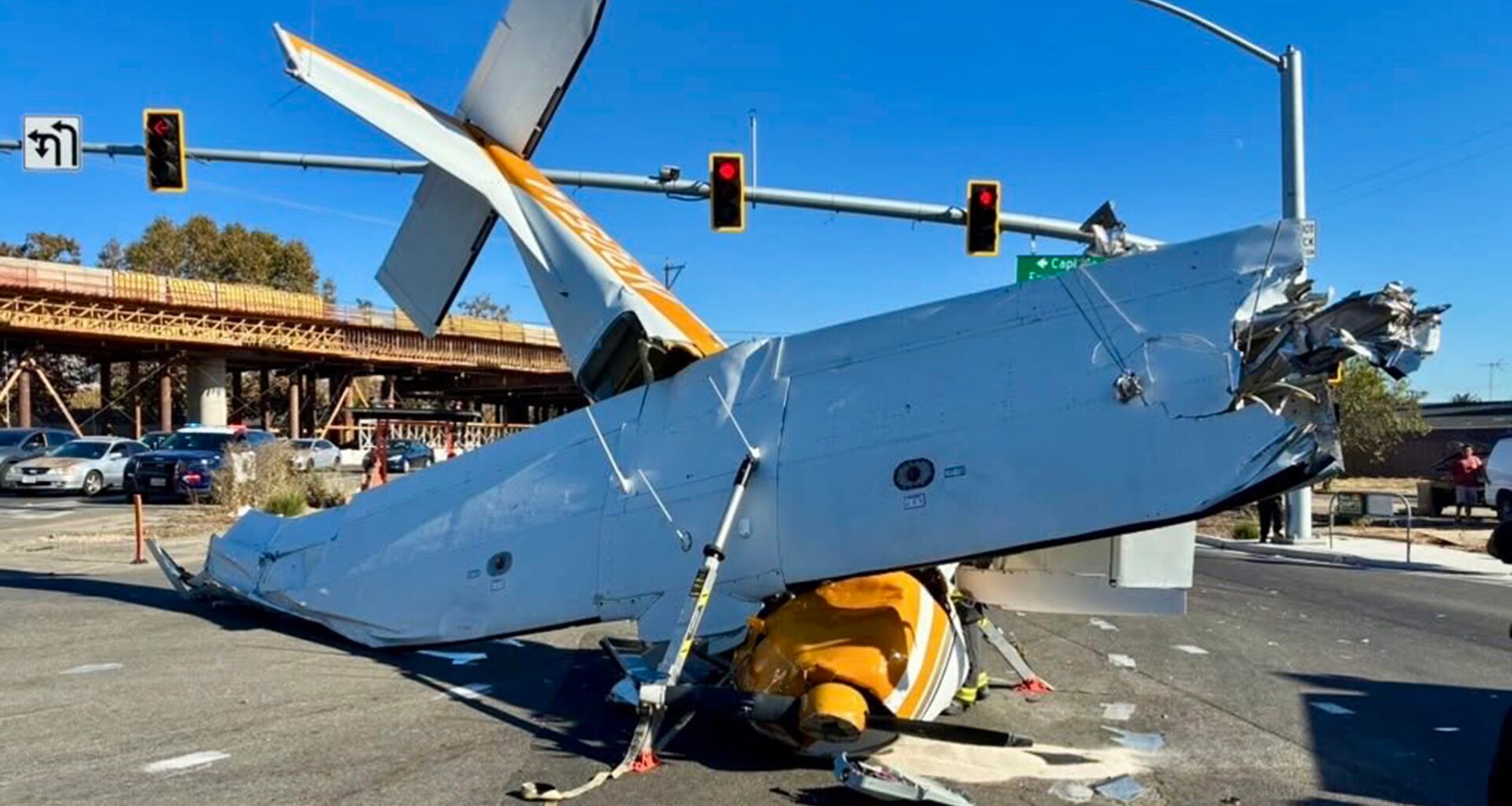
The pilot of a small propeller plane faced with engine issues or other problems mid-flight is usually trained in identifying the best spot for an emergency landing if they are forced to choose: A wide open field. An empty beach. A freeway.
But in highly urbanized areas like the Bay Area’s cities, the options can be limited in the regions surrounding small airports, pilots said. Two planes crashed in San Jose last week, with one coming down over busy Capitol Expressway and clipping a new BART project under construction, a vertical obstacle that one expert said could complicate what used to be a reliable rough-landing location.
With general-aviation airports spread across the Bay Area — San Jose, Livermore, Concord, Hayward and Palo Alto, to name a few — there are plenty of pilots in small aircraft flying overhead at any time. On Friday, a plane crash-landed at Reid-Hillview Airport due to faulty landing gear. The Saturday crash-landing injured three passengers in a crash witnessed by a roadway full of drivers.
Having two Bay Area incidents in a 24-hour span “is pretty unusual, but the statistics show that, with the random distribution, you’re going to get that occurring from time to time,” said Steve Philipson, an independent Palo Alto flight instructor who has been teaching for 36 years and flying for 43. “There’s a whole lot more (collisions while) driving. … People tend to take notice of airplane crashes because they’re relatively rare.”
In 2024, there were 1,201 accidents in U.S. civil aviation as tracked by the National Transportation Safety Board, seven of which were in the Bay Area. Of those, 188 resulted in fatalities, with 321 people dying nationwide.
The Saturday collision, which occurred around 3:10 p.m., came after the Cessna’s pilot reported having engine trouble, according to preliminary information provided by the Federal Aviation Administration. The passengers’ injuries were all categorized as minor, and the plane suffered an unspecified level of damage, according to the FAA’s accident and incident notification.
The incident remains under investigation by the FAA and the NTSB, authorities said. A preliminary report will be available within 30 days, said Sarah Taylor Sulick, public affairs specialist for the NTSB.
Most plane incidents of this type are “pretty small,” Philipson said, “like somebody lands off field due to a failure or they make a poor landing at an airport.” The majority of crashes are caused by pilot error, such as undershooting or overshooting the runway while landing, but those are typically less serious accidents.
“Those are typically severely bruising to one’s ego and damaging to the airplane but not fatal,” Philipson said.
Other mechanical issues — such as the failure of a part of the aircraft or an issue with maintenance — are “relatively in the minority,” he added. But there are “a whole lot of systems that make an airplane work” and “any number of them could be involved.”
Pilots are trained to be able to glide their aircraft into a forced landing, even if they do not have engine power, said Andrew Dilworth, a Palo Alto-based flight instructor who has been flying for 25 years and teaching for 23 years. To do that successfully, the plane must have enough altitude.
“All these airplanes are capable of gliding into a forced landing,” Dilworth said. “Everybody thinks that if the engine dies the plane comes tumbling out of the sky.”
In making their quick decisions, pilots have to weigh several factors: preserving life of both those in the plane and those on the ground and attempting to land the airplane without crashing, Dilworth added.
“One thing that I have always taught my students is that we should not endanger people who have not elected to take the risk of flying to the maximum extent possible,” Philipson added.
That’s where the challenge lies in densely populated areas like San Jose: finding an appropriate place to conduct an emergency landing.
Sometimes, “it’s either someone’s living room or the street,” Dilworth said.
The wide space of Capitol Expressway — where the Cessna landed on Saturday — was previously a good place to carry out emergency landings while facing an engine problem near Reid-Hillview, Philipson said.
But the recent construction of an elevated structure as part of the Valley Transportation Authority’s Eastridge to BART Regional Connector Project has made that more difficult, Philipson said.
“That airport is city-locked, so it becomes very difficult for pilots if they have a problem and can’t make the airport,” Philipson said. “Any road is potentially a surrogate emergency runway, but if it’s covered by a tall structure, that makes it more difficult.”
Decisions regarding land use in the areas around airports are determined by local governments, but under federal law developers are required to “give the FAA the opportunity to evaluate proposed structures near airports to determine whether they could pose a hazard to aircraft or interfere with navigation aids,” said an FAA spokesperson. That evaluation includes looking at the surface material and height of proposed structures.
The Eastridge to BART Regional Connector Project extends the light rail service and includes elevated guardrails in the middle of Capitol Expressway, an elevated station at Story Road and a ground-level station at the Eastridge Transit Center, said Stacey Hendler Ross, VTA’s public information officer. The section of the project that the plane clipped was a bridge located on the north end of the project near the Alum Rock Station.
Hendler Ross added that the FAA was consulted during the project’s planning and the “FAA performed a thorough evaluation for safety and approved the project alignment and raised structure.”
Santa Clara County, which owns Reid-Hillview Airport, did not respond to a request for comment.
In the vicinity of Reid-Hillview Airport, Dilworth could think of only two potential emergency landing sites aside from Capitol Expressway, given that the area is surrounded by buildings and residences: an abandoned golf course or in the water of Lake Cunningham.
“Every pilot dreads this,” Dilworth added, “but every pilot trains for it.”