
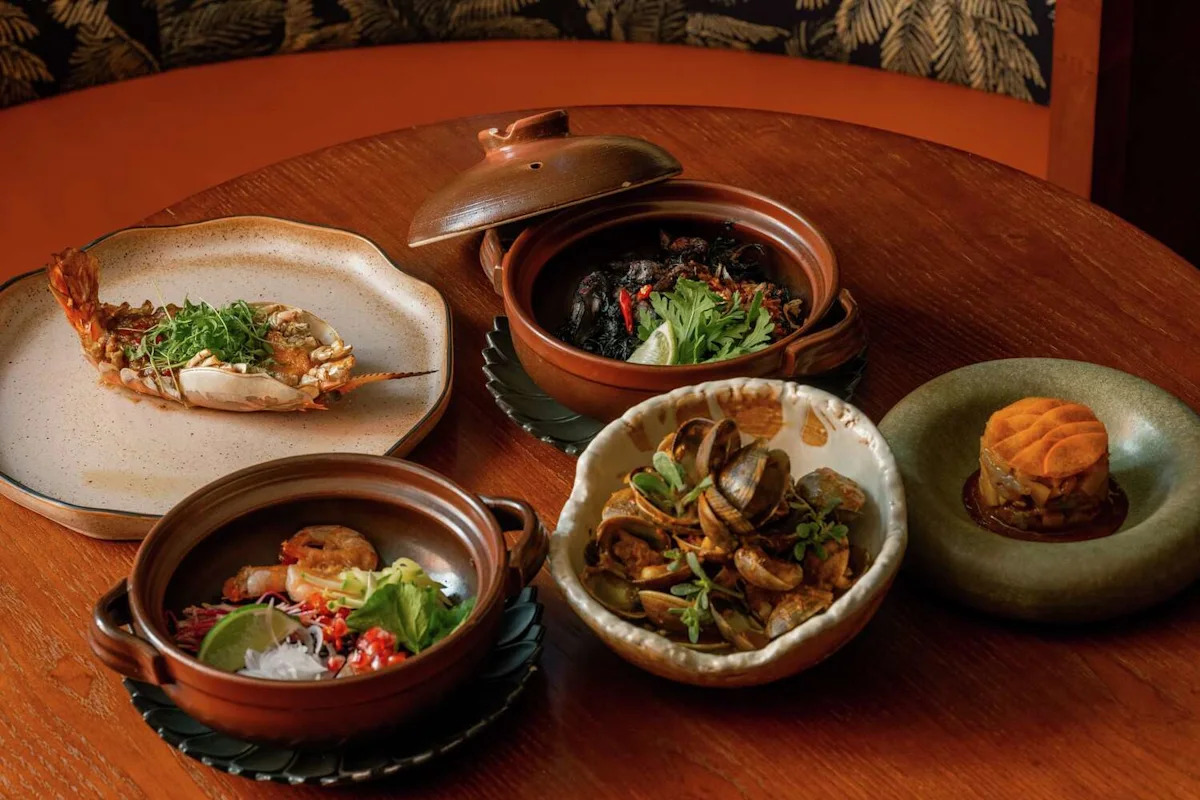
The past couple years have been fruitful for Thai restaurants in the Bay Area, with numerous high-profile openings, especially in San Francisco. A few were excellent additions to the scene, but they weren’t true peers of the establishments that set the region’s standard, and which remain the only two Michelin-starred Thai restaurants in America: Pim Techamuanvivit’s game-changing Kin Khao and Nari, which trailblazed the Cal-Thai approach. Then Saam arrived earlier this summer.
Saam is a collaboration between Thitid “Ton” Tassanakajohn – a celebrity chef in Thailand with numerous TV appearances under his belt, along with at least a dozen restaurants, two of them Michelin-starred – and two local partners, chef and restaurateur Tee Atthapon (owner of Kan Kiin in Daly City and Song Wat in San Francisco, among others) and chef de cuisine Ty Choosuwan. (Saam means “three” in Thai, as in the three men behind it, as well as a nod to the restaurant’s three tentpole flavors of spicy, salty and sour.)
Tassanakajohn worked at Eleven Madison Park and Jean-Georges in New York City during the late aughts, then opened Le Du in Bangkok in 2013. He returned from the U.S. with an approach to Thai cooking that emphasized terroir and local produce, which still lacked the prestige of “Italian food and expensive French cuisine” made with imported luxury ingredients, he told me. That changed in 2017, with the arrival of Michelin in Thailand, which led to the “booming of local ingredients,” Tassanakajohn said. Le Du received a star in the 2019 Thailand guide; Nusara, an ode to his grandmother, was awarded one in this year’s edition.
Saam arrives at a moment when the status of Thai food across the U.S. has never been more glamorous, as seen in Los Angeles (Anajak Thai), Philadelphia (Kalaya) and New York (Bangkok Supper Club, among others). The landscape shifted in 2015, when Michelin awarded stars to three Thai restaurants, including Kin Khao – cutting against the guide’s established track record of favoring European cuisines. “One thing that a Michelin star can do for a restaurant is show us that the idea of good food, what tastes good, doesn’t begin and end with the Western sensorium,” said Mark Padoongpatt, author of “Flavors of Empire: Food and the Making of Thai America” and associate associate professor of Asian American Studies and Interdisciplinary Studies at the University of Nevada, Las Vegas.

Muck Nam Dam (squid ink noodles) at Saam in San Francisco, Calif. on Wednesday, October 14, 2026. (Kelsey McClellan/For the S.F. Chronicle)
Saam pushes boundaries with its vivid funk and challenging spice levels and embraces a roving, pan-regional approach to Thai dishes – a prevailing theme among this year’s Thai restaurant boom – offering fresh takes on now-familiar hot-and-sour cooking of Thailand’s northeastern Isan region while exposing Bay Area diners to the seafood traditions of Thailand’s eastern and southern regions. A seafood clay pot noodle, for instance, nods to Chon Buri, known for its squid culture, while the accompanying sauce for a river prawn dish borrows from the south’s prodigious use of kopi (shrimp paste).
Through its embrace of the Cal-Thai approach of Kin Khao and Nari, mastery of seafood, and sheer originality – dry-style khao soi noodles in place of pad Thai, beef jerky instead of sai oua sausages and a white curry where you might find green – Saam surpasses its recent contemporaries, and is the Bay Area’s best new Thai restaurant in some time.
Tassanakajohn opened in San Francisco largely due to the “quality of the ingredients,” he told me. “What you can get here is actually better to cook Thai food, than (in) New York.” Here, he said, he has access to fresh cilantro root and makrut lime leaves from Thai, Hmong and Lao farmers; in New York, he’d have to settle for frozen. He also takes surprisingly direct inspiration from the Californian approach pioneered by Nari and Kin Khao. “This is how I want to cook as well,” he said. So farmer’s market tomatoes sit underneath thick tuna slices, while som tum, typically a green papaya salad, gets a refresh with local fruits, as do specials, such as scallops that are coated in nam prik narok (a searingly hot pepper condiment) and balanced with strawberries and pluots.
The cooking at Saam is way spicier than anything I had at Le Du, which I visited a few years ago (and thought was spectacular). Case in point: the shrimp tartare ($25), a tower of diced shrimp and seasonal fruit (peach during the summer, currently persimmon) marinated in a wrathful Isan-style sauce of chile flakes, fish sauce and lime juice. If the average crudo feels like a library in its quiet presentation of flavor, this is more akin to a thumping concert. Like chasing a shot of kerosene with a lit match, it blazes immediately, followed by the sweetness of fruit and the salty funk of shrimp paste. The addition of sugar could make the dish “more approachable,” Tassanakajohn said, but instead he honors the unflinching Isan approach by “using the same spiciness, the same funkiness.”

The khao soi haeng seafood (dry-style northern Thai curry noodles) is one of the most aromatic dishes at Saam. (Kelsey McClellan/For the S.F. Chronicle)
Tassanakajohn admits that it’s been a challenge adapting to California’s seasons, but also to Bay Area diners, many of whom understand “the complexity of Thai food,” having travelled to Bangkok. “I have to also think differently and step up my game,” he said. “The San Francisco diner is actually ready for it.”
The crowd is on the younger side, typically people in their late 20s, lounging in rounded banquettes with their oversized leather jackets, or thirtysomethings, who might be sipping wine and scrolling their phones on the bar or on a throuple date. The dining room is a gradient of rustic tones, with dark wood shelves displaying terracotta pottery, a bar flaunting glossy, clay-colored fish scale tiles and a ceiling that features a cream paint job with a sponge finish.
Saam isn’t a rehash of Le Du. The menu is a la carte menu, for one. While the river prawn dish ($48) – featuring the one primary ingredient sourced from Thailand – appears similar to the older restaurant’s signature, it is reimagined here to rapturous effect. Le Du’s version sees the prawn slathered in tom yum sauce and accompanied by risotto and a crunchy Thai omelet. Saam’s take is partly assembled tableside, with staff presenting a belly-up prawn covered in two sauces: an orangish, egg yolk-thickened one made from the prawn’s roe, as well as a southern Thai-inspired one containing kopi, shallots, garlic, coriander root and palm sugar. In front of you, they combine the sauces, then transfer the mix to a clay pot filled with black and white sticky rice before churning it all together. The mixing reveals shrimp candied in palm sugar and copious chopped bird’s eye peppers hiding beneath the greens. It felt like hearing the remix of a song you love that’s more hard-hitting than the original.

Chef and restaurateur Tee Atthapon, above, is behind a number of other Bay Area Thai restaurants, including Kan Kiin in Daly City and Song Wat in San Francisco. (Kelsey McClellan/For the S.F. Chronicle)
Saam was still clearly finding its footing in the kitchen in its early days, however. The river prawn dish is a significant improvement over a tiger prawn one I encountered on an earlier menu, which saw the crustacean woefully overcooked, with roe that looked like a hardboiled egg and meat as rubbery as a Michelin tire.
The real area that remains in need of improvement at Saam is service. Staff provided enticing details for certain dishes (the shrimp tartare), but failed to mention menu changes for others. When I ordered the beef curry, for instance, it arrived with white rice instead of the advertised roti. The server only mentioned that the roti had been 86’d when I inquired about the audible. Slim inventories in general seem to be a pattern; across multiple visits, several menu items were sold out within hours of opening. The restaurant has also yet to figure out coursing, which resulted in an awkwardly crammed table during one dinner.
Still, I think the lapses in service and pacing are eclipsed by the vigor of the cooking. At least a half dozen items on the menu you won’t find elsewhere in the Bay Area. Three of them compete for the most aromatic dish award, including dry-style khao soi noodles ($49) with a peppery, smoky warmth that you feel in your chest; curried clams ($29) heavily perfumed with lime leaf and lemongrass; and pad ped ped ($39), a full-bodied curry with roasted duck and delightfully chewy coconut meat. The clay pot noodles ($39), gussied up with squids and their precious ink, which is used to create a silken, oceanically briny sauce, were another knockout – especially when you add the accompanying nam jim seafood for the full live-wire experience.

Chef Ton Tassanakajohn chose San Francisco for his U.S. debut, he said, because of the “quality of the ingredients – what you can get here is actually better to cook Thai food, than (in) New York.” (Kelsey McClellan/For the S.F. Chronicle)
Tassanakajohn has been immersed in the restaurant since opening day, personally selecting produce and pounding curries by hand, as well as stir-frying any number of clams, scallops and fish. By all accounts, he is integral to Saam – so I’m a little anxious about him returning to Bangkok at the end of the year, even if he plans to shuttle back and forth between Thailand and the U.S. As it stands, Saam feels like the next step in Bay Area Thai food, following in the tradition set by San Francisco establishments Kin Khao and Nari – that, above all, Thai food never needs to compromise on flavor.
Subscribe
There’s more to San Francisco with the Chronicle. Subscribe today for just 25¢.
This article originally published at S.F.’s best new Thai restaurant pushes the boundaries of flavor – and the scene to new heights.