
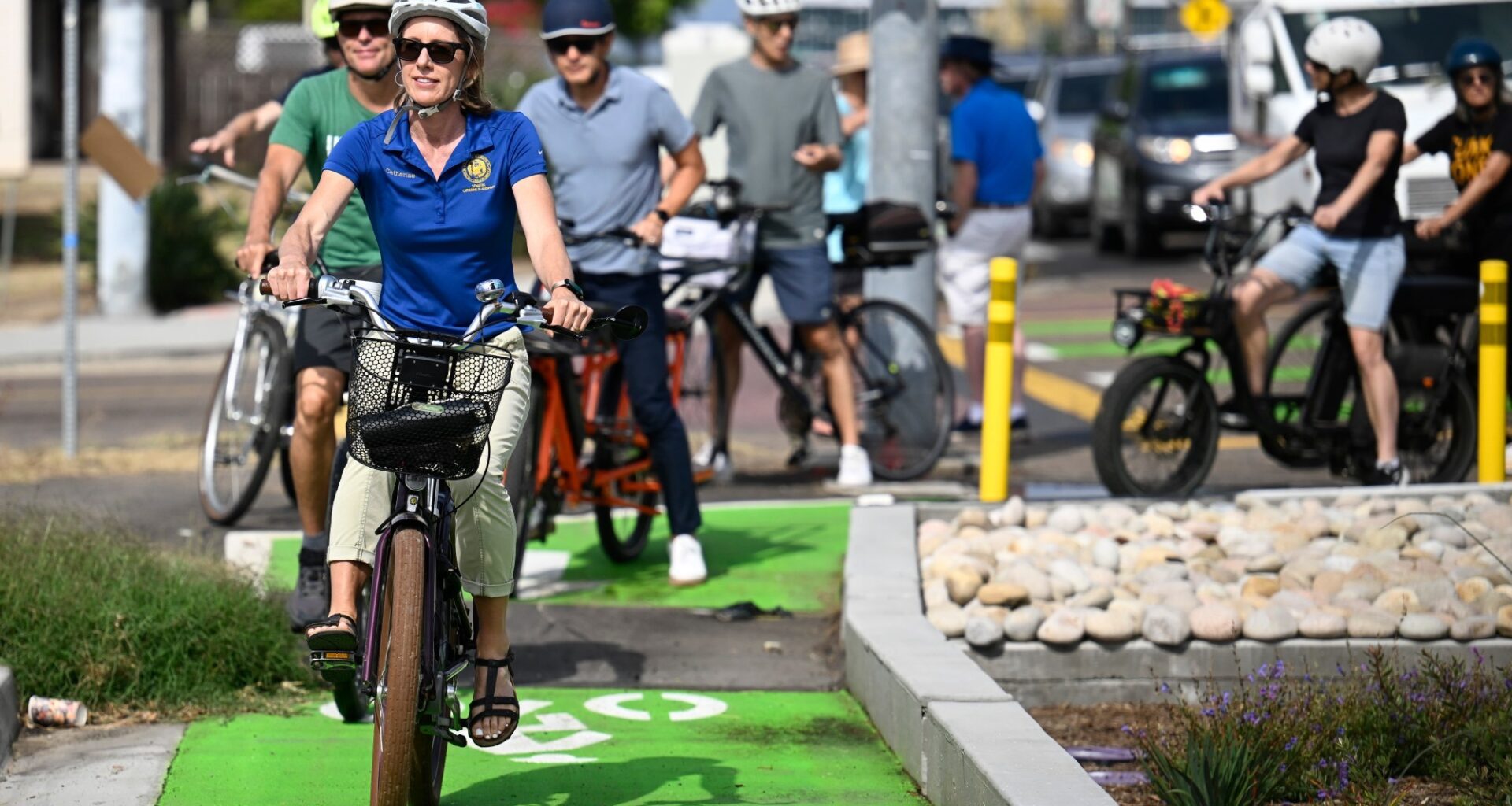
Encinitas will pursue legal action against the state of California over its recently enacted legislation that prevents the city from removing a recently built, protected bike lane on Santa Fe Drive for at least five years.
The City Council also voted Wednesday to continue with plans to rework a South Coast Highway 101 project that created another protected bike lane. That plastic-bollard-and-curb-stop-protected bike lane along the west side of Coast Highway south San Elijo State Beach is proposed to be replaced with a wide, sidewalk-style promenade that could be shared by less-confident cyclists, distance runners and sunset-viewing pedestrians.
The council’s vote to pursue legal action against the state over the Santa Fe Drive situation came during a closed-to-the-public meeting. The vote was 4-1, with Councilmember Joy Lyndes opposed. Lyndes has said she believes the recently completed Santa Fe Drive project should undergo some upgrades, but the protected, off-the-road bike lane ought to remain in place because she argues it’s safer than having young cyclists riding along the edge of the road near San Dieguito High School Academy.
Other council members have argued that it’s dangerous to keep the protected bike lane across the street from the high school. Mayor Bruce Ehlers has said there are many driveway entrances along that section of Santa Fe Drive and there is the potential for a “right-hook” accident where a vehicle hits a cyclist while turning into a driveway.
The roadway renovation project, which included many other changes to Santa Fe Drive near the high school, was approved several years ago when a majority of the council members were Democrats. In the November 2024 election, that majority shifted. Lyndes now is the lone registered Democrat.
Since the 2024 election, the new council majority has sought to rework the roadway, saying there was plenty of opposition to its current condition during the 2024 campaign season. They’re proposing to remove the highly unpopular, back-in parking spots, widen the vehicle lanes and replace the protected bike lane on the south side of the roadway with a traditional, edge-of-roadway bike lane. A protected, off-the-road bike lane on the north side of Santa Fe Drive next to the high school would remain in place.
Their proposed changes hit a roadblock last month when Gov. Gavin Newsom signed Senate Bill 114 into law. A provision in that law states that Encinitas can’t “remove or modify” the bike lane for at least the first five years of its existence. Between five and 15 years, the city can remove it, but only if the removal “results in equal or greater safety, accessibility and mobility for non-motorized users,” the law states. If the city violates these conditions, then it must give back the $3.09 million in state grant money it received for the project.
The SB 114 provision was sought by state Sen. Catherine Blakespear, a registered Democrat and former Encinitas mayor who originally helped the city obtain the Santa Fe Drive project grant in 2023. She has said that the council’s other recently proposed changes to the roadway, such as the removal of the back-in parking spots, are not impacted by the new state law. It’s only the bike lane that she wants protected for safety reasons, she has said.
Blakespear also supported the South Coast Highway 101 project that also is now being proposed for removal. Its opponents have argued that it’s both unsightly and unsafe. Proponents say it provides a protected space for young cyclists and their parents to ride near the ocean.
During Wednesday’s regular meeting, the City Council voted 3-2, with Ehlers and Councilmember Luke Shaffer opposed, to select one option from a list of choices for reworking that roadway project. Two of the proposed options would have preserved the current, protected, “cycle track” bike lanes on the west side of the roadway, while the third one called for replacing them with a wide sidewalk that could be used by both pedestrians and lower-speed cyclists. Traditional, edge-of-roadway bike lanes would be included for faster cyclists.
Council members all supported the third option with the wider sidewalk, but split 3-2 over where a proposed signalized intersection ought to go. Lyndes, plus Councilmembers Jim O’Hara and Marco San Antonio, voted to put a push button signal for pedestrians at the unofficial Harbaugh Seaside Trail crossing point near the city limits of Solana Beach.
They said Encinitas has grant money for that option; it’s a project supported by Solana Beach officials, who said this themselves during Wednesday’s meeting; and it’s where people are already crossing. San Antonio said he previously supported the other option — a full traffic signal at the South Cardiff State Beach driveway, which is further to north — but then met with Solana Beach officials in the area and found himself using the unofficial crossing point when he walked back to his vehicle.
“It’s like the path of least resistance,” he said.
Ehlers and Shaffer, who both voted against the trail crossing point, said they instead wanted a full traffic signal at the state beach parking lot. They argued that there are more vehicles regularly using that driveway than pedestrians crossing at the Harbaugh Trail location, and said the trail users could be convinced to simply walk further northward and then cross at the state park driveway. Encinitas will regret not putting the traffic signal at the state parks parking lot, they said, because the vehicle traffic will only increase in the coming years. The council majority told them that if this is the case, Encinitas can always revisit the traffic signal issue at a later date.