
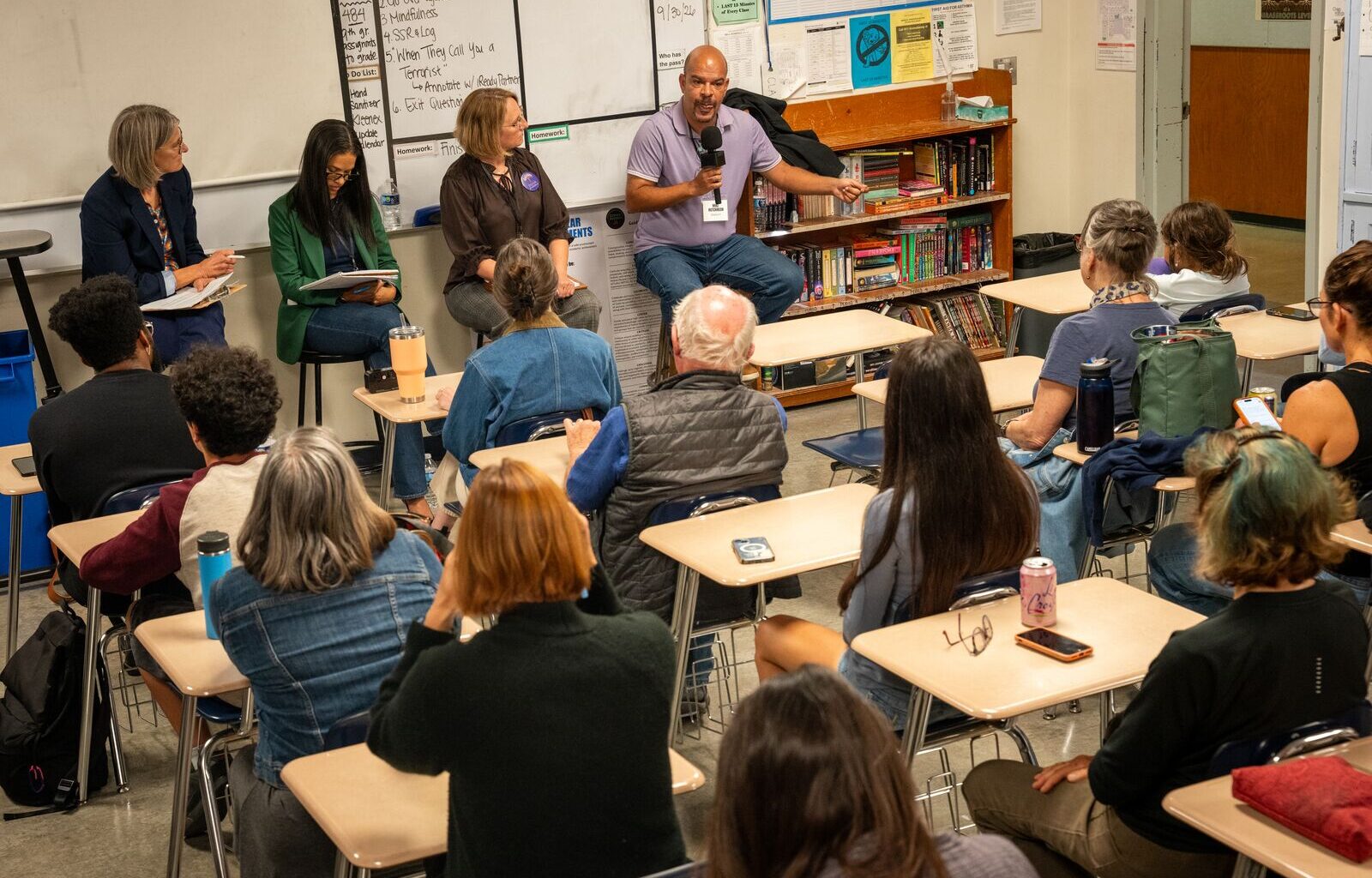
On September 29, The Oaklandside gathered all eight candidates vying for seats on the Oakland Unified School District school board this election cycle for a public debate at Oakland High School. Each candidate briefly addressed the crowd of some 150 Oakland parents, teachers, principals, students and community members, and then the candidates broke out into separate rooms by district to engage with voters.
See the other discussions here:
District 4 runs from the Oakland Hills down to the Laurel District and Allendale and is home to Montera and Bret Harte middle schools, Hillcrest K-8, and eight elementary schools: Joaquin Miller, Thornhill, Montclair, Glenview, Sequoia, Redwood Heights, Laurel and Allendale. In this race, Kathryn Camp and Sylvia Williams are both challenging incumbent director Mike Hutchinson.
Hutchinson has run after school programs and supervised lunchtime at a number of OUSD schools, including two that were shuttered: Santa Fe and Maxwell Park elementary. He highlighted his lifelong residence in District 4, his role in helping guide OUSD out of receivership, and his “Three Rs” plan for re-envisioning the district; he’s been endorsed by District 2 councilmember Charlene Wang, sitting school board members Clifford Thompson and Patrice Berry, and Empower Oakland.
Williams has spent 18 years as an adult educator and special education aide; she’s also a former teachers union bargaining committee member who’s been endorsed by the Alameda County labor council, the teachers union, and the Wellstone Democratic Club. She emphasized her commitment to making deep cuts at district headquarters in order to maximize spending in the classroom.
Camp, a parent with a child at Glenview Elementary, has done regulatory affairs work over more than a decade in the financial services industry, which she said has taught her how to collaborate effectively across teams; her endorsements include District 4 council member Janani Ramachandran, the Alameda County Democratic Party, and former Oakland mayor Elihu Harris. She said she would bring a sharp focus on getting far more of Oakland’s students on grade level in math and reading.
The candidates debated some of the major issues the board will face in the coming period, including how to tackle school safety, stabilize and rightsize the district, get special education spending under control, repair the tone on the board and ensure that OUSD is properly tackling discrimination and inequity. They also weighed in on a local fight in District 4, over a plan — recently called off — to eliminate a teacher and consolidate classrooms at Montclair Elementary, which hadn’t met enrollment projections.
The Oaklandside’s deputy editor, Esther Kaplan, moderated our District 4 debate, kicking it off with a question about the district’s budget deficits and then opening it up for audience questions. This transcript has been lightly edited for clarity and ordered by topic.
Esther Kaplan: Thank you all for being here. I’d like to welcome our District 4 candidates: challengers Kathryn Camp and Sylvia Williams and the incumbent director, Mike Hutchinson. The first question is for all of you. What are the key changes the Oakland Unified School District needs to make to maintain a sustainable budget? And should school closures or mergers be on the table? Let’s try to keep it to one minute each.
Sylvia Williams: OUSD has historically had much higher administrative overhead and buildings and grounds overhead and other expenses for adults who work in the district than other comparably sized districts. And the current board and the current superintendent have started to work on that by shifting some of the funding toward the classroom. I’m in support of that; I would like to see that work continue. That’s the kind of reform I would like to see.
My understanding is that closing schools does not save money, so I don’t think there’s any reason to keep that on the table as a way to balance the budget.
 District 4 school board candidate Sylvia Williams at The Oaklandside’s candidate forum at Oakland High School, Sept. 29. 2026. Credit: Maurice Tierney/Cityside
Mike Hutchinson: This is a big question for only one minute. First, school closures are not a budgetary issue, and let me stress that there is no current plan to close schools on the books at all. The last plan that had people protesting in the streets, I authored the resolution in 2023 to rescind those school closures.
And what we passed instead is the Three Rs resolution, which calls for a year-long community process to re-envision our footprint to make these decisions going forward. We’re not going to have a school close in District 4, and right now there’s only one campus that’s become vacant because a charter school no longer operates there.
And at that school, we already have plans to have satellite offices and build a full field. We can see what happened at [the former] Kaiser Elementary, a school that was only serving 20% of students in the neighborhood. [Editor’s note: Kaiser was a small school, but was operating nearly at capacity the year it was closed.] There was a move to change it to an early childhood hub, which is great. But we have to be able to do that without protests and have a real process.
Kathryn Camp: In terms of adjusting the budget, I think we need to move away from the annual crisis management situation and really get to sustainable fiscal strategy. We need simplified reporting that’s easy to understand, and we need spending that’s aligned with student impact and the district’s long-term stability.
We need to protect what is producing results and scrutinize things that are duplicative or ineffective. In terms of closures, the can has been kicked down the road. We need to have everything on the table. It’s not saying that we need to do it necessarily, and I do agree they are not something that will save money immediately, in the short term, and there is a process, extensive community outreach that’s required, but over the long term, it’s really a quality of education issue, which is what we need.
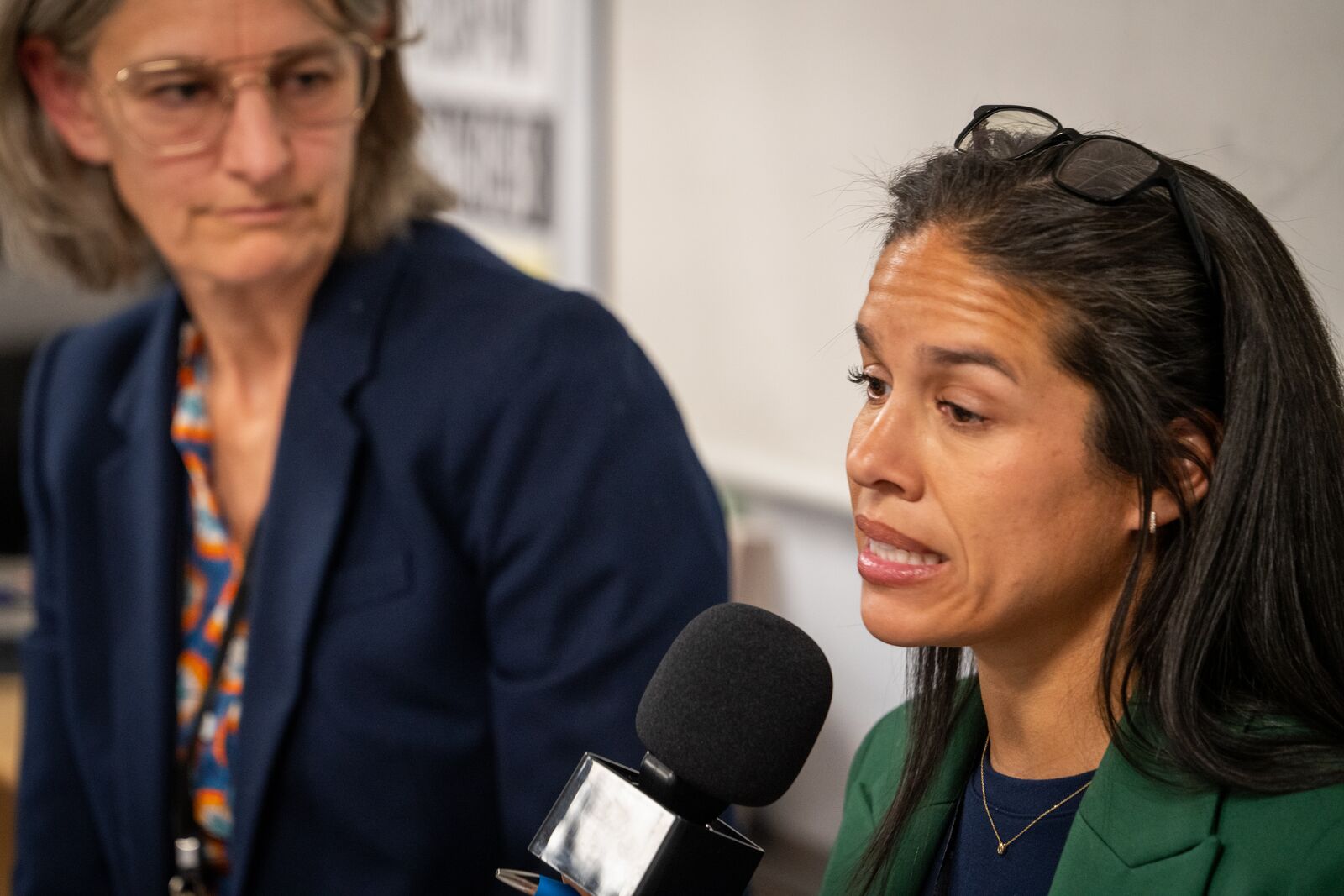 District 4 school board candidate Kathryn Camp, right, speaks at The Oaklandside’s candidate forum at Oakland High School, Sept. 29. 2026. Credit: Maurice Tierney/Cityside
Kaplan: Alysse Castro, the county education superintendent who has to sign off on budgets, sent a budget approval letter on September 15 saying “meaningful progress” had been made on the budget by the current board and district leadership. What do you think is the most important progress that has been made?
Hutchinson: I would argue with that characterization of her letter. A conditional approval is not an approval, and it means we have to make $30 million in cuts in our unrestricted spending this year and have that plan in place in order for her to approve our budget. That’s what the letter says.
Williams: The progress I see is, one, not having so much money in reserves, because we had just an enormous amount of money in our reserves, and that money was actually given to the district to spend on educating students. Having over $200 million sitting around in reserves is not the best practice, which is one of the things that she’s pointing towards when she says that this is a significantly better methodology that the new fiscal team is using.
So that’s one. Another one is directing more money towards the classroom in the form of a raise for teachers. That is major progress, which is why we started out the school year with a lot fewer vacancies for teachers than any other year in recent memory.
Camp: I would agree that shifting monies appropriately to where they should be allocated is progress, because they’re actually following appropriate accounting practices. Where this falls short is we’re not addressing the elephant in the room, which is the structural deficit of $30 million this year, $30 million next year, and another $10 million the following year [Editors’ note: $11 million], and not accounting for the fact that we’ve got bargaining units that we have not finished negotiating with yet or even started.
This paycheck-to-paycheck mentality is still there. The leadership has not learned over time to change their practices or to direct the district to do anything different than what they’ve been doing.
Academic priorities
Kaplan: Okay the next question is for all of you. Please name one academic program in OUSD that you think makes the district special and deserves more investment
Hutchinson: As a proud graduate of Oakland Public Schools who actually spent a year wandering these halls [at Oakland High School], we have successes all over the district, and the real problem now is we’re in a financial crisis.
I really want to tout the expansion of middle school sports, which, when I came onto the board, didn’t exist in the district, and now we have thousands of middle school students playing competitive sports.
 District 4 school board candidate Mike Hutchinson, the incumbent, right, speaks at The Oaklandside’s candidate forum at Oakland High School, Sept. 29. 2026. Credit: Maurice Tierney/Cityside
But we can’t ignore this conversation about the budget. When I was board president and vice president and chaired the Budget and Finance Committee in 2023 and 2024, we developed a plan that got us out of state receivership after 22 years by rescinding school closures, getting all unions at least a 15% raise, passing balanced budgets, and being able to project our budget forward. [Editor’s note: The district formally exited receivership in May 2025, while Jennifer Brouhard was board president, but the 2024-25 budget was passed in June 2024, while Hutchinson was vice-president and before Brouhard had a leadership role.]
It’s only gone into the tank over the last 18 months because the current board has been chronically overspending and has walked away from those plans. At a bare minimum, as a lifelong resident, we need school board directors who understand the budget, know the numbers, and are prepared to lead on this most important issue.
Camp: In terms of academic programs, my son is in second grade over at Glenview Elementary, and Makerspace there is an amazing program for kids. It is play-based, it is teaching creativity and arts, but also critical thinking and sound judgment all at the same time. So that’s a vital program that exists within the schools.
There are a lot of things that do need to be improved around what supports are provided and targeted resources that are needed throughout the schools, and the lack of attention to what has been deemed effective, like Jennifer Brouhard mentioned [during the introductory panel], is something that needs immense attention.
Williams: As a former adult educator, I will lift up family literacy classes. Family literacy classes are classes for adults who speak English as a second language, but they also train parents to work with their own children on academics. I developed a curriculum for family literacy, which was based around teaching English to adults, using children’s literature so that these adults are learning how to engage with literacy strategies and reading to their children from an early age.
That’s what I would advocate, more family literacy across the district.
Kaplan: Here’s a lightning round question, from a community member. In a few words, what is the one student outcome metric that you would want to track at every regular board meeting?
Camp: Early literacy between kindergarten and third grade.
Williams: I agree.
Hutchinson: The board is the wrong place to do that kind of work. At best, it should be the Teaching and Learning Committee. And what do we mean by tracking something at every meeting, every two weeks? Does that mean we’re giving rounds of tests? We have comprehensive schools. We need to look at this comprehensively.
The parent perspective
Kaplan: Thanks so much. Now I have some specific questions for each of you. Ms. Camp, you are the only current OUSD parent in the District 4 race. What’s the number one thing you think the current school board misses about the challenges facing our schools and our students right now?
Camp: It comes down to student outcomes and the lack of tracking towards them or prioritizing them in any way, shape or form. We have such a low bar right now that if you’re looking at the metrics, one in three kids are meeting the state standard. That is unacceptable. And that’s one in five for Black and brown students, for literacy. That’s a lot.
For me, having the core reading, writing, arithmetic, focusing on those things so we’re not advancing the school-to-prison pipeline. I know that seems like a jump, but literacy literally is the path to opportunity and success. You can’t do things in life without that. So we really need to prioritize student outcomes and focus on those.
 District 4 school board candidate Kathryn Camp gives opening remarks at The Oaklandside’s candidate forum at Oakland High School, Sept. 29. 2026. Credit: Maurice Tierney/Cityside
The teachers union
Kaplan: Ms. Williams, a question for you. You’re a past union rep and past member of the bargaining team for the teachers’ union, the Oakland Education Association. How would you relate to the OEA if you were elected to the board?
Williams: Somebody asked me if I was being run as a candidate by the union, and I’m not. I wasn’t sure there for a minute if they were even going to endorse me, but they did. I will relate to all the stakeholders in the district, including the OEA. I would value the input of OEA members and OEA leadership.
However, I definitely do not take my marching orders from the OEA in any way, shape or form. I would also value input from parents, administrators, students and other folks from the community. I think organized labor is important, but I don’t think that the teachers should have a disproportionate influence in the school district.
Board transparency, accountability and tone
Kaplan: A question for you, Mr. Hutchinson, from the community. A resident wrote to suggest your record of abstentions and nay votes on the board might contribute to the board’s dysfunction. What’s your response to that?
Hutchinson: It’s actually the opposite. It’s in response to the board’s dysfunction. And so as we talk about the financial crisis that we’re in now, I voted against those budgets. I introduced resolutions for a different path forward. The board decided to go a different direction, and I’m not going to just vote to go along with something.
If anyone has seen me on social media over the last 18 months, I’ve done everything that I can to try to stop the district from going this route, including getting information to the community so people know what’s happening. I know my constituents don’t want me to vote for something that’s going to lead the district into ruin, but I also do a lot more than just voting no. I stand up, I advocate, I propose alternatives, and I have a track record from ’23 and ’24 that shows we were on the right path until this board majority came in.
Lastly, one of the key things that I voted no to, and then I took it public, was when they fired our long-term superintendent for no reason.
Kaplan: We received community questions about what residents see as the board’s failures of transparency, including around the separation with the last superintendent. If elected or reelected, how would you communicate the reasoning behind key decisions with the public in a way that is clear and transparent?
Williams: With regard to transparency, I want to be meeting frequently with constituents, in person, face-to-face. I’m committed to educating the public about how the budget works. I can communicate that on my website. I can communicate that in workshops.
I would look at simplified reporting. I find a lot of things that are shared with the board are way too complex, and you’re expected to have a finance degree to understand what’s going on, so that’s one.
 District 4 school board candidate Sylvia Williams gives opening remarks at The Oaklandside’s candidate forum at Oakland High School, Sept. 29. 2026. Credit: Maurice Tierney/Cityside
Two, I would say providing materials well ahead of time. This whole 72 hours nonsense, I know that’s the minimum requirement, but we are not the minimum, okay? We deserve way more than that in order to understand what’s going on and to be fair and transparent.
Also having town halls is incredibly useful and should be utilized. Having one-hour coffee meets once a month is not community outreach. We need to be out there pounding the pavement, talking with our community partners and our members and our stakeholders. We need to open those floodgates of communication and dialogue.
Hutchinson: My track record over the last four years speaks to that. When it comes to the superintendent being forced out by the school board, I broke closed session confidentiality because I believed it was a violation of the Brown Act and other laws, and the community needed to know. Because of that, the ACLU sent me a thank you letter.
I take this seriously, as people who I’ve met with learn very quickly. Before I was elected to the school board, I had been at every school board meeting except for a handful over eight years. Now I have six more years at all of the meetings. In that time, I also attended most of the committee meetings, and I have consistently shared information with the community by any means that I could because I believe in my community that I’ve lived in my whole life. The way we make the best decisions is by ensuring that everyone has the right information.
And this is the intersection with why I’ve voted no and abstained so many times, and I’ve explained all of those votes publicly each and every time.
Kaplan: An individual question for Ms. Camp. You have described the district as fractured with parents, district leaders and educators divided. What has made you say that, and what steps would you take to bridge those divides?
Camp: Well, we have a four-three majority, and I’ve gotten that directly from folks on the board. Their voting records don’t reflect the things that happen behind the scenes, which is kind of wild. So they may feel one way off the dais, and then they get up on the dais and vote another way. That is incredibly surprising and disturbing all at once.
I stand out as a coalition builder. My experience over the last 10 years in my last job was doing regulatory affairs work, which is basically a fancy way of saying I worked with government agencies and private entities and made sure to work with everyone from the board to tax teams to engineers to product people to accountants to the legal teams, all towards one purpose. That was my job.
So this is same stuff, different day in terms of what this role would be for me. That’s what I would bring.
Kaplan: A question for Director Hutchinson. As The Oaklandside has reported, you are facing up to $95,000 in fines from the City Ethics Commission for what they say is a failure to file campaign finance disclosures dating back to your 2016 school board race. Can you respond to that?
Hutchinson: I’m just really frustrated that this is even still an issue from 10 years ago and that it hasn’t been resolved. This is the result of a campaign committee never being registered as being closed. No money has gone through there. Nothing else is happening. And I’ve been doing this dance with the Ethics Commission for way too long. And I’m just hoping that it will finally get resolved.
Special education
Kaplan: Ms. Williams, you’ve campaigned in part based on your background in adult education and special education. Special education spending in OUSD has in recent years dramatically outstripped the dedicated federal and state funds to support it. How, as a board member, would you help the district rein in special ed costs without sacrificing services to kids with individualized education programs or IEPs?
Williams: One best practice is to offer some of these interventions universally to all students in a class, whether or not they need a particular special ed intervention. So training classroom teachers to use best practices that are inclusive of all students, that’s one thing that I would lean towards.
It’s a knotty problem. I don’t think I have a lot of solutions to it yet. But I do see that special ed spending is increasing at a rate much faster than you would expect, and I would like to do some digging into why that is.
Discrimination and inequity
Kaplan: This next question is for all of you. We received several questions about discrimination and inequity in the district. Do you believe OUSD has adequately addressed racism, antisemitism, gender discrimination and anti-LGBTQ bias in our schools? Where do you think OUSD has fallen short?
Camp: Do I think it’s been appropriately addressed? No. I mean, we have headlines about judges saying that OUSD has not been in compliance with AB 715. [Editors’ note: This state law, designed to strengthen anti-discrimination protections, was unrelated to the judge’s September ruling, which was about compliance with orders from the state education department.] There are families who are very afraid and scared to send their kids to school.
The training, from anecdotes of what teachers are experiencing, is not up to standards that would be appropriate for providing empathy towards others. So I think we really need to hold the board and the district accountable for complying and for maintaining a welcoming, inclusive environment for our students, for our staff, for our teachers, for everyone.
 District 4 school board candidate Mike Hutchinson gives opening remarks at The Oaklandside’s candidate forum at Oakland High School, Sept. 29. 2026. Credit: Maurice Tierney/Cityside
Hutchinson: No, it hasn’t been adequate, and over the last two years, we’ve moved backwards. Things like the disproportionality of Black suspensions in this district is now up to a rate of almost three times the general population, which is worse than when we got put under a voluntary resolution [in 2012] with the [federal Department of Education’s] Office of Civil Rights.
This is what happens when we lack leadership in the district, and it wasn’t great before. We live in Oakland, California, so we’re semi-protected, but we live in the United States, and there’s a legacy of a lot of things, especially in Oakland.
Right now in this room, there’s 10 times as many people than have been attending school board meetings, because we’ve lost the culture of engaging and demanding. You know, my mom, in the back of the room, was pregnant with me the first time I was at a school board meeting. It’s up to all of us when we see any of these issues happening to step up and get involved and demand better.
Williams: I’ll agree with these other folks that things have not been adequately addressed. One thing I’m hearing from parents in the community in particular is around AB 175 not being enforced. So that’s an important issue that needs to be addressed. It needs to be enforced.
Also, I’m hearing that there’s a disproportionate number of non-reelects [nonrenewals] given to Black educators in this district, which is very concerning. So there are some outstanding problems that need to be addressed.
For the antisemitism issue, I would like to see more programming that is really conversation-based, heart-based, and building empathy, rather than compliance-based.
School safety
Student question: I’m a student at Skyline, which I know is not within this district, but we had a shooting last year, and there have been other shootings over the past couple of years at my school, and the students there were pretty disappointed at the outreach and communication from our board members. So I’d like to know how you would prevent the violence in our schools and what your actions would be if something like that happened at a school within this district.
Williams: That’s a really important question, and it’s actually come up a lot from young people. I mean, if you’re starting from the younger ages, and that really is where you need to start, there are some programs that are effective, which is — I don’t know what you call them — peer yard monitor-type situations where there’s —
Camp: Culture keepers.
Williams: Culture keepers, thank you, on the schoolyard who are trained to mediate disputes between students. I think that kind of program really works at the younger ages. At older ages, you can also have peers who are in charge of working with other students to deescalate violent situations and to be in communication with trusted adults when things start to come up that seem like they could devolve into violence.
Hutchinson: Thank you. For 25 years, I worked directly with youth in Oakland, ran a lot of junior coach and conflict manager programs, and I firmly believe that the more quality adults that we have in our schools, the better off we’ll be.
I’m Skyline ’91, so I was at that meeting at Skyline when the elected representatives in that district weren’t. I was so mad at what I saw happening, I kind of hijacked the meeting for a couple of minutes to say something. I also made myself available to parents from Skyline who were really upset with what had been happening. This is something I’ve done a number of times. I was just at a community meeting last night at Montclair Elementary, where we made the superintendent backtrack on her plan to reduce the number of teachers there.
We need elected representatives who are connected to the community, who see it as our responsibility to go where needed, whether it’s fun or not or comfortable or not — that’s the job we’re running for. We need to do much better. The worst kind of failure is when our constituents or community is in need, and we don’t even bother to show up. That would never happen from me, and we need to demand better from everyone.
Camp: To answer your question on school safety and things to do differently, I think there are a number of things.
Restorative justice, a number of those roles were cut, across the board. And studies have proven their effectiveness. They have had great success. So the fact that we lost those during the recent cuts? Those should be prioritized and reinstated.
We need to ensure that we have mental health supports. I also think that with the George Floyd Resolution, there was the pot of money, about $2 million, that’s been reallocated for some other programs. [Editor’s note: The district allocated $6 million.]
I think there needs to be more focus on the relationship with OPD [Oakland Police Department], and there has not been a reengaged conversation. So if OPD gets called to a school, there is no agreement, there is no MOU. That needs to be prioritized for sure.
Youth voices and the youth vote
Kaplan: Let’s turn to a community question. Beyond the two student board reps, how would you work to include student perspectives in the decisions you would make as a board member?
Williams: I have been campaigning with the youth and it’s been fun. I was up at Skyline High the other day talking to students, so I think it would be fun to continue that. It would be great to push into social studies classes and get a chance to really talk to youth on a regular basis. I would love to partner with teachers at the high schools in particular.
Hutchinson: District 4 is unique. We don’t have a high school in District 4. Oakland High and Skyline High are both about one block outside of the district, and so it just makes it a little different when it comes to student engagement.
I’ve always really tried to encourage not just the student directors, but the All City Council [Student Union] to be much more engaged and active, and to lean on the legacy we’ve had in Oakland of amazing student directors and student leadership that has led to protests in the streets and real changes in policy.
I’m really proud that I’m a graduate of Oakland public schools. My nieces attend Oakland public schools. My daughter will start in four years in TK. But what we need to really start doing is collectively engaging and creating this space where we’re all sitting around the same table, because it’s not about lifting up student voices, it’s about including students in the decisions we’re all going to make on how we redesign our schools moving forward.
I wish we could all answer some of the same questions because, as a lifelong resident, I want elected officials who are prepared for the seriousness of this job.
Camp: One thing we could have more of is more civic education in our schools. Especially in this environment with what we’re seeing at the federal level, we need our youth, we need generations to know what it means to be a participant and do their civic duty, and know what that means.
Especially in Black and brown communities, we are taught, we are conditioned, to feel and think that our voices and votes don’t matter. I’m sorry, last time I checked, it matters. We need to really emphasize that, push that, advocate for that, and ensure that our curriculums include that.
Student question: What can the district do to promote youth voter registration and education? [Editors’ note: Students who are 16 or 17 can vote in Oakland school board elections.]
Hutchinson: It would be difficult for the district to have a direct role, but I remember for me, when I turned 18 my senior year up at Skyline, my social studies teacher always had voter registration forms in his desk, and as each student turned 18, he made sure he put it in our hands.
That’s the kind of culture now that we are starting — civics classes with the civics seal [the State Seal of Civic Engagement]. How do we create this culture where there’s this expectation of either you’re going to get your voter registration from your teacher at school, your family at home, or you’re going make that a part of your journey when you turn 16, not just to get your driver’s license, but also to register to vote?
That’s what we can focus on, and really, not just for students. Our voting rates are way too low, even in District 4, which has the biggest turnout. I think creating this culture, creating it young, that’s the way I would like to institutionalize it, using the adults we have in the system and their peer pressure and encouragement to really make it happen.
Camp: I beg to differ. I think this is totally something we could knock out of the park, in terms of being able to support students in the district, having days where it’s like pre-registration day and people come and they make a whole thing out of it and it’s a nice event.
We do that for plenty of other things. I don’t think there’d be any issue with putting something like that together in terms of supporting youths to vote. I think it would be widely celebrated. It’d be easy to put out comms. So I’m all for it.
Williams: I would love to hear what your ideas are for how to involve other youth, because it sounds like you have something in mind that’s going on that you don’t like. But I would love to involve youth themselves in educating other youth about the whole process of voting for school board.
Superintendent Denise Saddler
Audience question: What do you think of the current superintendent?
Camp: I think the current superintendent is doing her job, because her job is to follow what the board is telling her to do. She’s doing that to the letter.
Now, in terms of what the board vision is and how she’s being directed, that’s something completely different, and one of the reasons why I’m running is because we need to get away from this status quo. It’s not been serving us. Look at the student outcomes alone.
We’ve got facilities where we’ve got, what, $4 billion [Editors’ note: $3.15 billion] in deferred maintenance that is not being addressed. We have vacant properties that they haven’t decided what to do with and are dragging their feet on with feasibility studies that are taking forever. There are a lot of things that have been distracting this board from focusing on the most important thing, and that’s the students.
Williams: Superintendent Denise Saddler has an incredibly difficult job, and she’s made some very courageous decisions that kept us out of receivership, and that was really important. Unfortunately for her, because she was taking over midstream from another superintendent, she had to make some very tough decisions and make some very large cuts in order to keep us from going back into state receivership at very short notice, and that’s been very hard on principals in particular and school sites in general.
It did not impact classrooms, but it impacted roles outside of the classroom at school sites, and that’s been tough. However, I have great admiration for her, for what she’s had to do, essentially alone, because the fiscal team that she was working with was working at cross purposes with her, unfortunately.
So I applaud her, and I think she’s making some very student-centered decisions by raising teacher pay and averting a strike, and that’s why we started out the school year with the lowest number of teacher vacancies. And also, she hasn’t merged classes together mid-school year, and that’s important as well.
Hutchinson: We have to remember what actually happened. So last April, Superintendent Dr. Kyla Johnson-Trammell — a homegirl born and raised in Oakland, started off as a teacher — was forced out of the district eight months into her three-year contract extension by this board majority.
Then in December, this superintendent, the new one, forced out our chief business officer. When Denise Saddler inherited the job, we had full local control and were out of receivership for the first time in 22 years. But when she was hired by the board, instead of hiring the second in charge, she had been a substitute principal for seven years. I’m sorry, she didn’t meet the minimum qualifications for the job at hand, and we can see what’s happened over the last 18 months.
One thing that I think should be required of every school board director is an understanding of what our roles and responsibilities are, and it’s two things: hire and fire a superintendent and act as fiduciary agents. The two things this board majority has failed on the most.
Restructuring the school district
Audience question: Director Hutchinson has mentioned several times the Three Rs plan, and I’m curious to know what that means to each of you and what specifically you feel needs to be restructured in the district office in order to make it both more student-centered and more efficient.
Kaplan: We’ll start with Director Hutchinson on the Three Rs, and then we’ll have the other two of you respond to the broader restructuring question.
Hutchinson: I authored the Three Rs resolution and was very proud that we were able to pass it. It was based on two years’ worth of conversations with the [former] superintendent.
As we were regaining local control, we knew we needed to change everything because we’d been subjected to 22 years of educational experiments when we didn’t have local control. And so we devised a way to address everything at the same time by compartmentalizing it.
One of the Rs is restructure. Restructure the central office, how many departments we have, how those things are organized, which needs to be a plan that comes from the superintendent.
The second R is re-envision our footprint. We need to decide how we’re going to use our facilities across the district. Now that we’ve beaten back charter schools and they’re in retreat, do we change one of our schools into an adult ed or early childhood education hub? We have all of these needs that aren’t being met, and we need a community process.
The third R is transformational school redesign, so we can move our district forward.
Williams: Part of the restructuring that I think is necessary is underway right now, which is directing money away from the central office. The way the school district has been run historically, which really doesn’t work, is we’ve had the lowest paid teachers in the entire county and in the entire area, and then we’ve had experts, very talented, intelligent people that work at the central office, and they go out and support sites and support new teachers.
And that is one way to run a school district. But a best practice is to have more highly paid teachers who are actually experienced, who don’t need all this central office support, and that’s something Denise Saddler has started to do, and I’m in support of that.
Camp: That’s a good start. In terms of restructuring, what’s needed, there are a few things. One is we need to get back to an era of good governance. I’m not seeing it on this board, frankly. We need to have a mission, vision, values that we actually adhere to because they have them on the website.
If you listen to any investor call from any company, any time they make a decision, it always ties back to the mission, vision, values. We need to have a North Star. It could be something like the three Rs, but that’s kind of a plan for a plan. We need something that has more teeth and more implementation components.
If you think public administration, it needs to have that dive-in with district leadership to understand what needs to be done. Fiscally, we need to address the structural deficit in its entirety and really have a plan to understand what it will take to get to a healthy district, because that’s what getting out of the structural deficit will be.
Vacant school properties
Audience question: It seems to me like Oakland has a lot of properties just sitting around lifeless, like the Second Avenue building that’s had a flood and the Lakeview campus. Those properties alone could probably bring in $30 million if sold to a developer. So does anyone have any out-of-the-box thinking about these properties to get us out of the fiscal hole?
Camp: Yeah, the physical facilities. If you didn’t know, OUSD is one of the largest property owners in Alameda County. They have, like, 525 acres, almost 110 properties, and about 10 or 11 of them have been deemed excess, meaning they’re not usable. [Editor’s note: As of June, 12 properties are listed as vacant, leased or underutilized.]
My recommendation wouldn’t be to sell them, because those are one-time funds coming in. What I would propose, and I’ve been checking on the viability of this with former board members, city council, the [Alameda] County of Board of Education, a number of people in different areas, and people on the board, is having low-income housing that supports our teachers and our unhoused families with students.
We have 1,800 unhoused students. I haven’t heard one thing about supports from OUSD for them. I hear about it from the county, but I don’t hear it from OUSD. For me, I think we need to have the 99-year-lease situation with developers and do that, not selling.
Williams: I agree with a lot of what Kathryn just said. You can’t run the school district by selling — it’s a one-time thing. You sell the building, and then you can use that $30 million once, and then you still have a structural deficit. And yes, 82% [Editors’ note: the most recent number is 80%] of our students are of low socioeconomic status, and the school district and the schools belong to all of us, but they especially belong to them.
I love what Kathryn is saying. We need to think outside of the box about how we can leverage the resources that we have, including these very valuable properties, to help those students. It could be in a variety of ways. Mike has mentioned adult ed. I love adult ed. We could probably provide childcare and early childhood education for 3- and 4-year-olds. Deeply affordable housing would be great, something like that.
Hutchinson: This is public property. I’m philosophically opposed to anything that cedes that public property to private hands longer than my four-year term. The properties you mentioned all have histories. I was deeply involved with both of those two properties that you mentioned, from when the admin building, the Paul Robeson building, was intentionally flooded in 2013 [Editors’ note: Reporting at the time said a faucet was accidentally left on] to try to make it available to developers, to Lakeview Elementary, where we had a three-week sit-in and occupation when they closed our school there.
This is what the Three Rs was supposed to address, when we look at re-envisioning our footprint across the district. There are laws that apply; we can’t just go sell or lease our property. Our property is for educational purposes.
You know, one of the things I learned being on the school board during the pandemic, when I was convening community partners to provide testing and vaccinations, is OUSD can’t be the safety net for everything. The county funds that because that’s their job and their role. What we need to do is go through a comprehensive community process to decide how our properties are going to be used, then we develop a plan, and then we implement the plan. So if we decide to do that, we’re still a long way from even being able to make that decision.
Prioritizing District 4
Audience question: If the voters in District 4 should elect you, how do you see your role as representing District 4 on the school board?
Williams: Last night I was also at the event at Montclair Elementary School. I feel like it would be my responsibility to show up and advocate. The issue at Montclair is they were thinking about combining some classes mid-year, which is a terrible, not a child-centered practice, and I’m glad they decided not to do that.
I would see it as my role to come in and advocate in those kinds of situations and if the school district or the board are making decisions that are not centering children or are upsetting adults in the community, then I’m there. I’m standing side-by-side.
Camp: For me, it’s really about ensuring that there’s always open communication and an open door. It’s really, really important for people to feel heard. As part of the PTA at Glenview, one thing I realized was that the PTAs don’t even talk to one another. They don’t have any connection, which is wild to me. They’re all doing things in silos.
So the first thing I did, when I took on the role, I was like, “All right. I’m just gonna have a bunch of the PTA presidents at my house, and we’re gonna shoot the stuff and talk about fundraising, talk about parent engagement, talk about challenges with the schools, barriers we’re experiencing, and have thought exchange and knowledge sharing.”
That’s the type of thing I’m looking for. I’ve been doing that with principals across our district. I’ve met with a number of principals already, and I’ve been speaking with a number of teachers on this as well to just hear: Are there commonalities? So I think I would just continue that practice.
Hutchinson: I still live in the family house. We’ve lived there almost 45 years. I know the schools in District 4 and most of OUSD intimately, from a lifetime’s worth of experience. I know all of the schools in District 4 very well. I can name them all. I know the issues that are occurring at most of those schools, and I know the long-term policies that we want to see put in place to be able to move things forward for our schools.
Whether it’s TK hubs and understanding that those were created because the physical space in many of our District 4 schools won’t accommodate the added classrooms that TK requires. We wanted to be able to enroll students, but we didn’t have the physical space. That’s why we developed TK hubs.
I love meeting with my schools. And last night at Montclair, because I was able to work with the parents up there, we had a huge victory, and it wasn’t just a victory for Montclair. Superintendent Saddler said last night that there’d be no teacher consolidations anyplace across OUSD.
What we need to do in our district is we need to organize and push and be confident that when we make it happen in our district, it’ll benefit all of OUSD.
Defining success
Audience question: A lot of what we’ve been talking about is really lofty, and it will take more than one person and more than four years. But how would you like to be evaluated within your term? What would success look like as an elected official within your term?
Williams: I would like people to measure my success by how many of our teacher vacancies are filled with a fully credentialed, qualified and experienced teacher, because that’s one thing that we know contributes to student outcomes. If we can get to the point where 100% of our vacancies are filled at the beginning of the year, and all of the teachers are credentialed in what they’re teaching, I would consider that a success.
Hutchinson: I’d like to be judged on my track record over the last four years and my two years in District 2 before that. In ’23 and ’24, when I was board president and vice president and chaired the Budget and Finance Committee, we negotiated 15% raises with every union, rescinded the plan to close schools, passed balanced budgets, paid the state loan off a year early, and passed a fiscal systems audit.
All of that allowed us to finally leave state receivership after 22 years. And it’s only been in the last 18 months, as this board has formed a majority, that we started to backtrack, and this is the throughline. That’s why I’ve voted no so many times. I’ve passed more resolutions and legislation than my colleagues on the board combined.
I’ve provided an option every time of how we should or could go forward. Before this current board, there were different coalitions for different items, and we were able to move things forward. That’s what we need to return to. That’s why I’m proud that I’m endorsed by my two colleagues on the board currently.
If I’m reelected and there’s one other change [to the board’s makeup], we’ll have that new board majority going forward.
Camp: For me, it was what I was speaking to earlier in terms of the mission, vision, values, being able to coalition-build with folks on the board to get to a place where we know where we’re going in the long term, not just the short term, not this paycheck-to-paycheck mentality.
Literally in the long term. We look 10 years out, and we’re like, “This is what we’re shooting for. This is gonna be a healthy district, by doing all of these things, and we’re going to have work plans that keep us accountable.” Think of them like performance reviews. That would be the same thing for the board, as well as the superintendent.
For me, being able to have that transparency, have that vision, have something people can really believe in and restore hope in, because there is no public trust. The public trust has been gone for quite some time, and so we need to make efforts to restore it.
Closing statements
Kaplan: Okay, you’re each invited to take one minute for a closing statement.
Camp: I’m Kathryn Camp. I am a district parent, PTA leader, public policy professional with over 20 years of experience in financial services, regulatory compliance, dealing with budgets, leading teams, all of this stuff, and I’m a Bay Area native, I’ve lived here for 25 years. My lived experience combined with my professional experience, my angle towards coalition building and getting people to focus on what we really need to prioritize, which is our students. We wouldn’t be here if it wasn’t for them. None of this would exist.
Schools, students, they make communities thrive, and that’s what we need to prioritize most. I hope to earn your support this November, keeping all that in mind.
Williams: I’m Sylvia Pfeiffer Williams and I was an adult educator in the district for 18 years. I was a special ed aide for two. And I’m running because I want us to restructure the district so that we’re directing more money that’s going outside of the classroom to inside the classroom. I want us to compensate our teachers so that there’s stability at school sites, there’s expertise, and we’re making student-centered and child-centered decisions.
Hutchinson: I’m Mike Hutchinson, proud graduate of Oakland public schools. My mom in the back was a teacher in Oakland. My family’s an OUSD family. I was first elected to the board in 2020 as part of a wave in 2020 and 2022, where we forced out all seven school board directors because of the policies they had engaged in.
In ’23 and ’24, we had historic progress that led us to finally leave state receivership and regain full local control for the first time in a generation. Then over the last 18 months, we’ve been taken back and thrown over the abyss again by the current board majority, by the narrowest of four to three margins.
This is our district, and we need to reclaim it. We need to all stand up. We should all be frustrated by what we’ve seen happen. The one thing I have now that I didn’t have when I ran four years ago is a proof of concept. It was working. We left receivership, and that’s what we need to get back to by creating a long-term fiscal solvency plan, relaunching the Three Rs, starting the search for a superintendent, and carrying this energy into the school year after election day.
Kaplan: Thank you, Director Hutchinson. Thank you, Ms. Williams, Ms. Camp. Thanks to all of you for showing up on a school night. Thanks to Oakland High School for hosting. Don’t forget to vote. Ballots start arriving Monday, October 5. In-person voting begins October 24.
“*” indicates required fields