
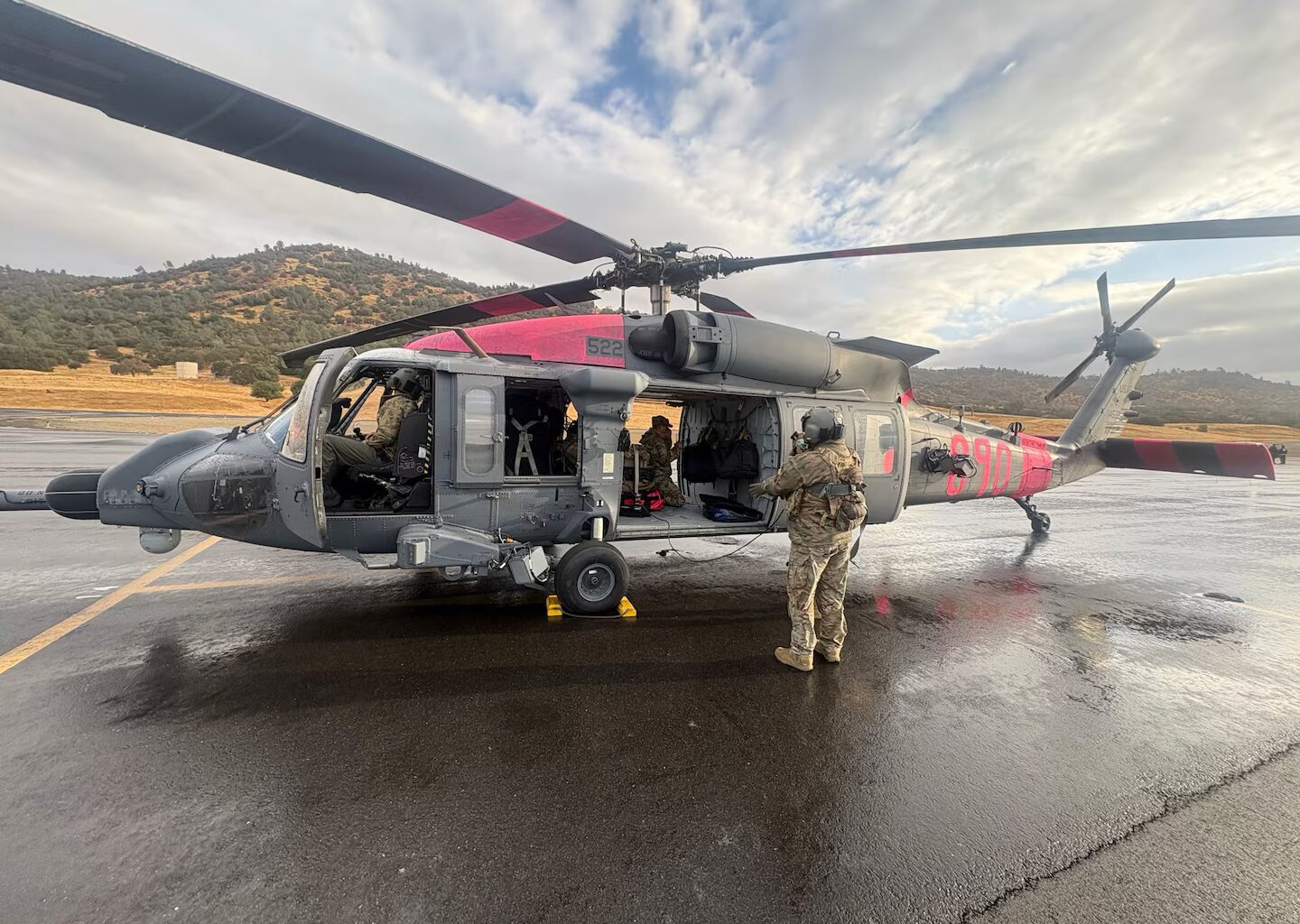
MOUNTAIN VIEW, Calif. – The California Air National Guard’s 129th Rescue Wing deployed its new HH-60W Jolly Green II helicopter to support wildfire operations in Yosemite National Park, Oct. 9-12, marking the aircraft’s first wildfire mission since the wing began transitioning from the HH-60G Pave Hawk last year.
The helicopter and its crew provided overnight medical evacuation support for firefighters battling the Dome Fire, which burned nearly 7,000 acres of rugged wilderness near Wawona, California.
Operating from Mariposa-Yosemite Airport in Mariposa, the crew maintained a 12-hour overnight alert posture, standing ready to conduct emergency rescue hoists and evacuate injured firefighters from remote wilderness areas.
Although no emergency evacuations were required, the mission provided an opportunity for aircrew members and pararescuemen to practice rescue techniques and gain operational experience with the HH-60W in challenging high-altitude conditions.
“The higher a helicopter flies, mixed with higher temperatures, decreases the amount of performance you can get out of the machine,” said U.S. Air Force Capt. Mike DeWein, an HH-60W pilot with the 129th Rescue Wing. “This takes careful consideration to determine aircraft weight and fuel requirements to be able to have the power required to conduct rescues.”
Taking off and landing from the airport in Mariposa at 2,254 feet above mean sea level, or MSL, and climbing to operational altitudes above 8,000 feet MSL near an incident where temperatures were hotter than normal gave the HH-60W and its pilots an opportunity to see how the new helicopters perform against their predecessors.
“The Whiskey inherently has better performance margins, so it does operate a little bit better at altitude,” DeWein said, referring to the helicopter’s model designation of W by the phonetic alphabet. “It was a good opportunity for us to train to high altitude, which we got some reps out there in the Whiskey.”
The short-notice tasking came as the wing was simultaneously supporting a community engagement mission with another helicopter at an airshow in Sacramento and welcoming home Airmen returning from deployment.
Despite competing operational demands, maintainers quickly reconfigured the HH-60W for the wildfire mission, removing gun mounts, rear seating and other equipment to reduce weight, increase space for a litter and improve performance at altitude.
The deployed team, which included two pilots, two special mission aviators, two pararescuemen and two maintainers, worked alongside California Department of Forestry and Fire Protection, or CAL FIRE, personnel, with a CAL FIRE military helicopter equipment manager embedded in the crew.
The mission marked the wing’s return to wildfire response operations following its support of the Los Angeles area wildfires in early 2025. Since then, the wing has focused on transitioning to the HH-60W and building proficiency with the new aircraft.
For DeWein, operating away from home station provided valuable experience beyond routine training.
“Anytime you get outside of the base and you’re doing something with DomOps or outside of your standard unit training, it exercises muscles you don’t normally exercise,” DeWein said of conducting missions supporting civil authorities, commonly referred to DomOps, short for domestic operations.
“It’s good for us. It expands our abilities and improves our proficiency,” he said.
First reported Sept. 15, the Dome Fire burned for more than a month before it was fully contained Oct. 17, according to incident information published on InciWeb.
The mission marked another first for the Whiskey and demonstrated the wing’s ability to balance multiple operational commitments while continuing to develop its rescue capabilities with the HH-60W.