
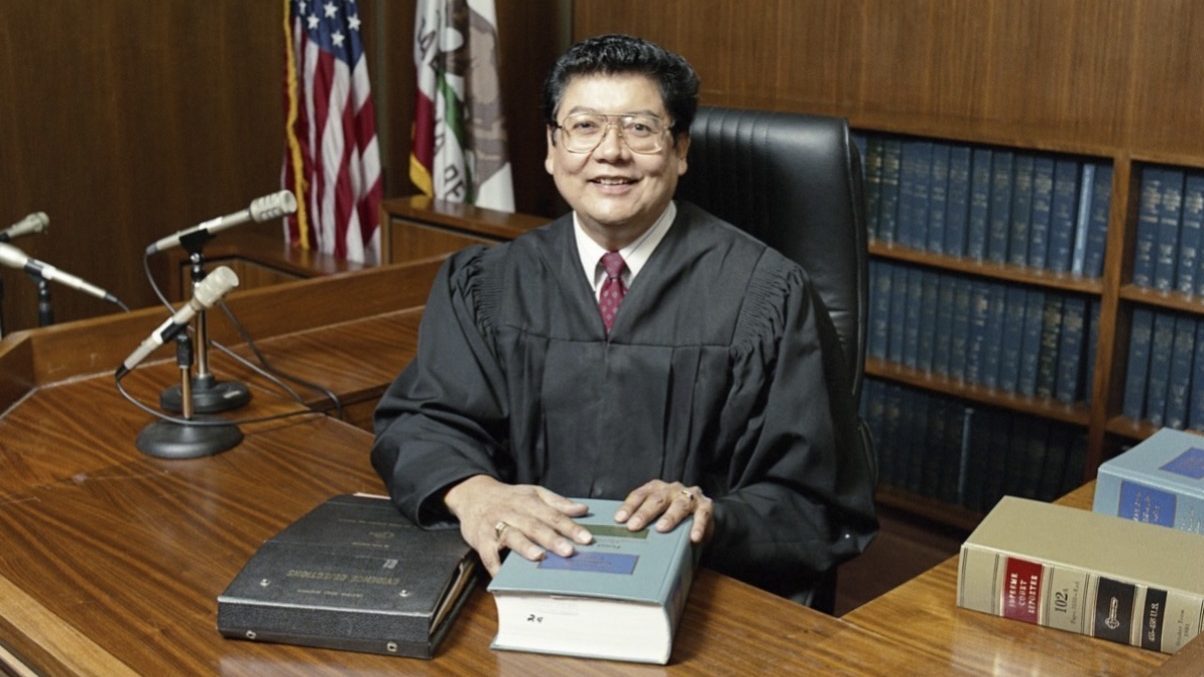
Rafael Arreola, a Mexican immigrant who went on to become a longtime San Diego judge and co-founded the San Diego and California La Raza Lawyers Associations and the California Latino Judges Association, died on Sept. 16 at his home in Riverside. He was 85.
Arreola served as a Municipal Court judge in San Diego County from 1981 to 1998, then as a Superior Court judge until his retirement in 2007. But even after his retirement, he continued working part time for most of the past 20 years as an assigned judge in San Diego, San Bernardino and Riverside counties.
“He was quite an icon in the Latino community,” San Diego defense attorney Hector Tamayo, the current president of the San Diego La Raza Lawyers Association, said Wednesday. “He was a really fair jurist who (co-founded) La Raza because so many of us were locked out of law school, the courthouse, the profession.”
Tamayo called Arreola a trailblazer who was “instrumental in opening the door” for future generations of Hispanic attorneys.
“Guys like him paved the way for guys like me to be lawyers today,” Tamayo said. “For that, I thank him.”
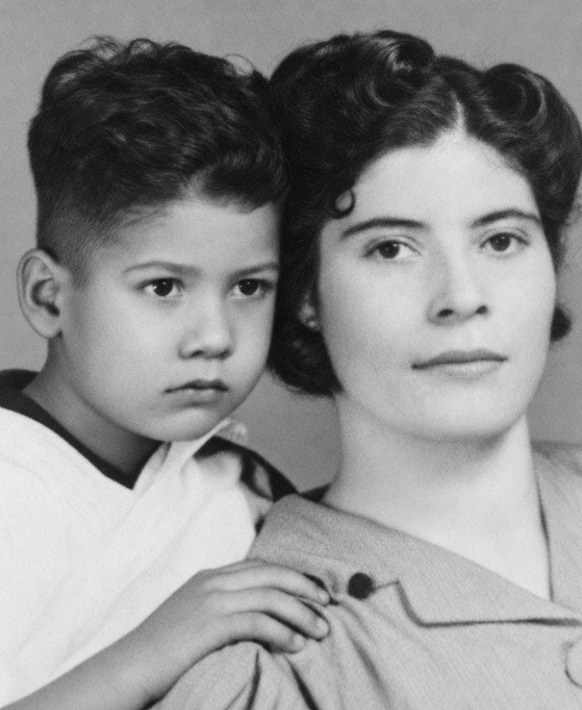 Rafael Arreola, seen here at age 6 circa 1947 with his mother, Julia Arreola, was born in Jalisco, Mexico. (Courtesy of Jennifer Williams)
Arreola was born March 18, 1941, in Jalisco, Mexico. He immigrated to the United States with his family when he was 13 years old. He later attended Riverside Community College, then went on to the University of California, Berkeley, where he earned a bachelor’s and a master’s degree in civil engineering.
In the early 1970s, Arreola worked as a civil engineer. But Jennifer Williams, one of his granddaughters, said that Arreola and his first wife had been part of the Chicano rights protest movement while attending UC Berkeley in the late 1960s.
“He graduated, and he became a civil engineer, but I think he realized that his true passion was advocating for people who didn’t really have representation, especially immigrants,” Williams said.
That led Arreola to law school at Stanford, where he earned his degree in 1974. Staying true to the reasons he became an attorney, he began working at nonprofit law firms that serve and advocate for low-income clients, first for about a year at the Legal Aid Society of Alameda County and then for five years at the Legal Aid Society of San Diego.
It was during that period, in 1976, that Arreola co-founded a group that would soon thereafter become the San Diego La Raza Lawyers Association, and also the California La Raza Lawyers Association, which now has chapters across the state.
“Last year, when I assumed the presidency, he came up and said, ‘Whatever you need,’” Tamayo recalled. “He was always ready and willing to help, even in the last year of his life.”
In 1981, Gov. Jerry Brown appointed Arreola as a Municipal Court judge in San Diego. He served in that role for about 17 years, co-founding and becoming the first president of the California Latino Judges Association in 1996. About two years after that, he became a San Diego Superior Court judge.
That was the role Arreola still held in 2005 when Tamayo first crossed paths with him as an intern in the San Diego County Public Defender’s Office. Tamayo was not yet a full-fledged attorney when he stood before Arreola, whose history he did not yet know, and argued his first-ever motion to suppress evidence in a criminal case.
Tamayo recounted the story last week at the San Diego La Raza Lawyers Association’s annual gala, as well as in a message to Arreola shortly before his passing. He admitted that his argument was a “historical rant” that was heavy on ideological zeal but light on legal substance.
“You must have known in the first 30 seconds how you were going to rule,” Tamayo wrote to Arreola. “You let me finish anyway. You denied (the motion), as you should have, but you gave a kid at counsel table the dignity of being heard all the way through. I’ve thought about that courtroom more times in 20 years of practice than I can count. It taught me what the job is and what a judge can be.”
Tamayo and the rest of the San Diego La Raza Lawyers Association honored Arreola at their Oct. 16 gala with the organization’s “Legacy Award.”
Arreola, who served as president and board member of numerous legal organizations over the years, was also heavily involved in the community over his lifetime. He served on the board of directors for the San Diego Foundation, where he established a scholarship for underprivileged high school students. According to his 2007 retirement announcement, he also “helped develop, build and manage over a dozen non-profit subsidized housing projects for senior citizens, low-income families, homeless and disabled persons.”
Arreola had four children, eight grandchildren, eight great-grandchildren and one great-great-grandchild. “He was always very proud of that,” Williams said. “He loved to tell everyone he’s a great-great-grandfather.”
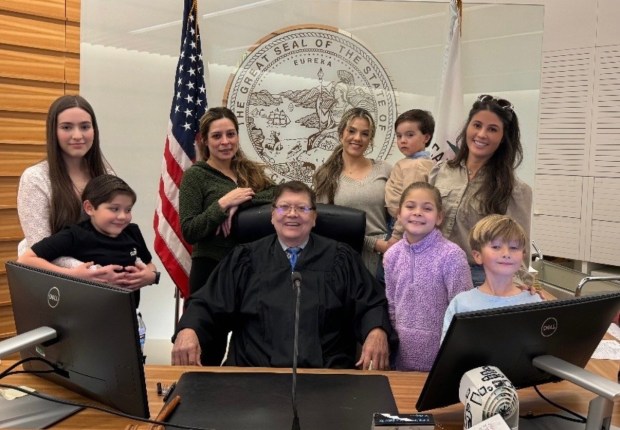 Judge Rafael Arreola, who continued working as an assigned judge long after his retirement in 2007, is surrounded by grandchildren, great-grandchildren and his great-great-grandson in February 2026 in San Bernardino County. (Courtesy of Jennifer Williams)
Williams said that Arreola became her legal guardian and raised her, and up until just before his death, she thought the special bond she felt with him was unique.
“After he passed away, I started getting letters from colleagues and people from different organizations … and I found out that he meant so much to so many people,” Williams said. “People called him their brother; they said that they loved him more than their own family. He just was one of those people that made you feel seen and heard and not judged — even though that was his job. He was just very down to earth and loving.”
Williams said all who knew Arreola are invited to services planned for him Friday and Saturday in Riverside and San Bernardino counties. There will be a rosary and memorial at 5 p.m. Friday at Christ the Redeemer Catholic Church in Grand Terrace. Beginning at 1 p.m. Saturday, there will be a Mass and burial service at Our Lady Queen of Peace Cemetery in Colton. At 4 p.m. Saturday, there will be a celebration of life at Fiesta Max Events Center in Riverside.