
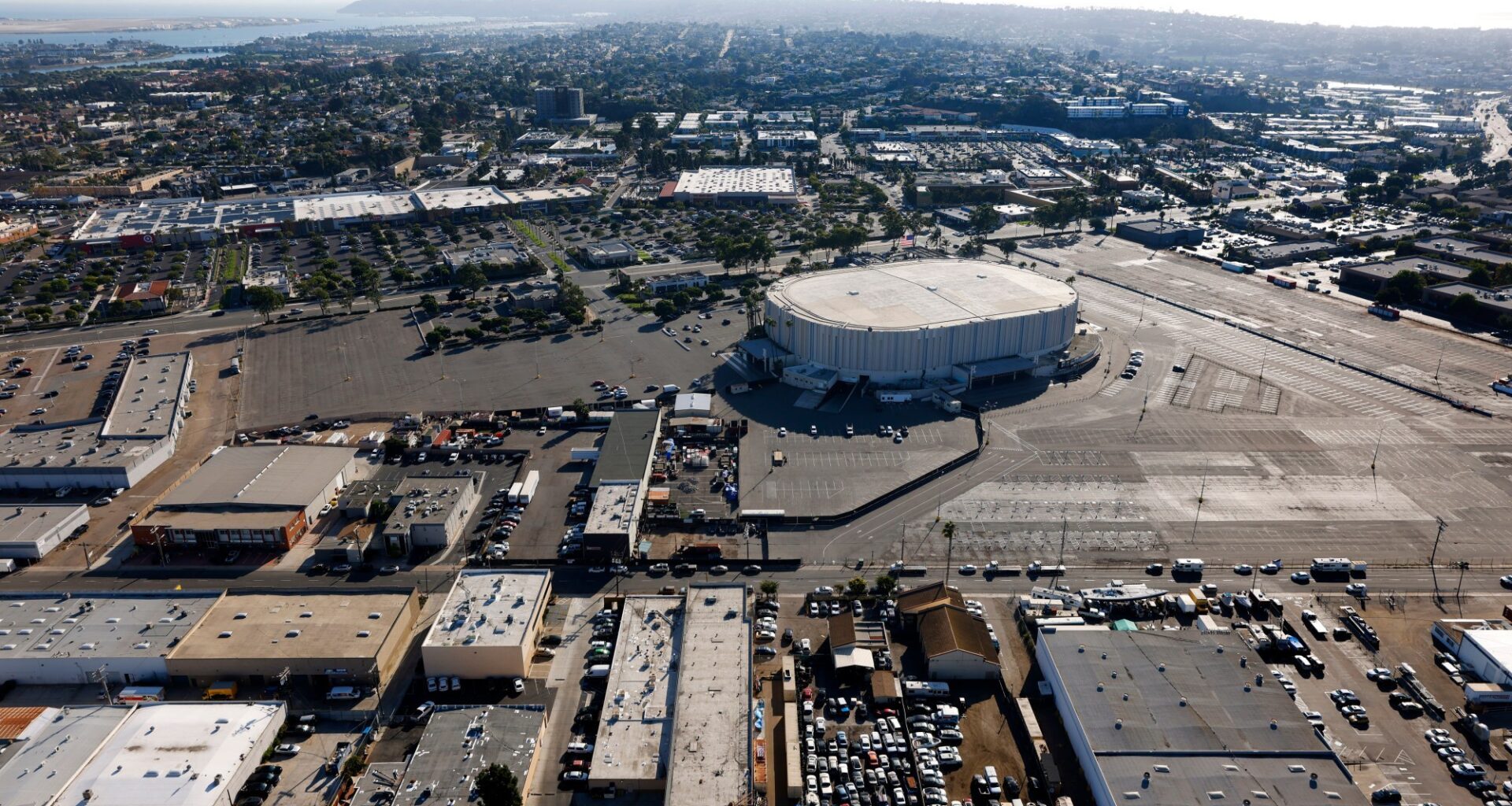
There are a lot of numbers baked into the Midway Rising project. None is more important than 2,000.
That’s the number of affordable housing units the massive proposal promises to deliver at the city-owned sports arena property and nearby land. That’s what won the developers the right to exclusive lease negotiations.
And that’s the main benefit cited by city officials and other supporters to sell the redevelopment project — more so than the new 16,000-seat arena, 2,000-plus market-rate homes, 130,000 square feet of commercial space, 8.1 acres of parks, 6.4 acres of plazas and other public space and nearly half a billion dollars of infrastructure improvements.
The affordable housing number hasn’t changed, but the way in which the developers might be able to reach it recently caught many people by surprise.
Lease negotiations appeared to leave the door open for other housing projects to essentially transfer their required affordable units to Midway Rising and pay the developers to build them.
Allowing that could mean the city, overall, might end up with less “net new affordable housing” — suddenly a ubiquitous term at City Hall — than might have been planned.
“The position always was this was 2,000 net new affordable housing units,” San Diego City Councilmember Kent Lee, chair of the council’s Land Use and Housing Committee, said in an interview early last week.
Those units would be rent-restricted for households earning 80% or less of the area median income.
Under certain circumstances, city law does allow developers some flexibility to build mandated affordable housing off-site instead of being included in a largely market-rate project as generally required.
The notion of other developers paying Midway Rising to build their affordable housing surfaced on Oct. 15 in an article by Scott Lewis of the Voice of San Diego.
That led to a scramble the next day at a land use committee meeting where Lee requested language in the lease aimed at keeping Midway Rising from becoming a so-called “receiver” site for affordable housing from elsewhere, according to Jennifer Van Grove of The San Diego Union-Tribune.
With that amendment, the committee voted 4-0 to advance the proposed lease to the full council.
There are still a lot of questions about all this, but yet another revelation about Midway Rising that seems at least a bit dodgy is certainly one of them. Never mind that other disputed and ill-fated city real estate transactions are still fresh in the public memory.
After Midway Rising was selected by the city, news broke in 2022 that Brad Termini, one of the lead developers, and his wife, Stephanie, contributed more than $100,000 to committees that helped elect Todd Gloria mayor in 2020.
The mayor’s office said the contributions had no impact on the selection process.
Then the development team made major changes to the proposal in 2023 by eliminating a 200-room hotel, citing infrastructure issues, and 250 homes that were to be priced for middle-income residents, pointing to financing problems.
More controversy erupted around Midway Rising just a couple of months ago when bills were rammed through the state Legislature to protect the project from environmental lawsuits. That was after the courts twice overturned voter-approved exemptions from a height limit for the development, citing inadequacy of environmental reviews.
It’s not clear whether the turmoil regarding affordable housing is a minor squall or a major project-changing storm. After the committee meeting, Lewis wrote, “City Hall was abuzz that the Midway Rising team considered all this a potential deal killer.”
In a telephone conversation last week, Termini said he would not comment publicly about the fate of the project or the overall discussion about Midway Rising being a “receiver” site for affordable housing.
Termini is CEO of Zephyr, a market-rate housing builder. His company is partnered with affordable housing developer Chelsea Investment Corp., and sports-and-entertainment venue operator Legends. The Kroenke Group, a subsidiary of billionaire Stan Kroenke’s real estate firm, is the project’s lead investor and limited partner.
Charles Schmid from Chelsea said in a statement that the project is committed to delivering “all 2,000 affordable housing units on-site, and it’s important to explore all available tools to expedite their construction.”
There’s no public information as to what degree, or even whether, the developers were depending on the affordable housing transfers being part of Midway Rising.
Councilmember Lee said he had seen no indication that the current dispute is threatening the project.
“It has not come up previously as a major problem,” he said, adding, “I would hope this is not a sticking point.”
He reiterated at the meeting and in the interview that he believes Midway Rising is needed for the necessary redevelopment of the Pechanga sports arena land and surrounding area.
During the selection process and since, there have been open questions about whether the affordable housing component of the project — larger than what competitors offered — would pencil out.
Lee noted that financial conditions could be challenging as the project moves forward. He said big economic changes have already taken place since negotiations began four years ago and pointed out that interest rates continue to rise.
“It’s impossible not to acknowledge that,” he said.
He and other council members seemed determined not to let affordable housing from other projects be used to help Midway Rising build and pay for the 2,000 units. But Lee acknowledged he’s leaving the door open a crack.
His amendment says such arrangements should not be considered “unless all other available funding options for gap financing have been pursued and exhausted…”