
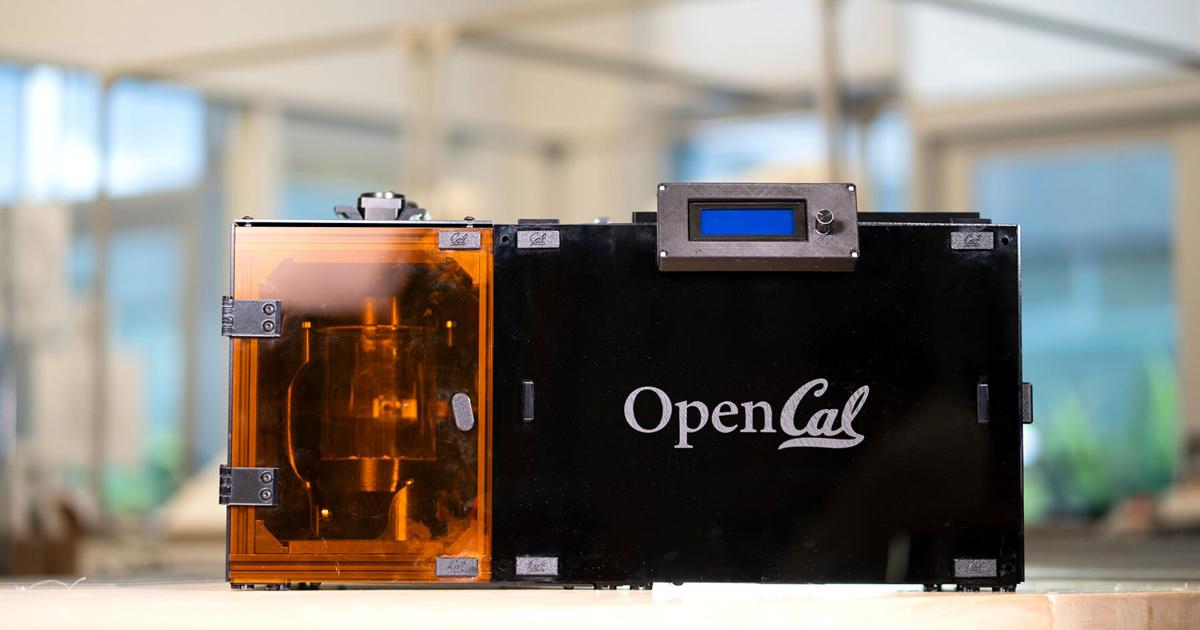
UC Berkeley researchers are bringing a rapid, light-powered, build-it-yourself 3D printing technology into the hands of the general public nearly a decade after its initial invention.
Most 3D printed objects are built layer by layer. The OpenCAL printer, however, creates every point of the object simultaneously through a process called computed axial lithography. This process works by projecting a sequence of images from many angles through a rotating vial of resin, which then hardens into plastic.
“We’re essentially able to form them all at once, which is really exciting because it can be fast,” said UC Berkeley postdoctoral researcher and project lead Taylor Waddell. “It can allow us to use really unique objects and materials.”
While the latest version of the OpenCAL printer has been out for about two months, Waddell said the commercial release of the resin Oct. 7 was the final step in allowing hobbyists and other users to complete their at-home printers.
According to Hayden Taylor, campus professor of mechanical engineering and co-inventor of the CAL method and printer, benefits of this technology include much faster print times, smoother surfaces and the ability to overprint. By immersing preexisting solid objects into the printing volume and printing around it, overprinting is useful in combining electronics and 3D printed objects.
“There are lots of research labs around the world that would benefit from being able to use this process,” Taylor said. “Particularly, I see the bioprinting application space being one of the most exciting right now because (of) the fact that the printed object is just floating within the precursor material, and you’re not exposing it to the motion of the material during printing. That’s actually ideal for printing cellular constructs where you don’t want to expose the cells to shear stresses.”
To get the technology into more hands, the team released a build guide and a software that creates the images and files needed for printing.
“There’s been a lot of interest in this technology, but it’s been kind of quite inaccessible, only in a few labs, and it takes usually a Ph.D. student or two to get a setup up and running,” Waddell said. “So we spent a lot of time, and I led a team to basically make it as accessible as possible.”
The cost of the materials needed to create the printer is approximately $1,600, and the team knows dozens of hobbyists who are already building the device on their own.
Waddell said one of the key components of this project is its open-source nature.
“It goes beyond just people being able to recreate it,” Waddell said. “With a good open-source community, you allow them to have feedback and improve upon it, and that’s really what we’re looking forward (to) with open source.”
While working on the project, Waddell said the team primarily printed demos, including miniature versions of The Thinker, a famous statue that has become the group’s “unofficial mascot.”
However, he’s excited to see what else community members and citizen-scientists are able to manufacture.
Taylor, the mechanical engineering professor, said he appreciates the collaborative nature of the project.
“I think what I like about this project so much is that it’s so driven by the students,” Taylor said. “We’ve had undergraduate, master of engineering and Ph.D. students work on this over years, and it’s really just heartwarming to see how so many people have been able to make a real contribution to it.”