
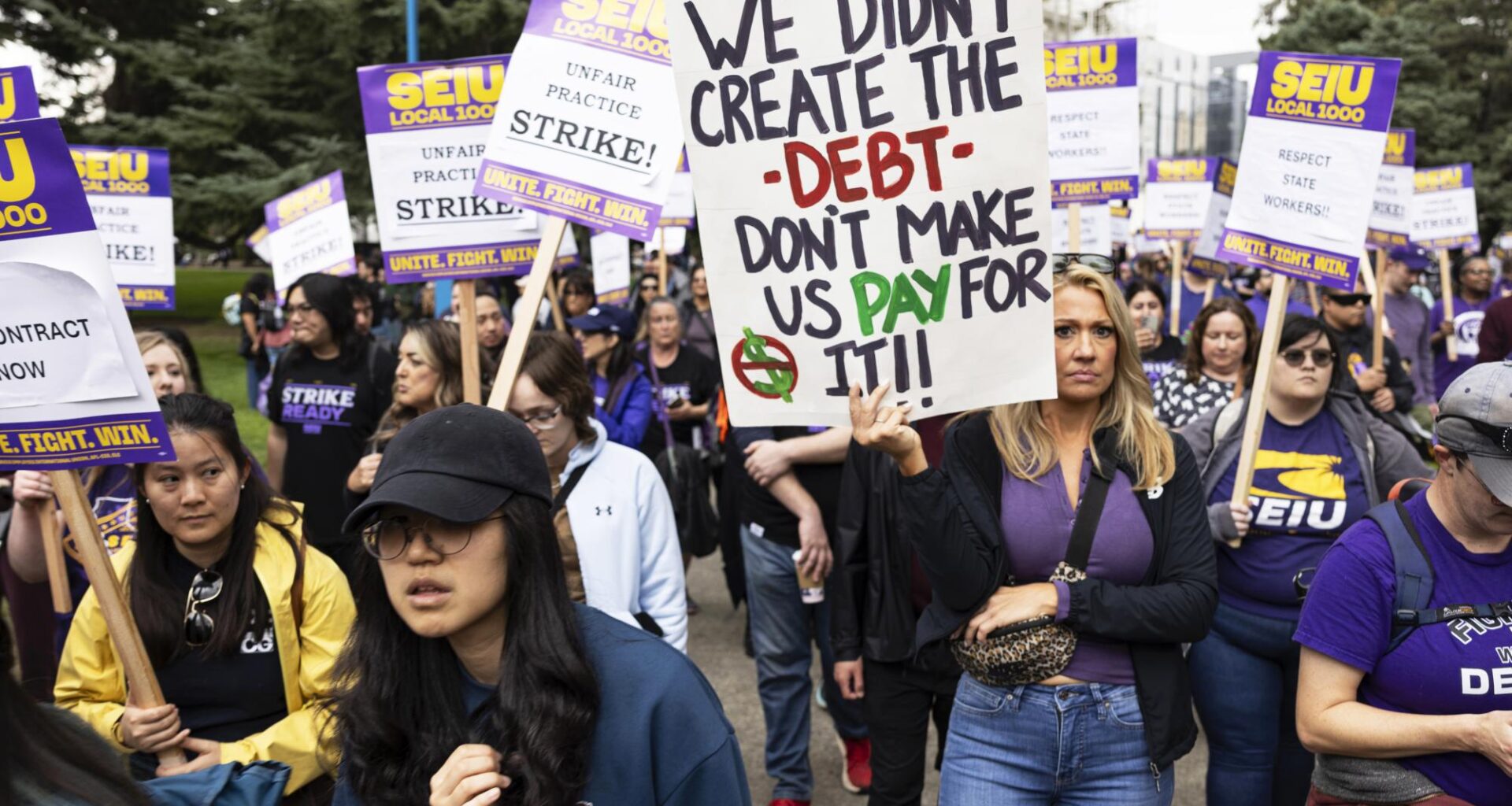
Service Employees International Union (SEIU) Local 1000 held a one-day strike in downtown Sacramento on Wednesday. The statewide strike comes after months of unsuccessful negotiations between the union, Gov. Gavin Newsom and the California Department of Human Resources (CalHR), according to a Public Employment Relations Board (PERB) Unfair Practice Charge filed by the union Friday, Oct. 9, 2026.
Outside of Sacramento, strike demonstrations were held in Oakland, San Francisco, Fresno, Norwalk, San Diego, Los Angeles and San Bernardino.
Called the “Unfair Practice Strike,” the day began at 7 a.m with people gathering at five different government buildings in Sacramento. Strikers marched around the buildings, holding picket signs that read “Respect State Workers!” and “Unfair Practice Strike!”
In the Secretary of State building, steward of District Labor Council 768 Joshua Guile said that he expected close to 10,000 people to march.
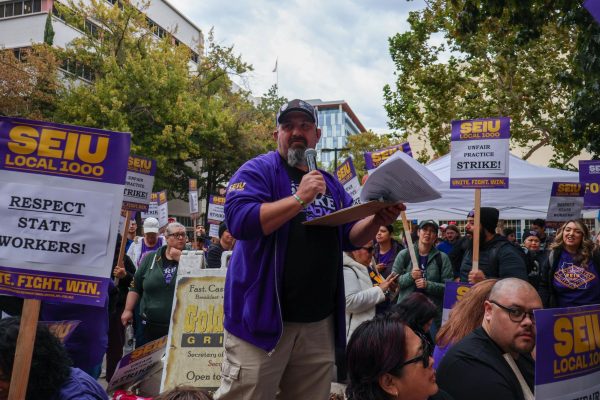 Union steward Joshua Guile gives a speech to a crowd of union members in front of the Secretary of State Archives building Wednesday, Oct. 21, 2026. According to Guile, the one-day strike was held in part because of the ‘rude’ bargaining from Newsom and CalHR. (Vanessa Gomez)
SEIU Local 1000 is the state’s largest union of government workers, representing an estimated 95,000 public employees. According to union reporting, 96.2% of union members voted to hold a strike, the first time in decades for SEIU. The closest the union got to striking was in 2016, when 92% of members voted to authorize a strike against Gov. Jerry Brown’s administration. The Brown administration was able to come to a last-minute agreement with the union, preventing a strike.
SEIU Local 1000’s contract ended on June 30, 2026. Neither party came to an agreement, and the union is still currently without a contract. Guile stated that the Newsom administration hasn’t offered the raises that union negotiators are seeking, something Guile says is necessary with the rising cost of living.
“We’re asking for a fair raise. It’s 20% over a period of three years, so it would be 7%, 7% and 6% at the end,” Guile said.
Christine Goodwin, an analyst for the California Department of Social Services, said that workers were promised a raise in July that did not happen.
“Our wages have been stagnant for many years, and as you know, all the prices of everything have gone up,” Goodwin said. “Now they’ve recalled us back into the office and it’s very expensive to be here.”
Another contentious issue between state workers and the Newsom administration is the return-to-office order that began July 1, 2026. Megan Ugarte, an analyst at the California Department of Education, said that many workers are struggling to get to work with the rising cost of transportation.
“We have to shoulder the cost of the travel, we have to shoulder the cost of the additional healthcare,” Ugarte said. “We have to shoulder the cost of the parking, which they raise[d] when they brought us back.”
One of the reasons why the union held a strike was due to the end of the last contract’s term, which in Article 5 section 1, declared that neither the Union nor its representatives could “authorize a strike or work stoppage.”
The strike continued despite the rain that began at around 10:30 a.m., with people marching to CalHR headquarters on 1810 16th Street. The strikers walked around the building for around two hours, chanting “Union Power” and “Shut it Down.”
Anica Walls, the president of Local 1000, was in front of the CalHR entrance, leading people in the chants.
“Since now we are way beyond a contract and the negotiations have basically stalled,” Walls said. “This is an unfair labor practice strike that our members, you can see, are excited about. They’re ready to participate and they’re tired of the budget being balanced on their backs.”
Other speakers included union leaders Justin Garcia of the California Association of Professional Scientists (CAPS) UAW Local 1115, and Talene Ghazarian of California Attorneys, Administrative Law Judges and Hearing Officers in State Employment (CASE). Government officials Flo Cofer and Mai Vang also spoke at the event, both of whom SEIU officially endorsed in their respective races.
SEIU Local 1000 hasn’t released official numbers of participants at the strike, the amount of people there was enough to turn the streets purple. Walls said that people have been reporting that only a couple of hundred non-essential workers went to work that day.
“I don’t know what the scope of it is, but if the offices are empty because they’re here, I’m all right with that,” Walls said.
Fabrizio Sasso, the executive director of the Sacramento Central Labor Council AFL-CIO, said that the strike was inevitable, and other strikes may be in the future if there is no contract.
RELATED: Sac State ceramics department holds silent protest
“You withhold your labor long enough, it’s gonna cost the state more for [state workers] to go out on strike than to sit back down at the table and bargain a deal,” Sasso said.
Some union members were labeled ‘essential workers’ and legally could not go on strike. These workers included people employed by the California Department of Corrections and Rehabilitation (CDCR), the California Department of State Hospitals (DSH) and CalTrans.
SEIU held a smaller demonstration on July 1, after the previous contract expired.
“That was the first time that we came together and state employees showed what collective power could look like,” Walls said.
It is still unclear if SEIU will be able to negotiate a new contract before Newsom’s term ends. Sasso expects that the strike will force CalHR and Newsom back to the bargaining table.
“This is Gavin Newsom’s problem,” Sasso said. “This is not something that he should hoist on the next governor.”
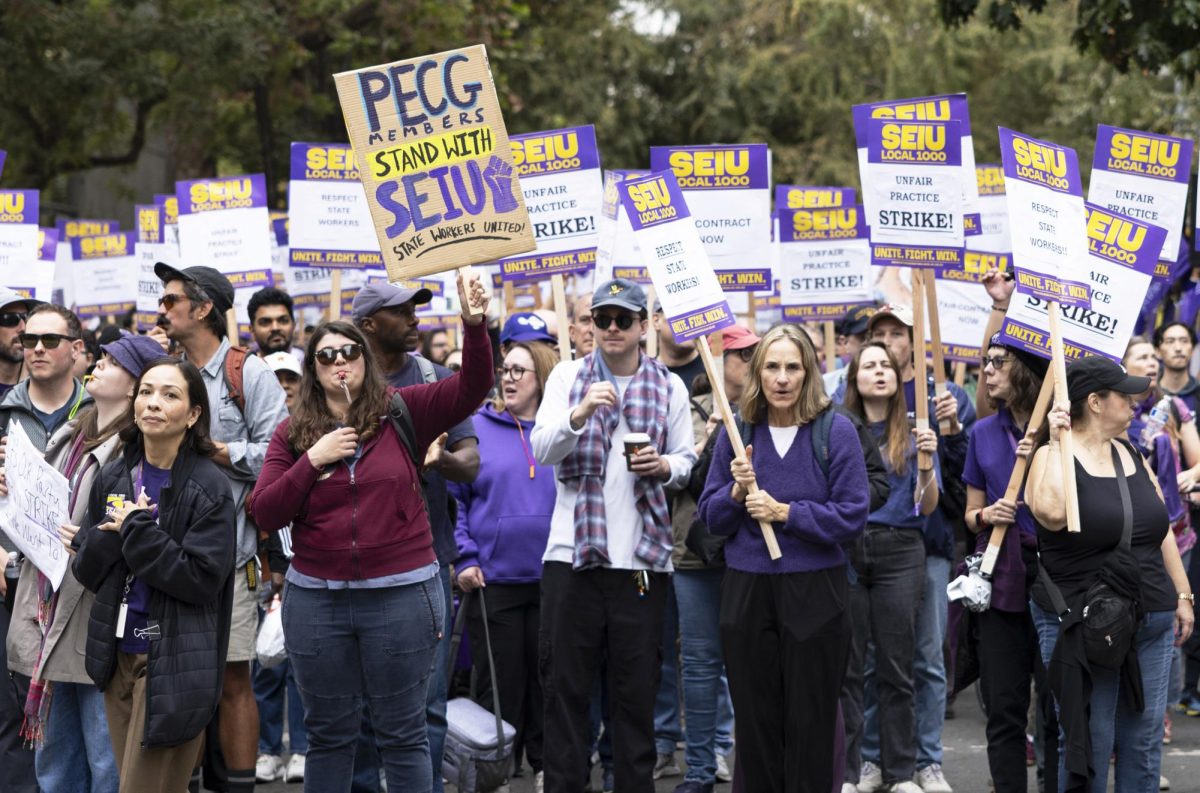
SEIU Local 1000 members marching across downtown Sacramento Wednesday, Oct. 21, 2026. The people on strike marched from CalHR headquarters on 1810 16th Street to the Capitol Annex Swing Space on 1021 O Street.