
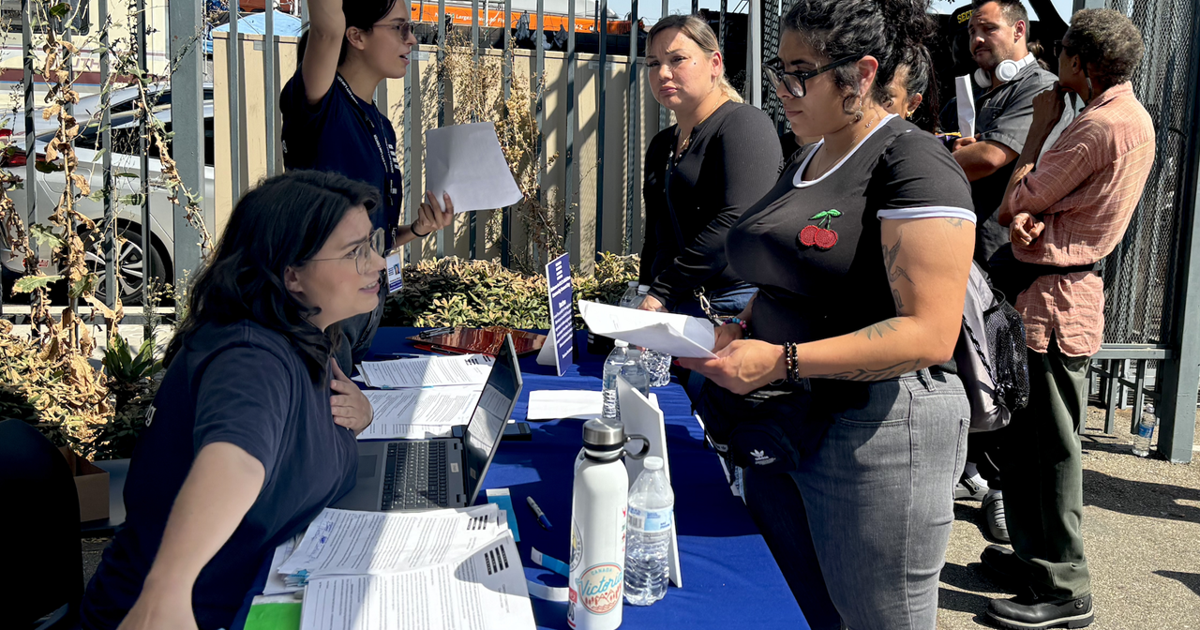
On Oct. 15, around 235 unhoused people and their pets gathered in the Inner City Law Center (ICLC) parking lot for the seventh biannual Skid Row Community Connect Day. In partnership with the Los Angeles Central Providers Collaborative, ICLC invited housing organizations, medical teams, legal advocates and mental health professionals to deliver services to unhoused and low- income Skid Row community members.
The event is part of ICLC’s mission to serve the city’s most vulnerable: extremely low-income families struggling to stay housed in LA. Thirty percent of its clients are homeless, and 48% of its clients last year had annual household incomes under $10,000. In the simplest terms: The nonprofit, poverty law firm helps people who are very precariously housed try to hold on to their housing, and people on the streets try to find a pathway into housing.
UCLA School of Law graduate Nancy Mintie started ICLC in 1980. After moving to the Catholic Worker Soup Kitchen, also known as Hippie Kitchen, in the Skid Row neighborhood, she began providing legal services to people in the area. Cases ranged from eviction and habitability issues to securing benefits.
About 27 years ago, Adam Murray, a brand-new attorney at a private law firm, had the opportunity to work as co-counsel with Mintie on a slum housing case in the MacArthur Park area. The experience was so rewarding that, in 2007, he joined ICLC as the executive director.
At the time, he joined a staff of four other attorneys. Today, ICLC has a staff of 160, over half of whom are attorneys, with over 700 volunteers, over half of whom are attorneys.
Last year, ICLC worked with 400 homeless veterans. There are about 3,000 homeless veterans in LA County every night. Last year, it worked on about 1,000 eviction cases. There are between 60,000 and 70,000 eviction cases filed in LA County each year. ICLC’s work is never done.
When thinking about homeless policy, Murray detailed three different levels. The first level is the things that alleviate the horror and the suffering that comes from being homeless. Skid Row Community Connect Day falls into this category. The second level is figuring out what individuals and families need to have a pathway back to being housed. How are they going to be able to afford food and rent in the long run? This is why getting people onto social security disability or veterans benefits is crucial. This, according to Murray, is where ICLC does most of its work.
The third level is asking — and working on — why are so many people struggling? That falls into the category of policy advocacy — and ICLC has three and a half full-time people working on policy advocacy.
“One of the big things we’ve been working on of late is how do we encourage more affordable housing?” Murray relayed. “Ultimately, the solution to homelessness, more than anything else, more than everything else put together, is to have more housing that is affordable to low-income folks. How do we get there? What does that look like? That is ultimately going to solve our homelessness crisis.”
ICLC also spends time arguing against the criminalization of homelessness: that the solution to homelessness is rooted in making it more difficult for people to be homeless. The goal is to make it more miserable to be homeless and therefore fewer people will choose to be homeless.
“We believe that fundamentally misunderstands what’s going on with homelessness and that that is cruel and counterproductive to actually solving homelessness,” said Murray. “If you want to solve homelessness, you have to have housing that is affordable for folks and you have to get them into that housing.”
About 30% of the people who are experiencing homelessness on any given night are struggling with significant mental health or addiction issues. ICLC’s benefits advocacy work often overlaps with this population. Last year, it recovered over $9 million in veterans benefits.
“Lots of people have mental health struggles and don’t end up on the streets,” Murray emphasized. “Because housing is so unaffordable, some people, when they’re struggling with those mental health issues, don’t have a safety net that enables them to remain housed. If housing were more affordable, when people had a mental health issue, they would have much more ability to navigate the housing and security aspects of that. It still always comes back to housing and affordability.”
Murray pointed to studies looking at what drives different homelessness rates around the country. The result: Differential homelessness rates cannot be explained based on the presence of poverty, mental health issues or addiction issues. These rates vary regionally in various ways but do not explain the homelessness variation. The only things that explain homelessness variation are housing prices and rents.
On Oct. 15, organizations such as Downtown Women’s Center, The Whole Child and K9 Connection were on hand to connect with community members. The pet services part is just one aspect of the Skid Row Community Connect Day, but it is one that ICLC has found to be effective in reaching people who they might not otherwise connect with.
“One of the things we realized a number of years ago is a lot of people who are on the streets have pets,” said Murray. “We find that people will show up for things for their pets that they might not come in for on their own. If we hold a legal clinic, they may not show up. But if we hold a pet clinic that also has legal services, they’re showing up to get a new collar or a vaccination for their pet or some pet food, and then we’re having a conversation with them about their legal issues as well.”
Murray traces his desire to serve back to a conversation he had in the seventh grade with his dad, who was born in 1946. Murray had just finished reading “Night” by Elie Wiesel. Although the Holocaust was just part of history for Murray, for his father, it was a very distinct moment.
“What he said to me was that he remembered hearing about it, and it forever changed what it meant for him to be human,” Murray shared. “The idea that human beings were capable of treating each other that way fundamentally changed his notion of what humanity was and how it was defined. Through our actions and what we do every day, we don’t just define our lives. We define what humanity is. When I look at the world and see so many things that infuriate me and that feel so wrong, it’s incumbent on each of us to be better than that and try to do better than that.”
For more information, visit innercitylaw.org.