
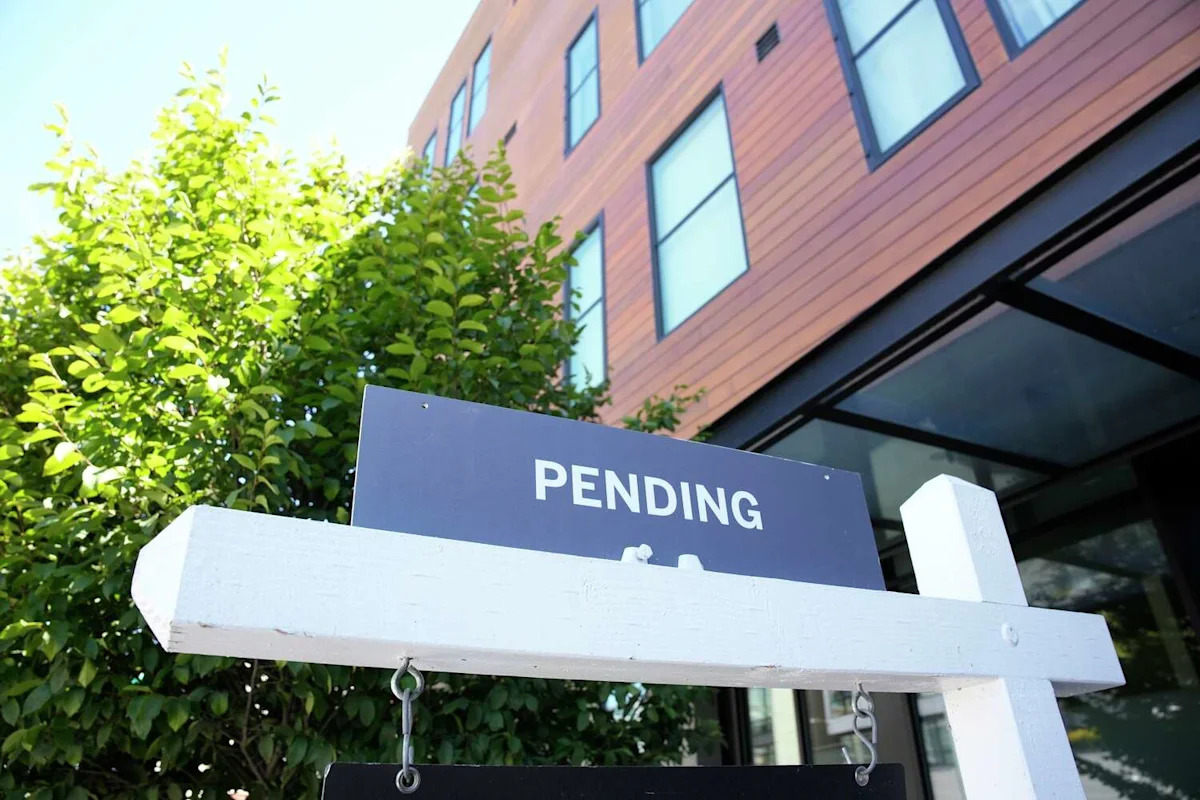
 Competition for homes in San Francisco has become so fierce that even real estate agents are having trouble deciding what price is right. (Anna Connors/S.F. Chronicle)
Longtime real estate broker Andrew Oldham knew that San Francisco’s market was red-hot. So when he was helping a homebuyer bid on a luxury condo in Cow Hollow last week, he figured they should add half a million dollars to its $3.8 million price tag.
They lost to an offer for well over $5 million.
“If you look at the recent comparable sales, you almost have to throw them out the window,” Oldham said. “They’re not going to give you an indication of where the market is now.”
It’s long been common for sellers in the Bay Area to “price to entice,” setting the asking price artificially low to spark a bidding war. But data from real estate brokerage Compass suggests that homes in San Francisco are now nearly always selling for prices over what’s on the for-sale sign.
In September, nearly 92% of single-family homes in the city sold above asking price, the highest percentage on record. The same was true of nearly 3 in 4 condos sold in the first three weeks of October.

San Francisco’s housing market has ramped up drastically from its cool period during the pandemic, in large part due to the artificial intelligence boom. Tech workers and investors who have found themselves in a new tax bracket are fighting over a very limited supply of homes. Just 240 single-family homes were on the market in San Francisco at the end of September, according to Compass, the lowest total for the month since at least 2020.
Competition, especially for luxury homes, has become so fierce that even real estate agents – let alone individual buyers and sellers – say they’re having trouble figuring out what price is right.
“We are pricing properties on aged data,” said Pete Rodway, a San Francisco real estate agent with Compass. “And aged data in this market is three months.”
Some sellers are leaning into the uncertainty. Compass agent Butch Haze said that this year sellers have been pricing homes even lower than usual – about a third below their market value – to set up what he calls “auction-style” sales.
That strategy might help explain why homes are not only selling over asking price more often, they’re selling much more over asking. The average single-family home that sold in September 2026 went for nearly 30% over the list price, more than double the margin of 13% in September 2025.
“We don’t really know where value is, and so the safe thing to do is to price low and just see what happens,” said Natalie Hatvany, a real estate broker with Team Hatvany Kitchen.

The approach appears to be working – at least for sellers. Among San Francisco single-family homes sold through Oct. 20, the median sale price was nearly $2.6 million, up from $1.9 million in October 2025 and the highest median for the city since at least 2020. Part of the spike is probably related to a shift in the class of homes that are selling, which in recent years has skewed toward luxury properties.

The tight market in San Francisco, and increasingly in parts of the Peninsula, stands in sharp contrast to much of the rest of the U.S. Rising mortgage rates and inflation have caused families in most of the country to step back from homebuying. In fact, a recent analysis by online brokerage Redfin found that San Francisco is one of just six major U.S. metro areas considered a “seller’s market,” in which the estimated number of buyers exceeds the number of sellers.
“There’s San Francisco, and then there’s the rest of the world,” Haze said.

Pricing for starter and mid-tier homes tends to be more transparent than for luxury homes, which are currently attracting the most competition in San Francisco, Oldham said.
But the deck is often stacked against buyers shopping at that price point. Mortgage rates are now above 7%, and the tech industry has seen multiple waves of mass layoffs in recent years, making homeownership costly even in parts of the Bay Area, such as the East Bay, where prices have dipped. Haze said about a fifth of the buyers he sees are purchasing homes for their children to help them get out of the scorching rental market, adding to the competition first-time buyers face.
It’s frustrating for buyers when every bid turns into a bidding war, real estate agents acknowledged. Even offering hundreds of thousands of dollars above asking price doesn’t guarantee a deal anymore.
“It can be very disappointing, because then you’ll find you’re not even close” to the final price, Oldham said. “But as a buyer you can’t give up.”
Subscribe
There’s more to San Francisco with the Chronicle. Subscribe today for just 25¢.
This article originally published at 9 in 10 S.F. homes are now selling for more than asking – sometimes much more.